Marcuse Family website > Herbert Marcuse homepage > Publications index page
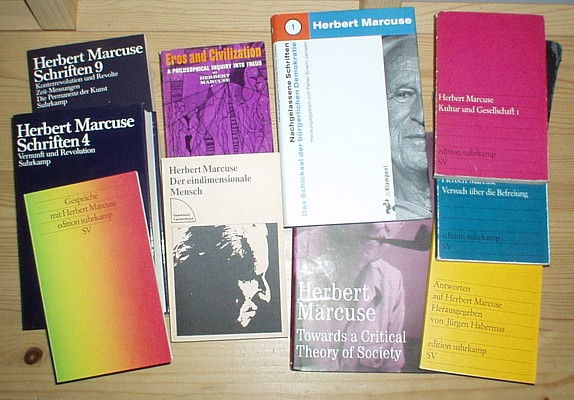
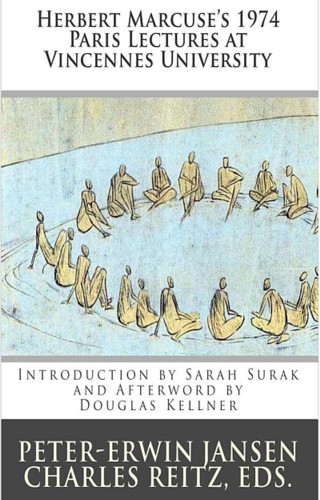
some of Herbert's books
some of Herbert's publications

Herbert Marcuse
Publications page

hyperlinked list of books and articles

compiled by Harold Marcuse (homepage)
to: Herbert Marcuse homepage, Books About Page

page created Dec. 26, 2004; updated 6/9/09


The large links in this navigation bar jump down to the section on this page;
small font italics links have links to separate pages with full or partial texts.
1920s, 30s, 40s
dissertation;
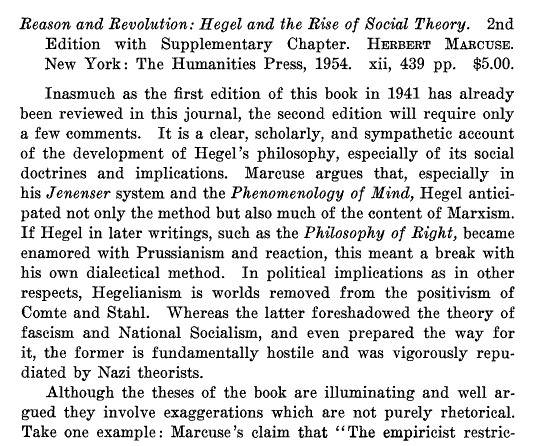
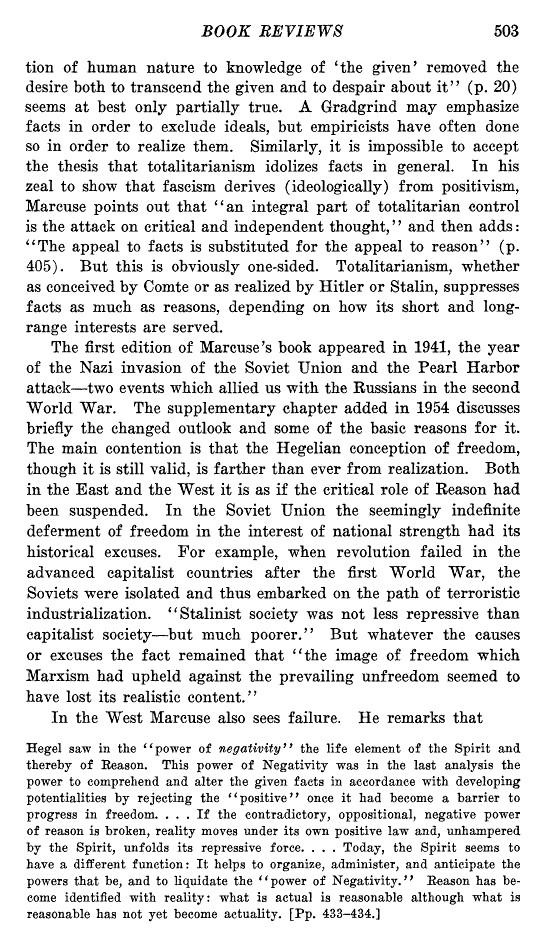
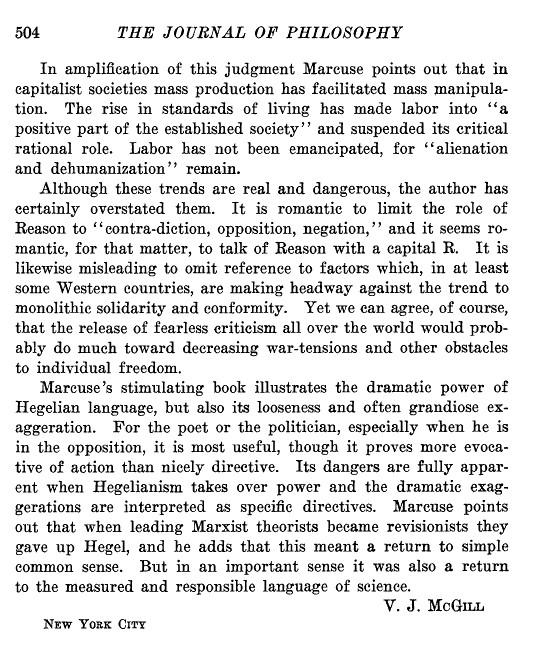
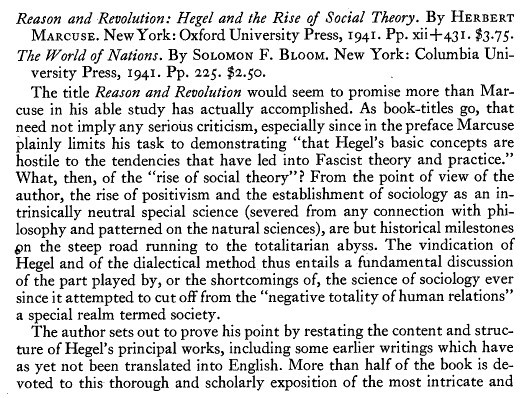
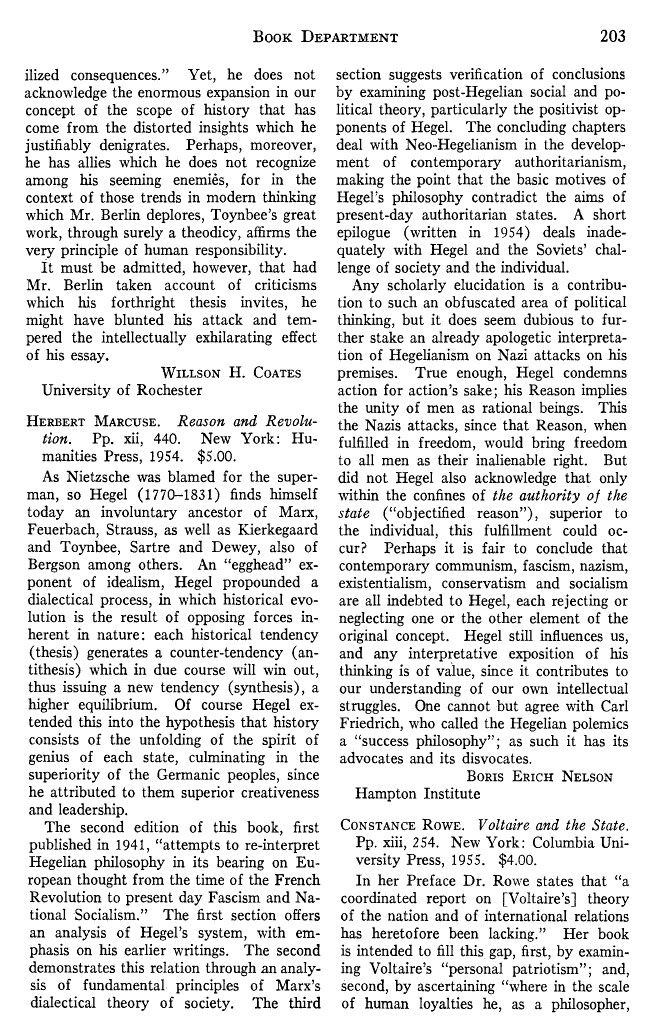
Reason & Revolution
1950s
Eros & Civ.;
Soviet Marxism
1960s
One Dimensional Man;
"Repressive Tolerance"
1970s
Aesthetic Dimension
Editions of Papers
English, German, Italian
Collected Works
Books about Herbert
(separate page)


For other listings of Herbert's publications, see also:

  • K.H. Sahmel's 30-page 1979 bibliography (scanned photocopies and 2M pdf--which is the most readable)
    with 158+55=213 citations of Herbert's works, and 309+24=333 citations of secondary works
    (Joan Nordquist's 60-page 1988 bibliography is not yet available. Details on Books About page)
  • The Biographisch-bibliographisches Kirchenlexikon's bibliography
    has a list of Herbert's 27 most important works.
  • To find translations in languages other than English or German, use your web browser's page search function (usually Ctrl-F) to search for the text "Danish," "Dutch," "French," "Hebrew," "Italian," "Korean," "Portugese," "Russian," "Spanish," "Turkish," etc. on this page (or in site search).
  • Geometry.net's Marcuse books page
    has an amazon-like interface with amazon reader comments, and links to amazon pages.

1920s (back to top)

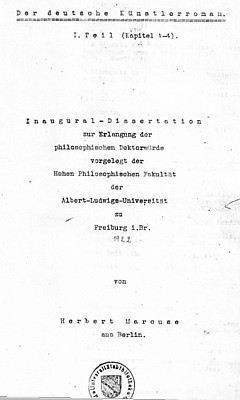
  • 1922 dissertation: title page of Herbert Marcuse's dissertation"Der deutsche Künstlerroman"
    • click on title page at right for an image of the original title page
    • published as the first volume of Herbert's works in German, but never translated into Englich (see below)
  • 1924-25 Das Dreieck: Monatzeitschrift für Philosophie, Dichtung, und Kritik, edited by Marcuse and Walter Gutkelch (Berlin, April 1924 - March 1925).
  • 1925 Schiller-Bibliographie: unter Benutzung der Trömelschen Schiller-Bibliothek (1865) (Berlin: Martin Fraenkel, 1925)[SUB Göttingen], 137 S. In Fraktur
  • 1928 article: "Beiträge zu einer Phänomenologie des Historischen Materialismus," in: Philosophische Hefte 1(1928), pp 45-68.
  • 1929 "Über konkrete Philosophie," in: Archiv für Sozialwissenschaft und Sozialpolitik 62, 1929, 111-128
  • 1929 356-369.
  • 1929-1932: articles in Die Gesellschaft and other journals
    • review of: Karl Vorländer: Karl Marx, sein Leben und sein Werk, Die Gesellschaft, 6:2 (1929): 186-189.
    • "Zur Wahrheitsproblematik der soziologischen Methode: Karl Mannheim, Die Ideologie und Utopie," in: Die Gesellschaft 2(1929), 356-369.
    • "Zum Problem der Dialektik I," Die Gesellschaft, 7:1 (1930): 15-30
      • translated by Morton Schoolman as "On the Problem of the Dialectic," Telos, 27 (Spring 1976): 12-24.
    • "Transzendentaler Marxismus?" Die Gesellschaft, 7:1 (1930): 304-326.
    • Besprechung von H. Noack: Geschichte und Systeme der Philosophie, in: Philosophische Hefte, 2 (1930): 91-96.
    • "Das Problem der geschichtlichen Wirklichkeit: Wilhelm Dilthey," in: Die Gesellschaft 8(1931), 350-367.
    • "Zur Kritik der Soziologie," Die Gesellschaft, 8:2 (1931): 270-280.
    • "Zum Problem der Dialektik II," Die Gesellschaft, 8:2 (1931): 541-557
      • translated by Duncan Smith as "On the Problem of the Dialectic," Telos, 27 (Spring 1976): 24-39.
    • "Zur Auseinandersetzung mit Hans Freyers Soziologie als Wirklichkeitswissenschaft," Philosophische Hefte, 3, nos. 1 and 2 (1931): 83-91.
    • "Besprechung von Heinz Heimsoeth: Die Errungenschaften des deutschen Idealismus," Deutsche Literaturzeitung, 53, no. 43 (1932): 2024-2029.
    • "Neue Quellen zur Grundlegung des Historischen Materialismus," in: Die Gesellschaft 9(1932), 136-174
  • See also: Herbert Marcuse, Heideggerian Marxism, edited by Richard Wolin and John Abromeit (Univ. of Nebraska Press, 2005), 288 pages, below. [essays 1928-32]

1930s (back to top)

  • 1932 Hegels Ontologie und die Theorie der Geschichtlichkeit
    • University of Freiburg Habilitation (German post-dissertation thesis to become a professor)
      The Nazi assumption of power in 1933 prevented Herbert from getting the habilitation. There is some question whether Heidegger even read this work. See Seyla Benhabib's introduction (German translation of Benhabib intro available on this site)
    • published (Frankfurt: Vittorio Klostermann, 1932; republished 1968; Suhrkamp 1989)
      • discussed by Johannes Hoffmeister, "Bericht über neue Hegel-Literatur," in: Kant Studien 9(1934), 84-98 (pdf)
    • amazon.de €10
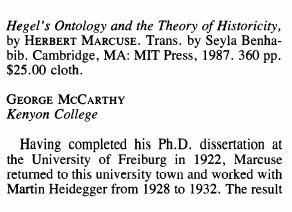
    • English: Hegel's Ontology and Theory of Historicity; translated by Seyla Benhabib (Cambridge, Mass.: MIT Press, 1987), xlii, 360/406 p. amazon.com $38/75
      • reviewed by George McCarthy in: Contemporary Sociology 17:2 (March 1988), 262-263.
      • Library Journal, 1987:
        "Marcuse Ontologia de Hegelcover of Hegel, frenchexamines three aspects of Hegel's philosophy: the concept of life and its ontological status, the concept of movement as an ontological dimension of all existence, and the bearing of both concepts on the theory of historicity. Examining first Hegel's Logic and then his theological writings and Phenomenology of Mind, he argues that Hegel was moving from an ontological to a historical characterization of human existence. The work, among Marcuse's earliest, is highly technical in its vocabularythough a glossary provides some assistanceand is translated into English for the first time here. Though it shows little of the Marcuse who became a popular New Left theorist, it will be of interest to students of 19th- and 20th-century philosophy.
        Brent Nelson, University of Arkansas, Technology Campus Library, Little Rock"
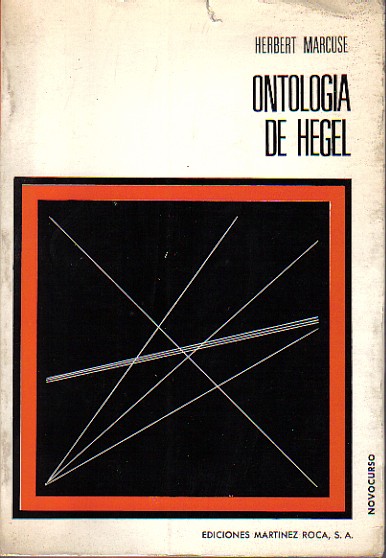
    • Spanish: Ontología de Hegel (Barcelona: Editorial Martínez Roca, 1970)
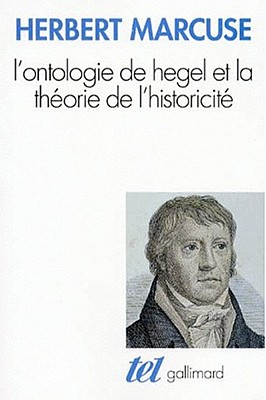
    • French: L'ontologie de Hegel et la théorie de l'historicité; traduit de l'allemand par G. Raulet et H.A. Baatsch; préface de Mimika Cranaki (Paris: Edition de Minuit, 1972), 342p. amazon.fr €10
  • 1933-38: articles in journals, mostly the Zeitschrift für Sozialforschung:
    • "Über die philosophischen Grundlagen des wirtschaftswissenschaftlichen Arbeitsbegriffs," in: Archiv für Sozialwissenschaft und Sozialpolitik 69:3(1933), 257-292.
      • translated by Douglas Kellner as "On the Philosophical Foundation of the Concept of Labor in Economics," Telos, 16 (Summer 1973): 9-37.
    • "Philosophie des Scheiterns: Karl Jaspers Werk," Unterhaltungsblatt der Vossischen Zeitung, 339 (14 December 1933).
    • "Der Kampf gegen den Liberalismus in der totalitären Staatsauffassung," in: ZfS 3(1934); also in Kultur und Gesellschaft (1975), and Schriften Bd. 3, 7-44.
    • review of Herbert Wacker: Das Verhältnis des jungen Hegel zu Kant, in: Deutsche Literaturzeitung, 55:14 (1934): 629-630.
    • "Zum Begriff des Wesens," in ZfS 5(1936);
      Also in Schriften Bd. 3, 45-84.
      English translation "The Concept of Essence," in Negations (1968), pp. 43-87; pp. 55-62 available at autodidactproject.org
    • "Philosophie und Kritische Theorie," in: ZfS 6(1937).
      Also in Schriften Bd. 3, 227-249. Focus on "historically situated reason."
      Translated in Negations (1968): Philosophy and critical theory (pp. 134-158); pp. 147-154 available at autodidactproject.org
    • "Über den affirmativen Charakter der Kultur," in: ZfS 6(1937), a
      Also in Schriften Bd. 3, 186-226.
    • "Zur Kritik des Hedonismus," in; ZfS 7(1938)
      Also in Schriften Bd. 3, 250-285
  • 1930: Brief an Ernst Manheim, published in: Reinhard Müller (ed.), Erno – Ernst – Ernest Manheim. Soziologe, Anthropologe, Komponist. Zum 100. Geburtstag. Katalog zur Ausstellung anläßlich des 100. Geburtstags an der Universitätsbibliothek Graz vom 3. März bis 14. April 2000 (Graz: Universitätsbibliothek Graz, 2000), 132 S, p. 35.
    (Table of Contents)
  • 1933: review of Hoffmeister, Johannes, Goethe und der deutsche Idealismus, in: Kant Studien 38(1933), 456-458 (pdf)
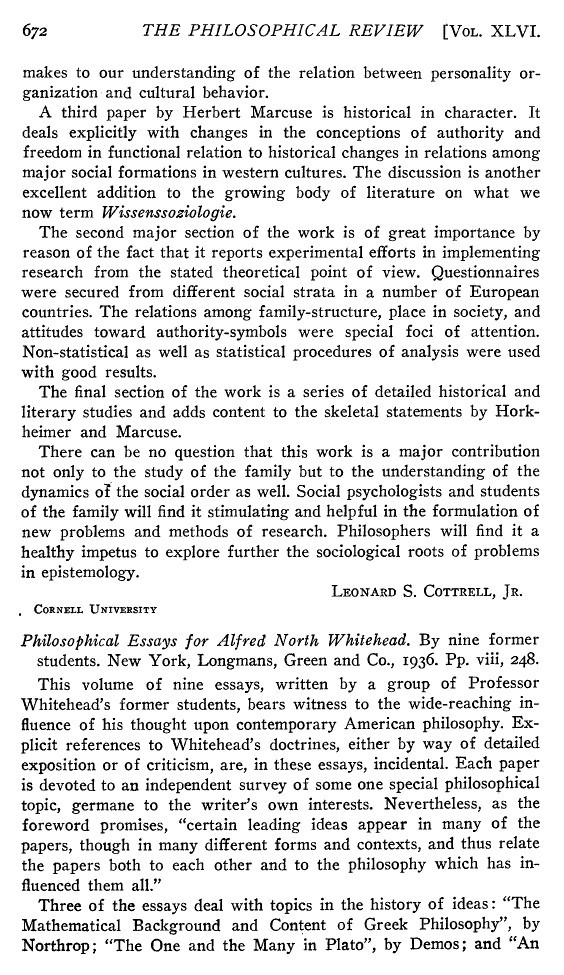
  • 1936: "Studie über Autorität und Familie"
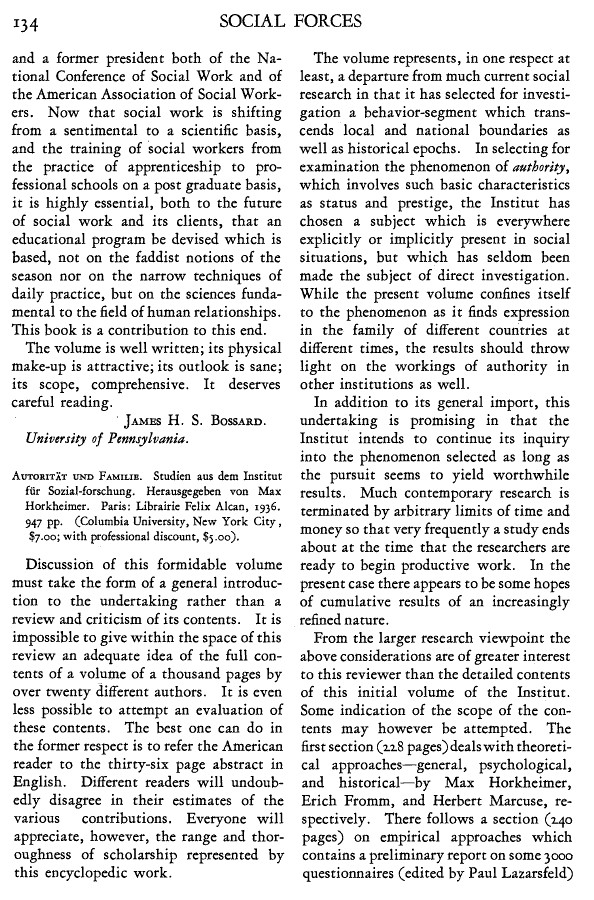
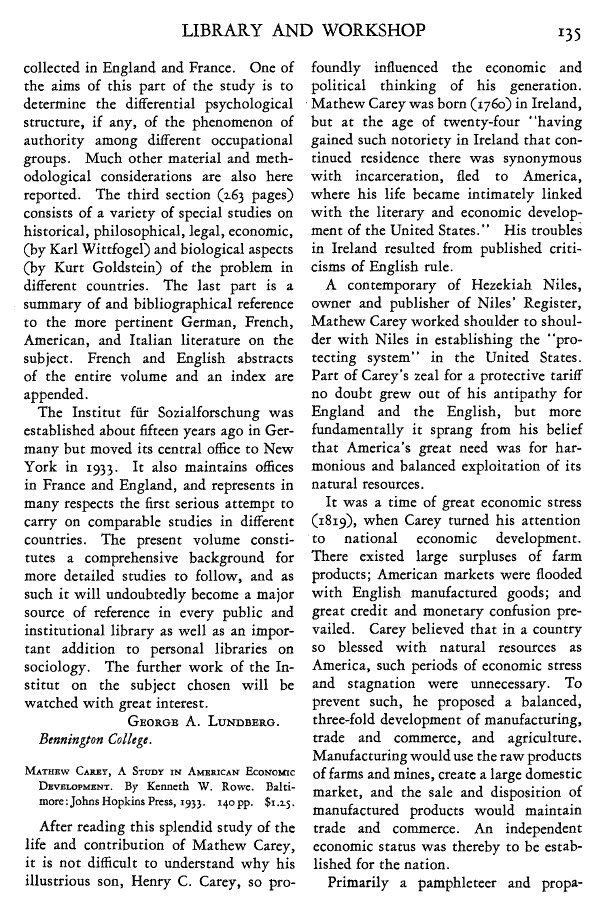
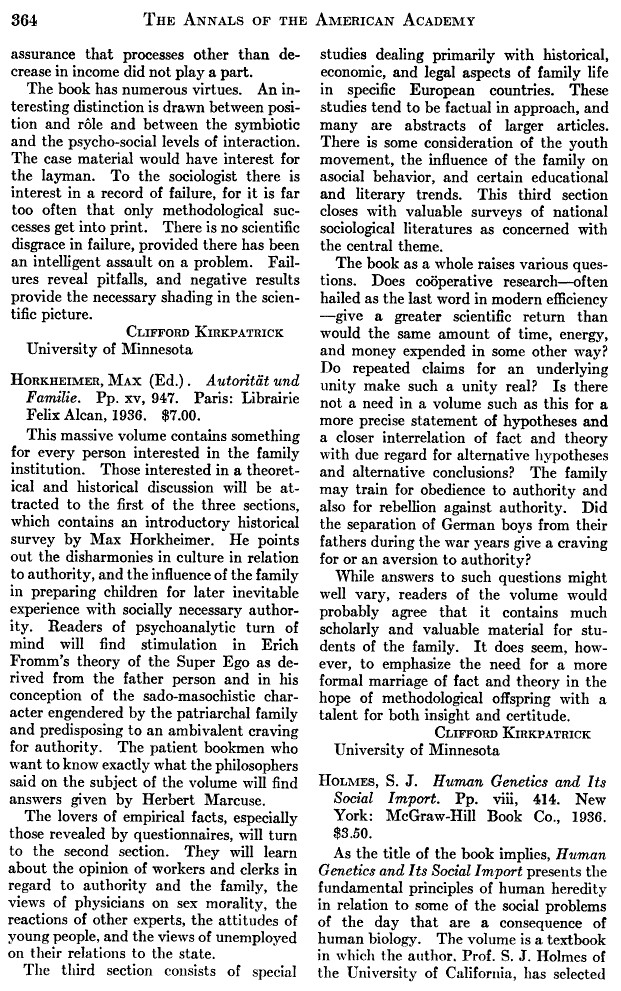
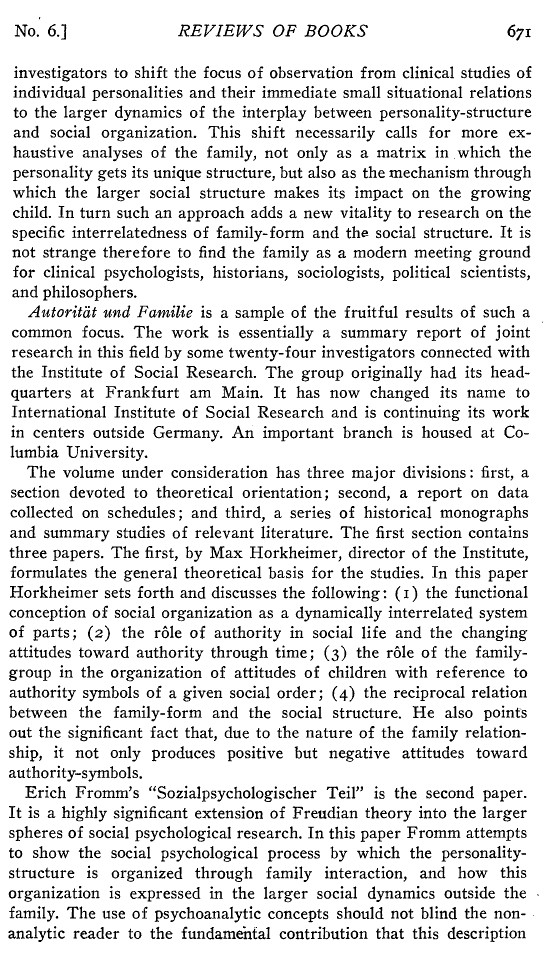
    • in the Frankfurt Institut für Sozialforschung's celebrated study: Max Horkheimer (ed.), Studien über Autorität und Familie (Studies about Authority and Family)
    • reprint Studien über Autorität und Familie von Ludwig von Friedeburg (Vorwort), Max Horkheimer, Erich Fromm, Herbert Marcuse, Hans Mayer, Karl A Wittfogel, Paul Honigsheim: (zu Klampen, 2005), 954 pages (49 Euro at amazon.de)
    • review by George A. Lundberg in Social Forces, vol. 15, no. 1 (Oct., 1936), pp. 134-135
    • review by Clifford Kirkpatrick, Annals of the American Academy of Political and Social Science (Nov. 1936), p. 364
    • review by Leonard S. Cottrell, Jr in The Philosophical Review 46:6(Nov. 1937), pp. 670, 671, 672

1940s (back to top)

  • 1940: "An Introduction to Hegel's Philosophy," Studies in Philosophy and Social Science, 8:3 (1940), 394-412.
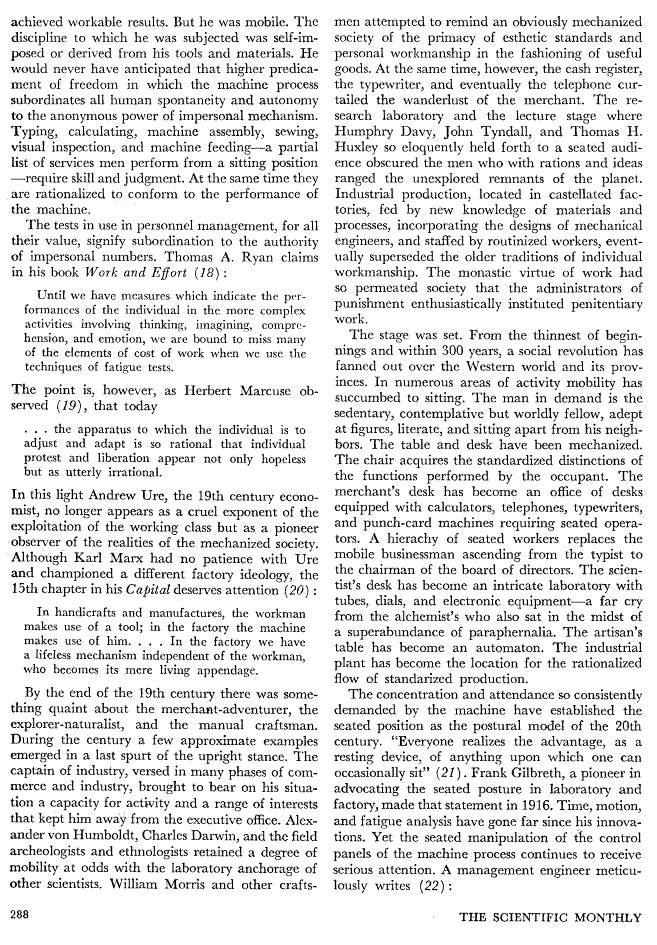
  • 1941: "Some Social Implications of Modern Technology,"
    in: Studies in Philosophy and Social Science 9(1941), 414-439
    • translated as "Einige gesellschaftliche Folgen moderner Technologie," in: Herbert Marcuse, Schriften Bd. 3, S. 286-319
    • full German text at gabnet.de/68er/; "gab" in gabnet stands for German Academic Brainpool
    • cited on p. 288 of Herbert Collins, "The Sedentary Society," in: Scientific Monthly 79:5 (Nov. 1954), pp. 285-292
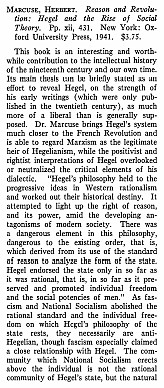
  • 1941: cover of reason and revolutionReason and Revolution: An Introduction to the Dialectical Thinking of Hegel and Marx
    • first major work in English, focus on critical reason and dialectical thinking
    • often republished:
      • Oxford University Press [c1941]
      • New York, Humanities Press, 1954 [i.e. 1955],
        new subtitle: Hegel and the Rise of Social Theory
      • Boston, Beacon Press [1960], with a new preface and note by the author on dialectic
      • France 1960, 1968
      • Germany 1962, 1972
      • New York: Humanities Press [1963, c1954]
      • New York: Humanities Press, [1968, c1954]
      • Atlantic Highlands, N.J.: Humanities Press, [1989]
      • Amherst, N.Y.: Humanity Books, [1999]
    • amazon $17 new, $10 used
    • Contents (various chapters available from hyperlinked version at marxists.org)
      Pt. I. The Foundations of Hegel's Philosophy.
      I. Hegel's Early Theological Writings
      II. Towards the System of Philosophy
      III. Hegel's First System
      IV. The Phenomenology of Mind
      V. The Science of Logic
      VI. The Political Philosophy
      VII. The Philosophy of History
      Pt. II. The Rise of Social Theory
      Introduction: From Philosophy to Social Theory
      I. The Foundations of the Dialectical Theory of Society
      II. The Foundations of Positivism and the Rise of Sociology
      Conclusion: The End of Hegelianism
    • excerpts on "OK Economics site" by Oldrich Kyn, created Aug. 4, 2004.
    • Reviews by
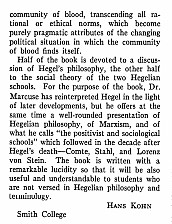
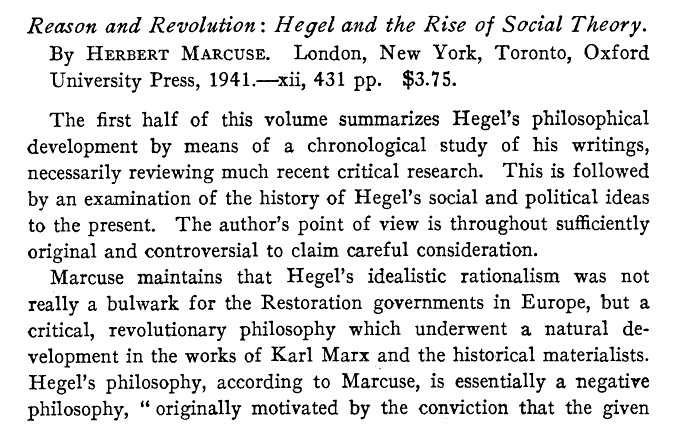
      • Hans Kohn, review of R&R, in: Annals of the American Academy of Political and Social Science 217(Sep, 1941), 178-179 (280k pdf of Kohn review)
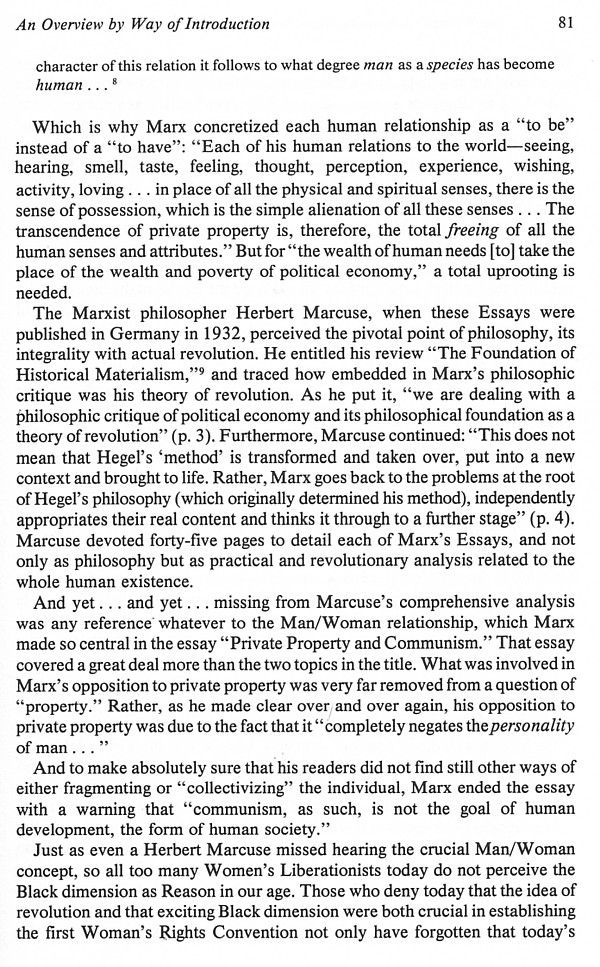
      • Kevin Anderson, "On Hegel and the Rise of Social Theory: A Critical Appreciation of Herbert Marcuse's Reason and Revolution, Fifty Years Later," in: Sociological Theory 11:3 (Nov. 1993), pp. 243-267 [930k pdf]
      • reviewed by V. J. McGill in The Journal of Philosophy 39:3 (Jan. 1942), pp. 75-82 (873k pdf)
      • 2nd ed. 1954 reviewed by V. J. McGill in The Journal of Philosophy 52:18(Sept. 1, 1955), pp. 502, 503, 504 (283k pdf).
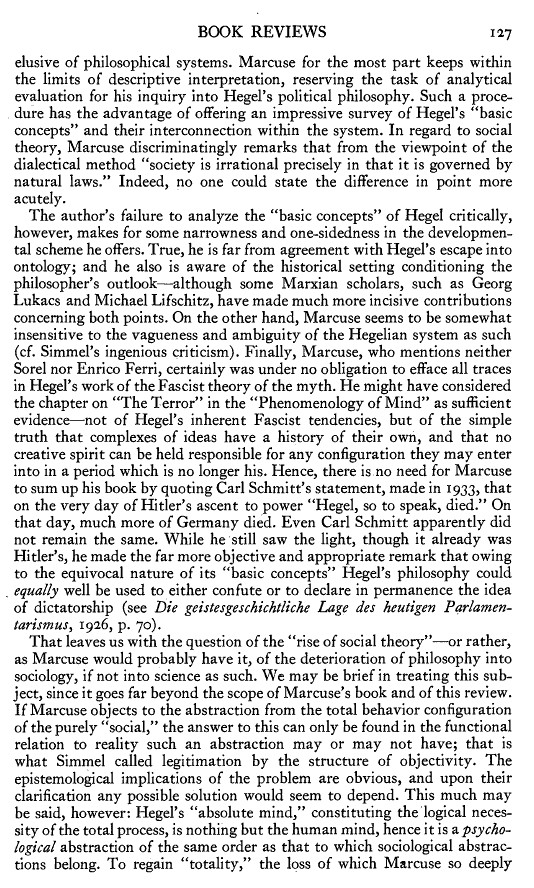
      • reviewed by Erich Franzen in American Sociological Review Vol. 7, No. 1 (Feb. 1942), pp. 126, 127, 128
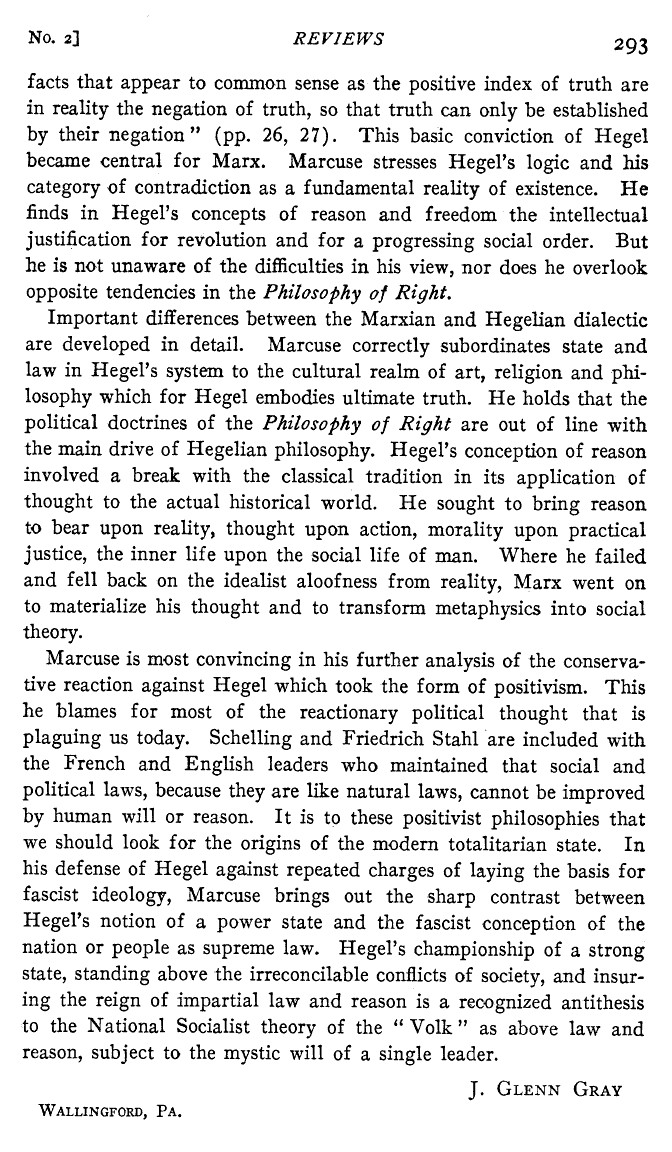
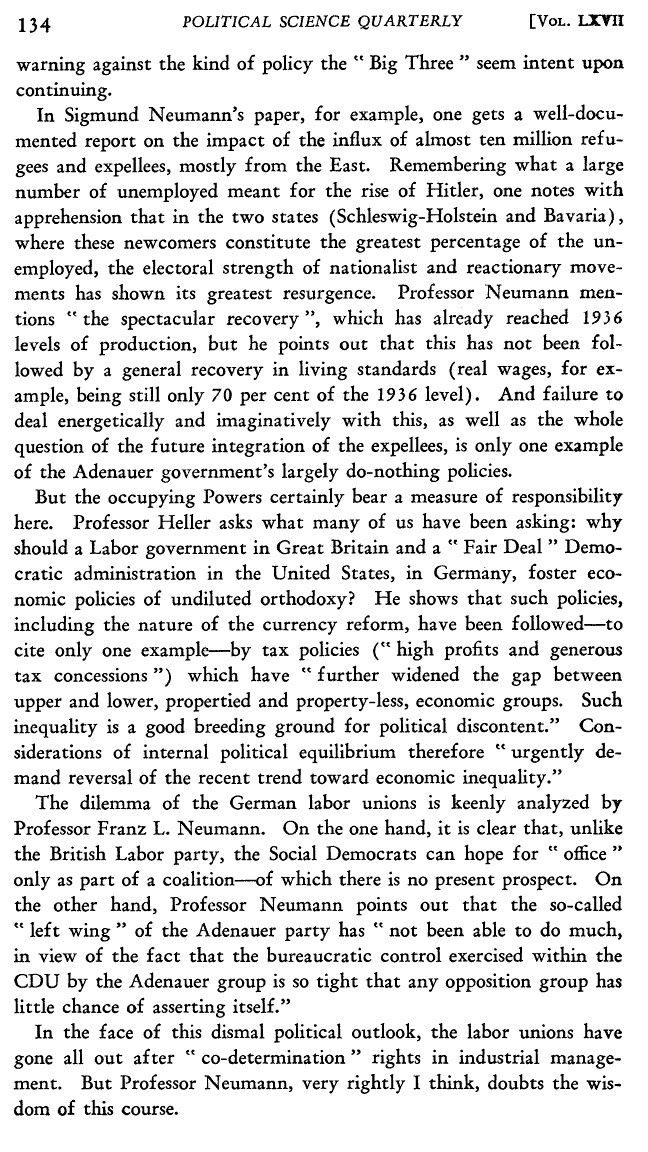
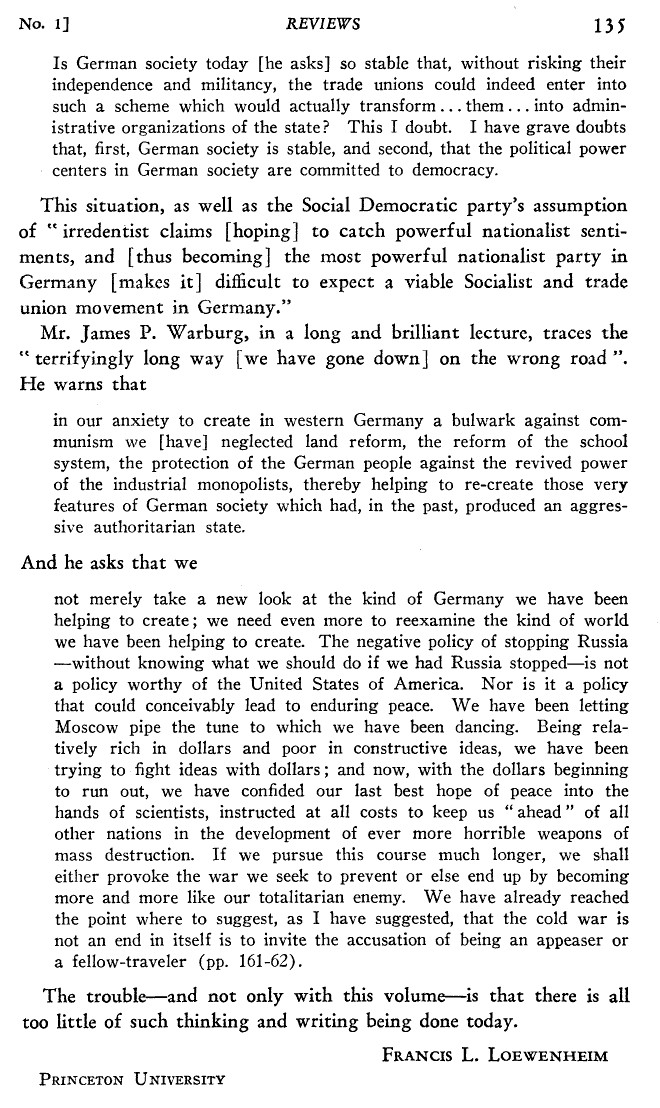
      • reviewed by J. Glenn Gray in Political Science Quarterly Vol. 57, No. 2 (June 1942), pp. 292-293
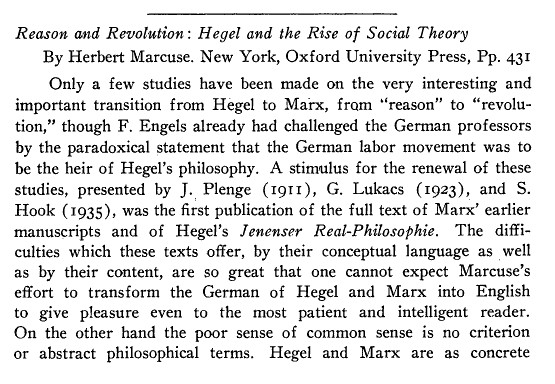
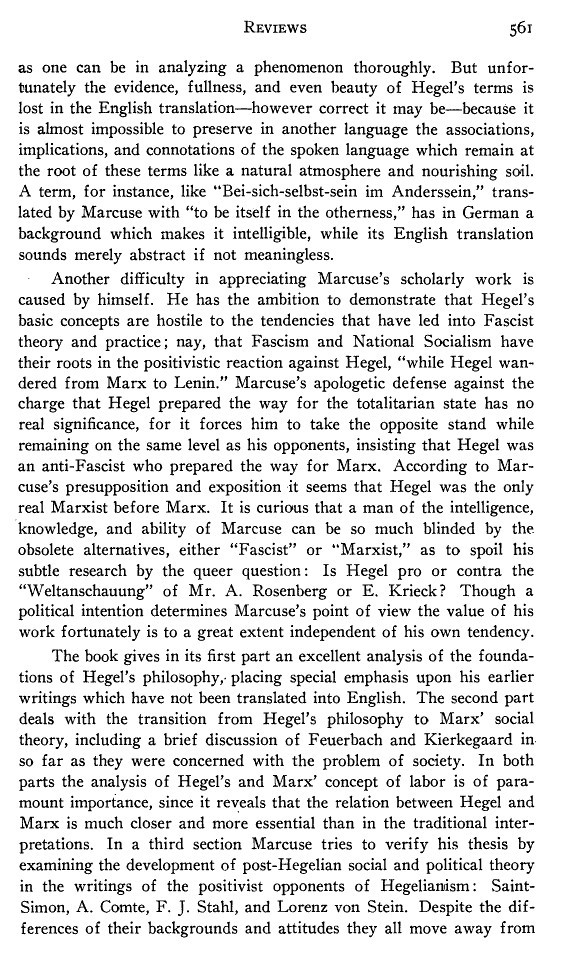
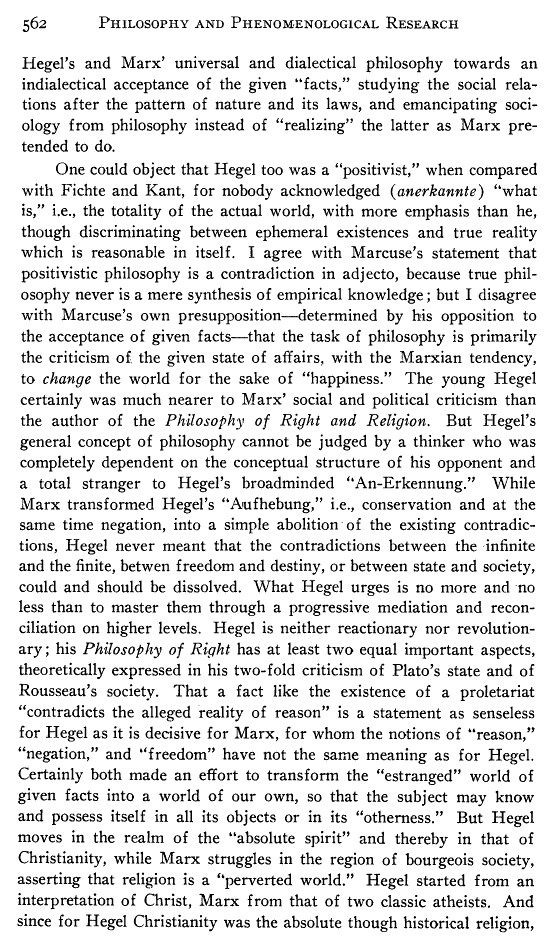
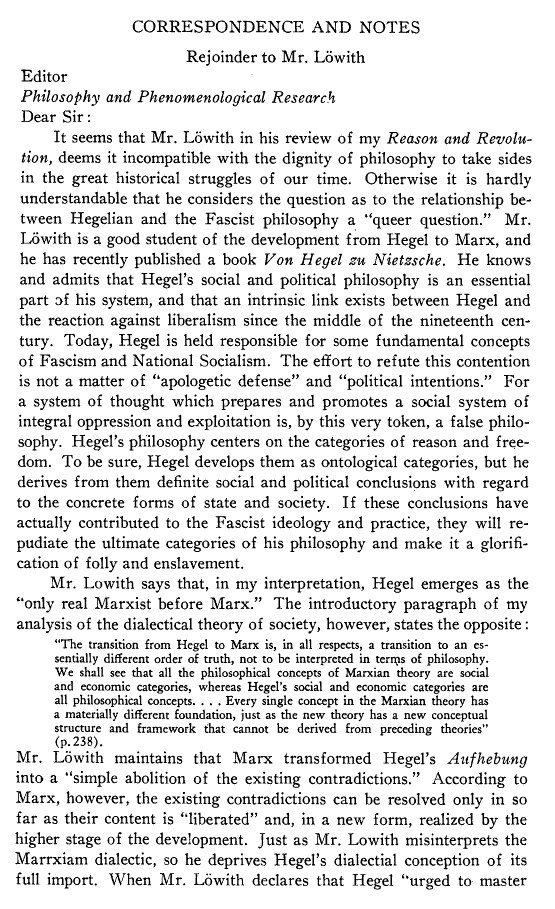
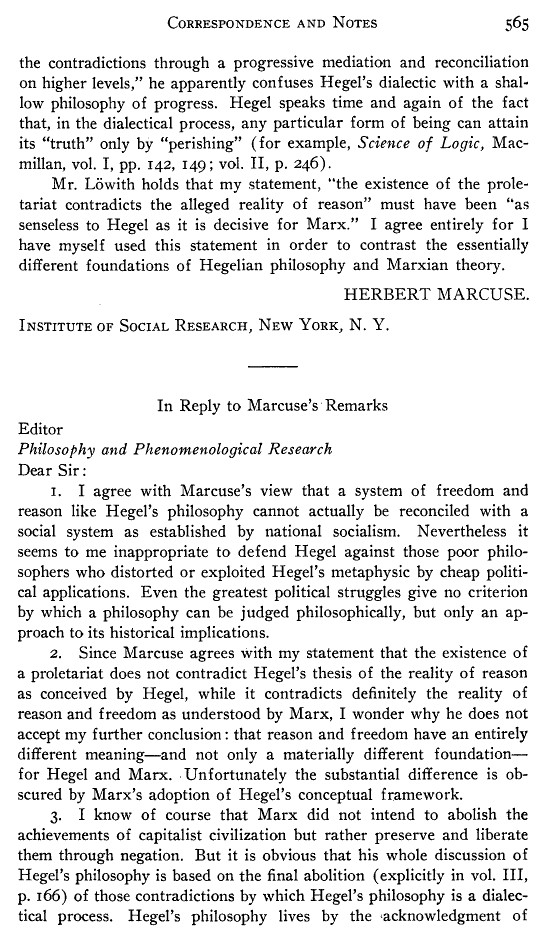
      • reviewed by Karl Lowith in Philosophy and Phenomenological Research Vol. 2, No. 4 (June 1942), pp. 560, 561, 562, 563 (385k pdf); response by Herbert 564-565
        "A Rejoinder to Karl Löwith's review of Reason and Revolution," Journal of Philosophy and Phenomenological Research, 2:4 (1941-1942): 564-565.
      • reviewed by Karl Löwith in Social Research 9(1942), 274-76 (pdf)
      • reviewed by Rudolf Allers in Thomist: A Speculative Quarterly Review 4(1942), 359-61 (pdf)
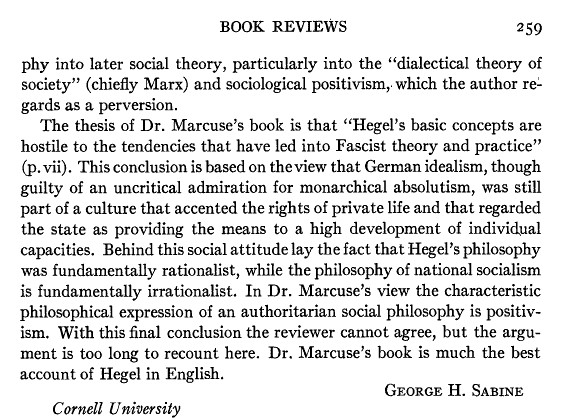
      • reviewed by George H. Sabine in The American Journal of Sociology Vol. 48, No. 2 (Sept. 1942), pp. 258-259
      • reviewed by G. Watts Cunningham in The Philosophical Review Vol. 52, No. 1 (Jan. 1943), pp. 73-76 [jstor]
      • reviewed by Boris Erich Nelson in: Annals of the American Academy of Political and Social Science 305 (May 1956), p. 203
      • reviewed by John Somerville in: Philosophy and Phenomenological Research 17:2 (Dec. 1956), pp. 273-275 (361k pdf)
      • Ralph Dumain, Notes on Herbert Marcuse’s Reason and Revolution, weblog April-Nov. 2003
      • Wikipedia Reason and Revolution page , created March 13, 2006 by FrenchieAlexandre
    • German: Vernunft und Revolution: Hegel und die Entstehung der Gesellschafts-theorie; übersetzt von Alfred Schmidt (Neuwied/Darmstadt: Luchterhand, 1962, 1972), 399 p.
    • French: Raison et révolution: Hegel et la naissance de la théorie sociale; traduction de Robert Castel et de Pierre-Henri Gonthier; présentation de Robert Castel (Paris: Edition de Minuit, 1968, orig. 1960), 480p.
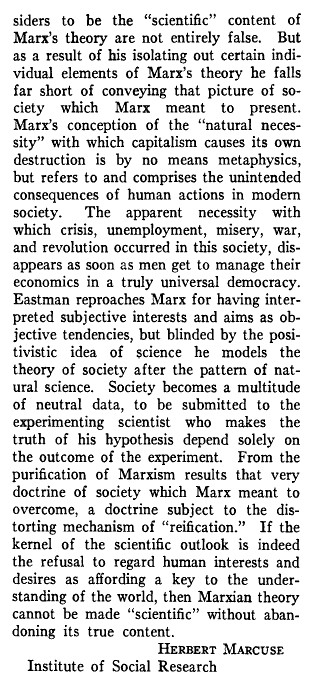
  • 1941: Herbert reviewed: Marxism: Is It Science by Max Eastman, in: Annals of the American Academy of Political and Social Science vol. 214, Billions for Defense (March 1941), pp. 254-255
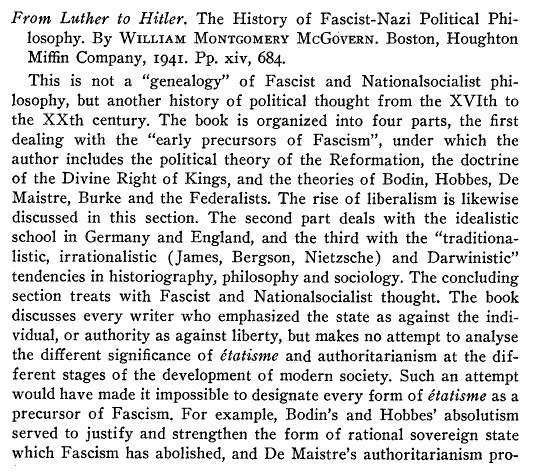
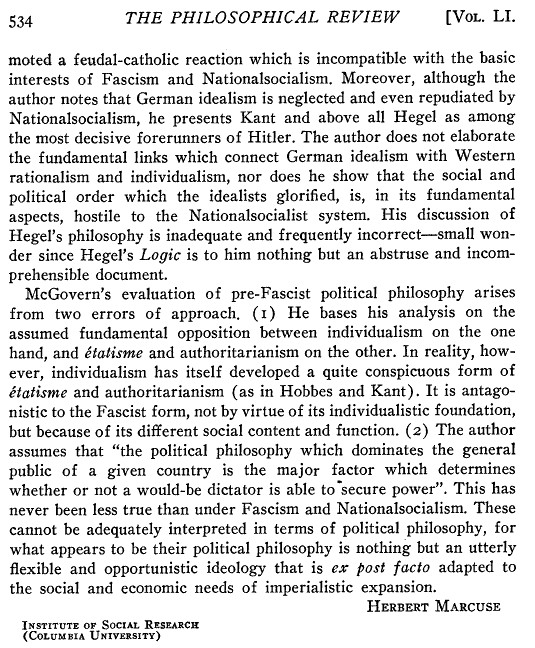
  • 1942: Herbert reviewed: From Luther to Hitler by William Montgomery McGovern
    The Philosophical Review Vol. 51, No. 5 (Sept. 1942), pp. 533-534
  • 1942: Herbert reviewed: Karl Lowith, Von Hegel bis Nietzsche, in: The Philosophical Review 51:6 (Nov. 1942), pp. 630-633 [jstor]
    note: Lowith reviewed Herbert's Reason and Revolution in the June issue of Philosophy and Phenomenological Research, with a response by Herbert; see above.
  • 1942: "State and Individual under National Socialism" (ms. first published in the 1990s)
    • According to Wiggershaus, this text was to be included in a book with essays by Gurland, Neumann, Kirchheimer and Pollock, which was, however, never published.
    • The complete essay is published in: Douglas Kellner, Technology, War and Fascism (New York: Routledge, 1998), 69-88.
    • "Staat und Individuum im Nationalsozialismus" (German excerpts)
  • 1943 Italian: Herbert reviewed The Destiny of Western Man by W. T. Stace in: The Philosophical Review Vol. 52, No. 4 (Jul., 1943), pp. 414-418 (500k pdf)
  • 1943: "Note sulla corretta propaganda di guerra verso i lavoratori tedeschi" and "Sulla neutralità psicologica" (introduction and translations by Raffaele Laudani in Storicamente)
  • 1946: Oct. 1946 letter to Horkheimer, translated into German [or originally in German?], with commentary by Tim B. Müller.
  • 1947-48: exchange of letters with Martin Heidegger (in German and English on this site)
    See also the 2005 publication of essays Herbert wrote in the early 1930s, below: Richard Wolin and John Abromeit (eds.), Heideggerian Marxism (Univ. of Nebraska Press), 288 pages.
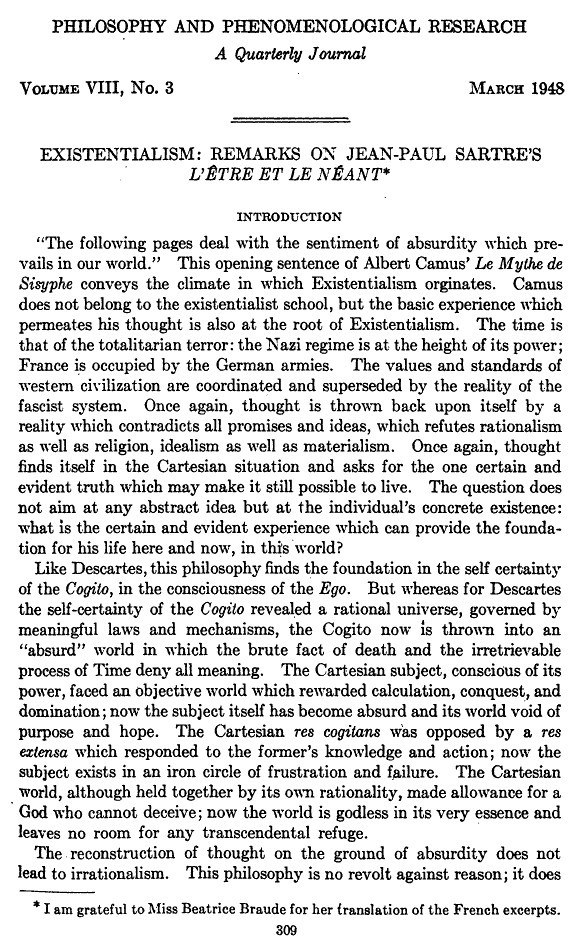
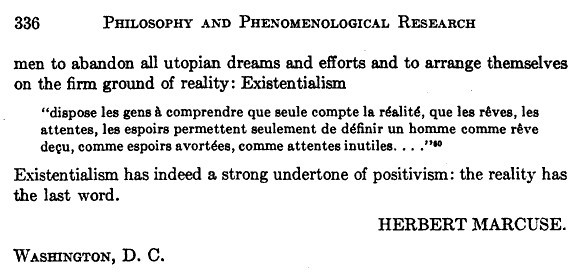
  • 1948: "Existentialism: Remarks on Jean-Paul Sartre's L'Etre et le Neant,"
    in: Philosophy and Phenomenological Research vol. 8, no. 3 (March 1948), pp. 309-336
    • 3.1M pdf
    • republished in: Studies in Critical Philosophy, trans. Joseph De Bres (London: New Left Books, 1972) (paperback edition re-titled From Luther to Popper (London: Verso, 1983)
    • and as chapter 5 of: Modern Critical Thought: An Anthology of Theorists Writing on Theorists, edited by Drew Milne, University of Cambridge (Blackwell, 2003) $24/$32 at amazon.com
  • 1949: Herbert reviewed: "Essays on Freedom and Power" by John Emerich Edward Dalberg-Acton, in: American Historical Review vol. 54, no. 3 (Apr. 1949), pp. 557-559 (306k pdf)

1950s (back to top)

  • 1950: review of: J. H. W. Rosteutscher, Die Wiederkunft des Dionysos, in: The Philosophical Review 59:1(Jan. 1950), pp. 123-124
  • 1950: review of: Benjamin Farrington, Francis Bacon: Philosopher of Industrial Science, in:
    Annals of the American Academy of Political and Social Science vol. 271, Moscow's European Satellites (Sept. 1950), pp. 228-229
  • 1950: review of: Georg Lukacs, Goethe und Seine Zeit, in: Philosophy and Phenomenological Research 11:1(Sept. 1950), pp. 142-144.
  • 1950: review of: Francis Bacon: Philosopher of Industrial Science by Benjamin Farrington, in: Annals of the American Academy of Political and Social Science 271(Sept. 1950), pp. 228-229
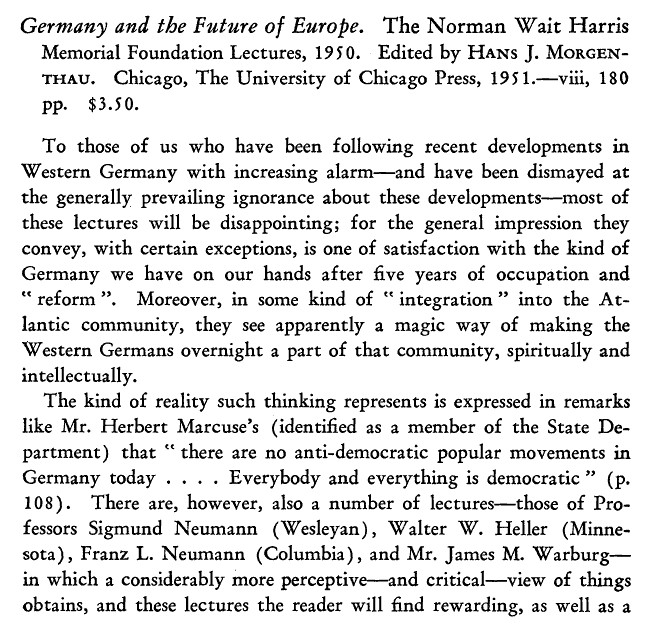
  • 1951: "Anti-Democratic Popular Movements," in: Hans Morgenthau (ed.), Germany and the Future of Europe (Chicago: Univ. of Chicago, 1951), p. 108-113.
    • From a review: a lecture by Herbert (member of State Dept.): "There are no antidemocratic popular movements in Germany today ... Everybody and everything is democratic."
    • Italian: Movimenti popolari antidemocratici (translation by Raffaele Laudani in Storicamente)
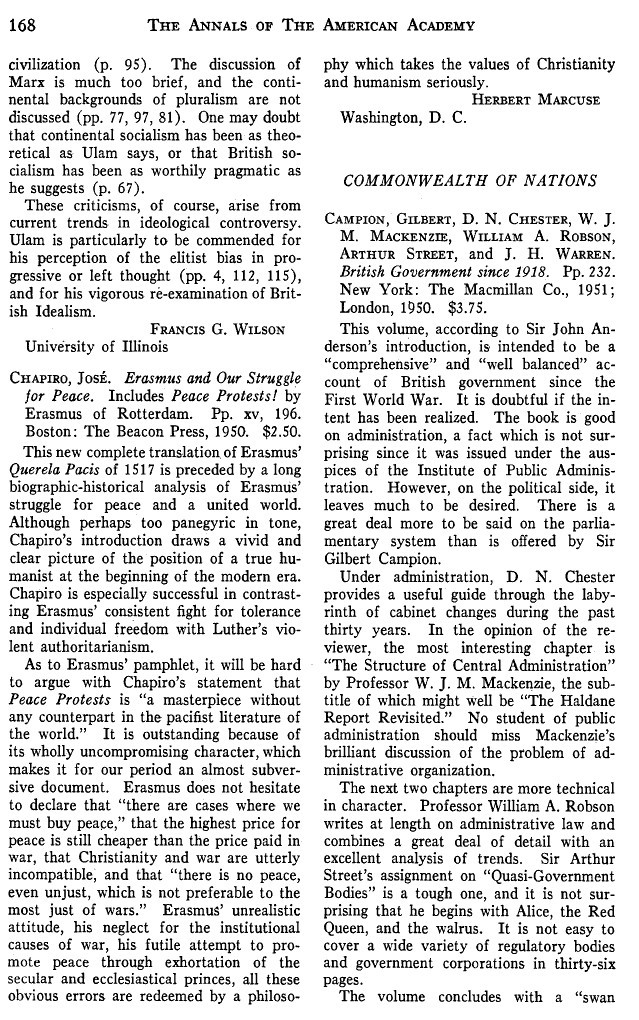
  • 1951: review of: Jose Chapiro, Erasmus and Our Struggle for Peace. Includes Peace Protests! and Erasmus of Rotterdam, in: Annals of the American Academy of Political and Social Science vol. 276, Lessons from Asia (July 1951), p. 168
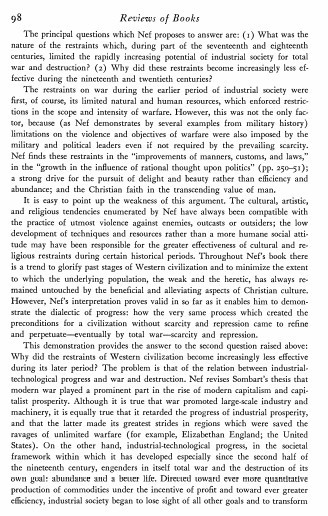
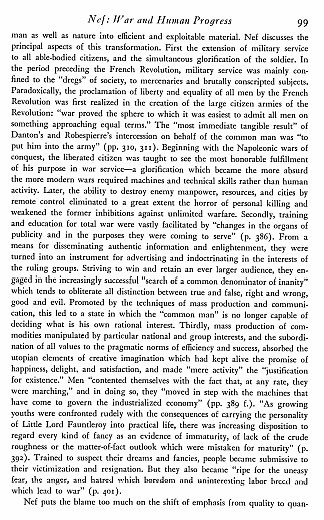
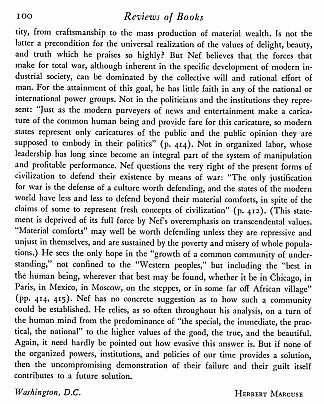
  • 1951: review of John U. Nef, War and Human Progress: An Essay on the Rise of Industrial Civilization, in: American Historical Review 571(Oct. 1951), 97, 98, 99, 100; (432k pdf).
  • 1952: review of Andrew M. Scott, The Anatomy of Communism, in: American Slavic and East European Review 11:4 (Dec. 1952), pp. 320-321
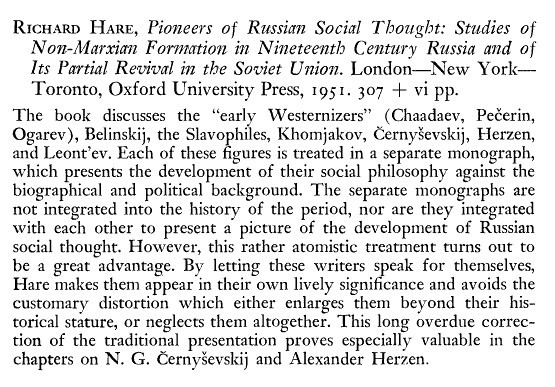
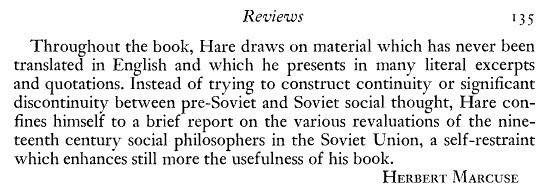
  • 1953: review of Pioneers of Russian Social Thought: Studies of Non-Marxian Formation in Nineteenth Century Russia and of Its Partial Revival in the Soviet Union by Richard Hare American Slavic and East European Review 12:1(Feb. 1953), pp. 134-135
  • 1953: review essay "Recent Literature on Communism," in: World Politics 6:4 (July 1954), pp. 515-525 (286k pdf), review of:
    • E. H. Carr, A History of Soviet Russia. I: The Bolshevik Revolution, 1917-1923;
      II: The Economic Order; III: Soviet Russia and the World
    • Barrington Moore, Jr., Terror and Progress--USSR.
    • Hugh Seton-Watson, From Lenin to Malenkov.
    • Rudolf Schlesinger, Central European Democracy and Its Background.
  • 1955: "Dialectic and Logic Since the War," in Continuity and Change in Russian and Soviet Thought, edited by Ernest J. Simmons (Cambridge, Mass.: Harvard University Press, 1955), pp. 347-358.
  • 1955: "Trieblehre und Freiheit," in: Frankfurter Beitraege zur Soziologie. Vol. I, Sociologica: Aufsaetze Max Horkheimer zum 60. Geburtstag gewidmet;
    • mentioned in: Joseph Maier, review of Frankfurter Beitraege zur Soziologie. Vol. I, Sociologica: Aufsaetze Max Horkheimer zum 60. Geburtstag gewidmet; Frankfurter Beitraege zur Soziologie. Vol. II, Gruppenexperiment: Ein Studienbericht by Theodor W. Adorno; Walter Dirks; Friedrich Pollock, in: Social Problems 3:3 (Jan. 1956), p. 197 (pdf)
    • mentioned on p. 483 of W. Phillips Davison's review of: Sociologica: Aufsaetze, Max Horkheimer zum Sechzigsten Geburtstag Gewidmet, ed. by Institute for Social Research, University of Frankfurt; Gruppen-Experiment: Ein Studienbericht, bearbeitet von Friedrich Pollock, by Institute for Social Research, University of Frankfurt, in: Public Opinion Quarterly 20:2(Summer 1956), pp. 480-484 (pdf)
  • 1955: "The Social Implications of Freudian 'Revisionism,'" Dissent, 2, no. 3 (Summer 1955): 221-240.
    • "A Reply to Erich Fromm," Dissent, 3:1 (1956): 79-81. (on Fromm website)
  • 1955: "Eros and Culture," I.E.: The Cambridge Review, 1, no. 3 (1955): 107-112.
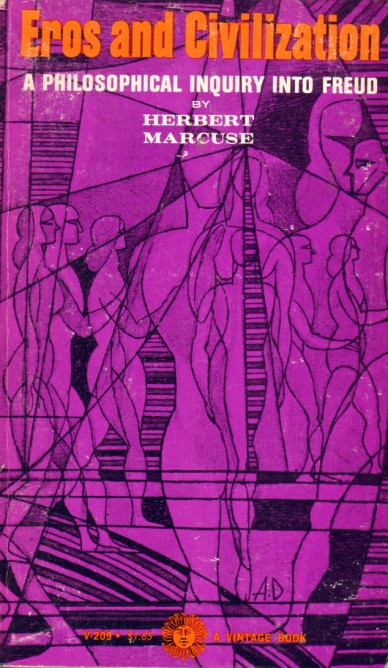
  • 1955: Postcard of an underground (llegal) publication of Eros & Civilization, designed by P.-E. JansenCover of 1961 Vintage edition of Eros and CivilizationThumbnail of Eros and CivilizationEros and Civilization: A Philosophical Inquiry into Freud
    • synthesis of Marx and Freud
    • Reviews
      • Abraham Edel, review of E&C, in The Nation 183(July 7, 1956), 22.
      • Herbert Fingarette, "Eros and Utopie," in: The Review of Metaphysics 10:4(1957), 660-665. (pdf)
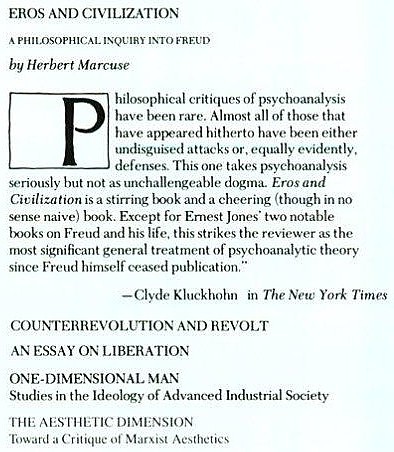
      • Martin Grotjahn, Kluckhohn blurb on back of Eros and Civilizationreview of E&C, in: Psychoanalytic Quarterly 25(1956), 429-431.
      • Paul Mattick, "Marx and Freud," review of E&C in: Western Socialist, Boston, USA, March-April, 1956 (at marxists.org)
      • Richard Jones, "The Return of the Un-Repressed," in: The American Imago 15:1(Spring 1958), 175-180. (pdf)
      • Clyde Kluckhohn, "A Critique on Freud," in: The New York Times Book Review (Nov. 27, 1955).
      • John David Ober, "On Sexuality and Politics in the Work of Herbert Marcuse," in: Paul Breines (ed.) Critical Interruptions: New Left Perspectives on HM (New York, 1970), 101-135.
      • Kurt Wolff, review of E&C, in: American Journal of Sociology 62:3(1956), 342-343
      • Robert M. Young, review of E&C, in: New Statesman 78:7(November 1969), 666-67
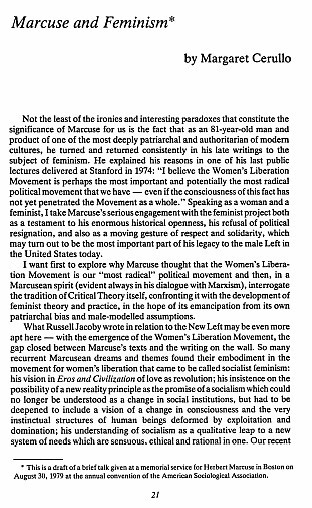
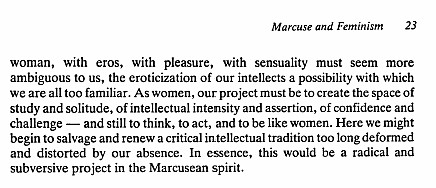
      • Margaret Cerullo, "Marcuse and Feminism," New German Critique 18(Autumn 1979), 21-23. (jpgs of 21, 22, 23; 368k pdf)
      • C. Fred Alford, "'Eros and Civilization' after Thirty Years: A Reconsideration in Light of Recent Theories of Narcissism," in: Theory and Society 16:6(Nov. 1987), 869-890. [560k pdf]
      • monographic critique by Bernard Görlich, Die Wette mit Freud: Drei Studien zu Herbert Marcuse (Frankfurt: Nexus, 1991), 150 S.
      • Wikipedia Eros & Civilization page
      • Henk Tuten's brief discussion on his philosophy.isfun.net site
      • another brief summary at parryandfirst.com
    • Discussion in Turkish: "Eros ve Uygarlik--Herbert Marcuse; Politik Önsöz, 1966; Çeviri ve Notlar"--Aziz Yardimli
    • Spanish: Manuel Foyaca de la Concha, Leyendo a Marcuse: "El final de la Utopía"; "Eros y civilización" (Madrid: Studium, 1969), 121 p. ["Reading Marcuse ..."]
    • Discussion in Portugese: Jorge Coelho Soares, "Eros e Civilização: sexualidade, repressão e a Teoria Crítica,". Revista Scientia Sexualis do Mestrado em Sexologia da Universidade Gama Filho, V.6, nº 1(2000), p. 27-51.
      cover of 1971 German edition of Ero
    • German translation (5€ from amazon.de).
      • first translation 1957 by Marianne v. Eckardt-Jaffe entitled Eros und Kultur  (Stuttgart: Klett, 1957)
      • reissued in 1965 under the title Triebstruktur und Gesellschaft
      • Frankfurt: Suhrkamp 1965
      • 79,000 copies in 1987
      • 17th edition 1995
      • Claus Behncke, "'Was darf ich hoffen?'" in: Frankfurter Hefte 22:1(1967), 59-61 (review of Triebstruktur)
    • French translation: cover of Eros et civEros et civilisation: contribution à Freud ; trad. de l'anglais par Jean-Guy Nény et Boris Fraenkel revu par l'auteur (Paris : Ed.de Minuit , Le Seuil, 1971; orig. 1963), 252 p. (P. Deramaix' description) amazon.fr €14
    • Spanish: Eros y civilización; traducción de Juan García Ponce (Barcelona, Ariel, 1981), 253 p.
      • 1969: Manuel Foyaca de la Concha, Leyendo a Marcuse: "El final de la Utopía"; "Eros y civilización" (Madrid: Studium, 1969), 121p
    • Italian: Eros e civiltà (Einaudi, 2001), €15 at Italian internet books
      • Secondary work: ?
  • 1956: Aggression in Industrial Society, presentation at the Chicago Psychiatric Society
    • first published in 1967 in English and 1968 in German (see below)
  • 1956: "La théorie des instincts et la socialisation," La Table Ronde, 108 (1956): 97-110.
  • 1957: "The Indictment of Western Philosophy in Freud's Theory," Journal of Philosophy, 54, no. 6 (March 1957): 154-155.
  • 1957: "Theory and Therapy in Freud," Nation (28 September 1957): 200-202.
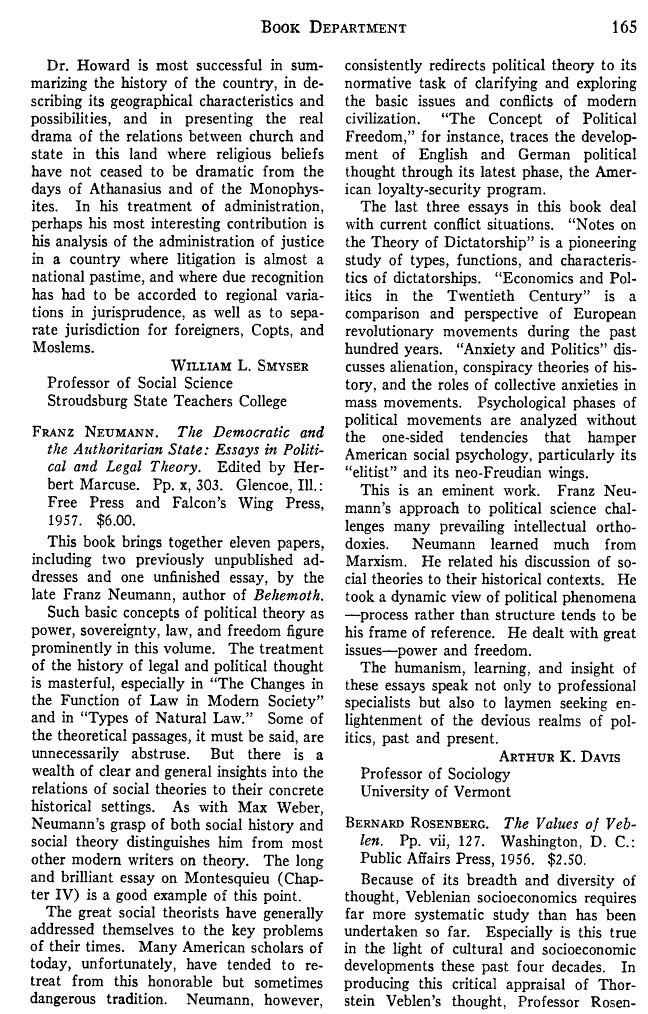
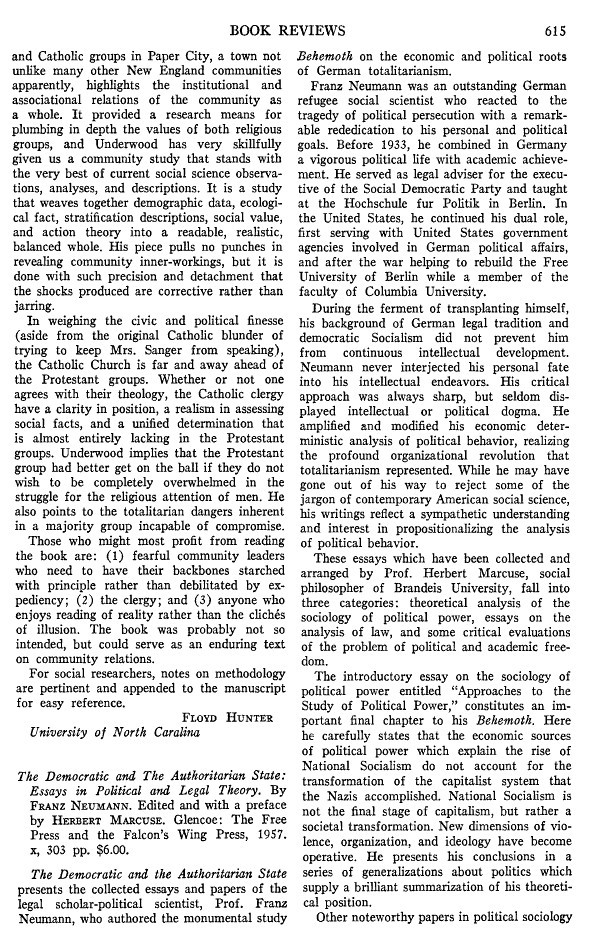
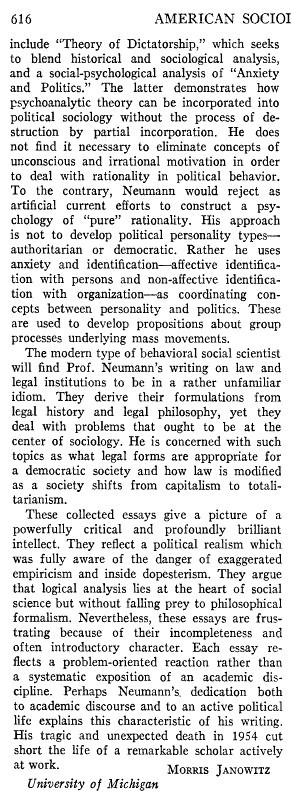
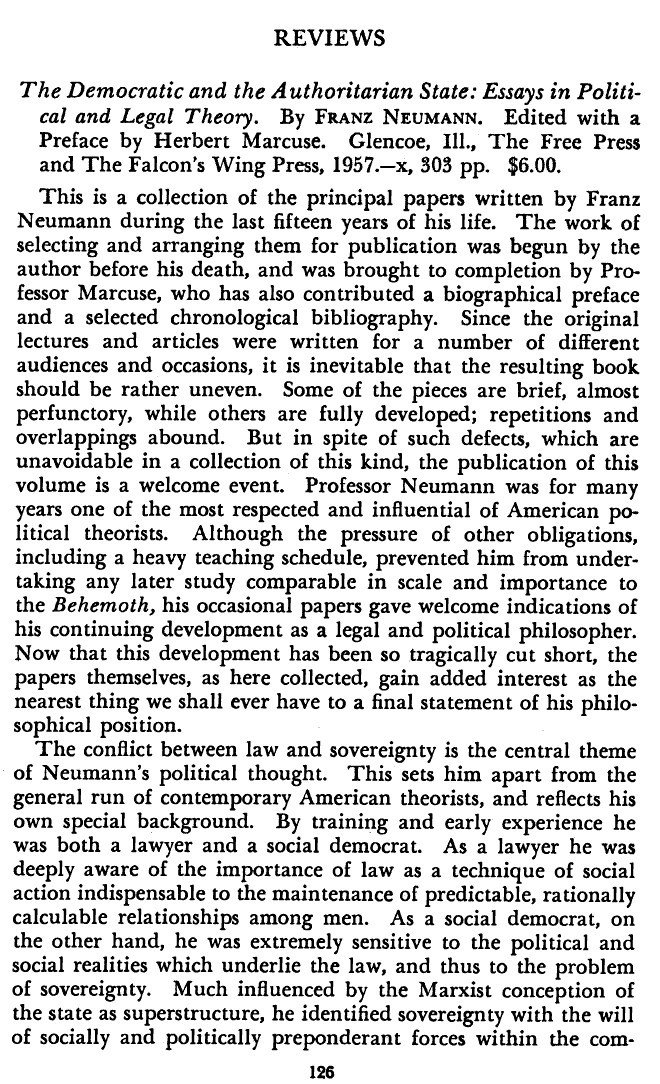
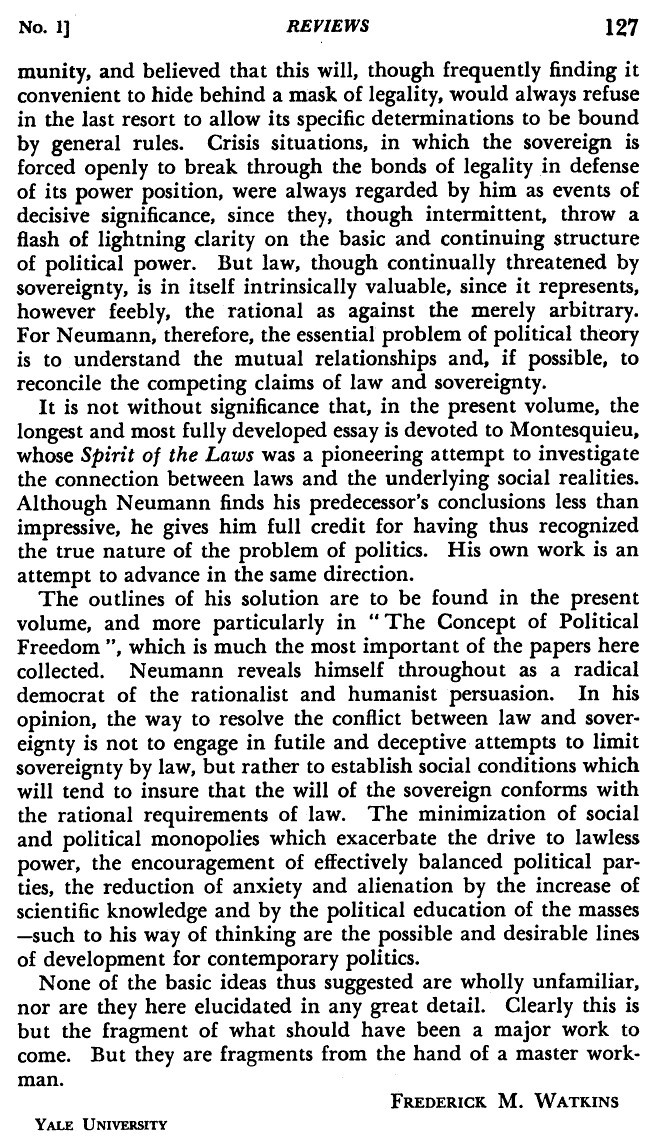
  • 1957: Franz Neumann, The Democratic and the Authoritarian State: Essays in Political and Legal Theory, edited and with a preface by Herbert Marcuse (Glencoe, Ill.: Free Press and Falcon's Wing Press, 1957), x, 303 p
    [see Franz Neumann page for more information and reviews]
    • reviewed by Arthur K. Davis in: Annals of the American Academy of Political and Social Science 313(Sept. 1957), p. 165
    • reviewed by Morris Janowitz in: American Sociological Review 22:5 (Oct. 1957), pp. 615-616
    • reviewed by Frederick M. Watkins in: Political Science Quarterly 73:1 (March 1958), pp. 126-127
    • reviewed by Samuel DuBois Cook in: The Journal of Politics 20:2 (May, 1958), pp. 416-418 (246k pdf)
    • reviewed by Max Beloff in: International Affairs (Royal Institute of International Affairs 1944-) 34:3 (July 1958), pp. 339-340 (1.4M pdf)
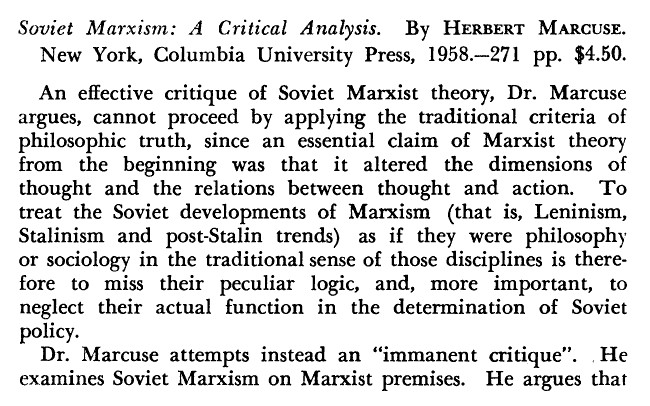
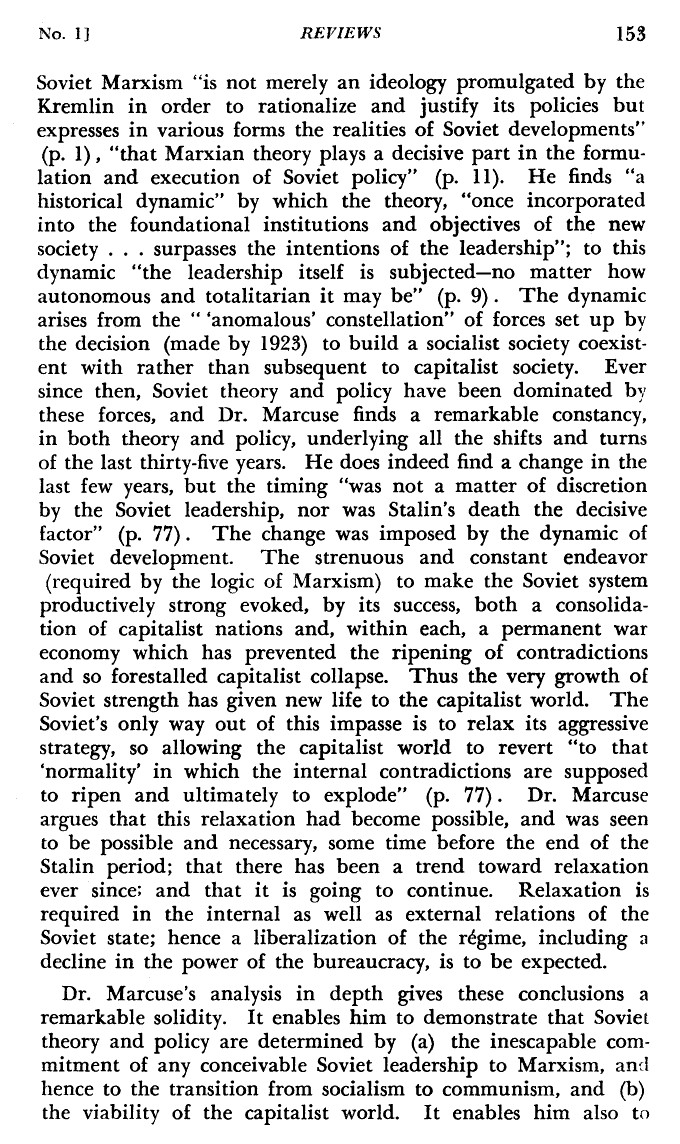
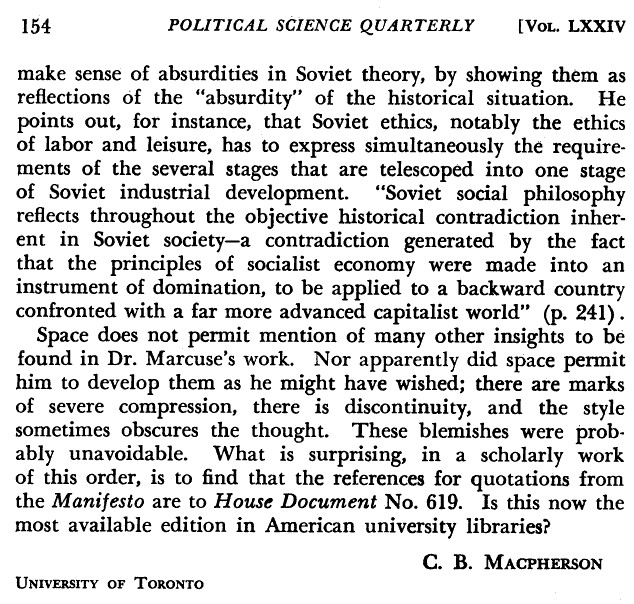
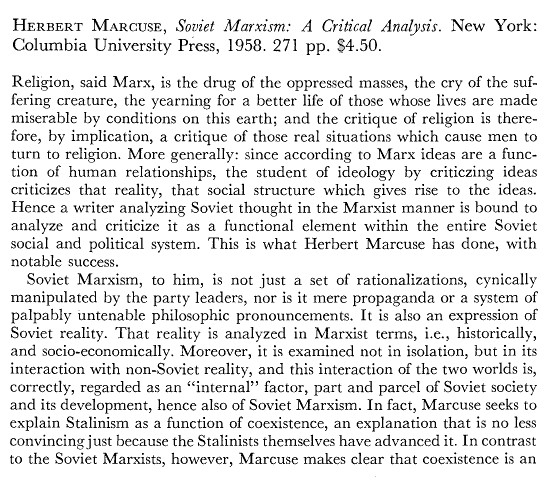
  • 1958: cover of soviet marxismSoviet Marxism: A Critical Analysis
    • currently in print: Columbia University Press, 1985
    • critique of the Soviet system
    • amazon $27 new, $4 used (all pages fully searchable on-line!)
    • Reviews
      • Richard DeHaan, review of Soviet Marxism, in: Ethics 69:1(Oct. 1958), 63-64.
      • C. E. Black, review of Soviet Marxism, in: Annals of the American Academy of Political and Social Science 320(Nov. 1958), 161-162.
      • Paul Kecskemeti, rev. of SM, in: American Political Science Review 53:1(Mar. 1959), 187-189.
      • C. B. Macpherson, review of SM, in: Political Science Quarterly 74:1(March 1959), pp. 152, 153, 154
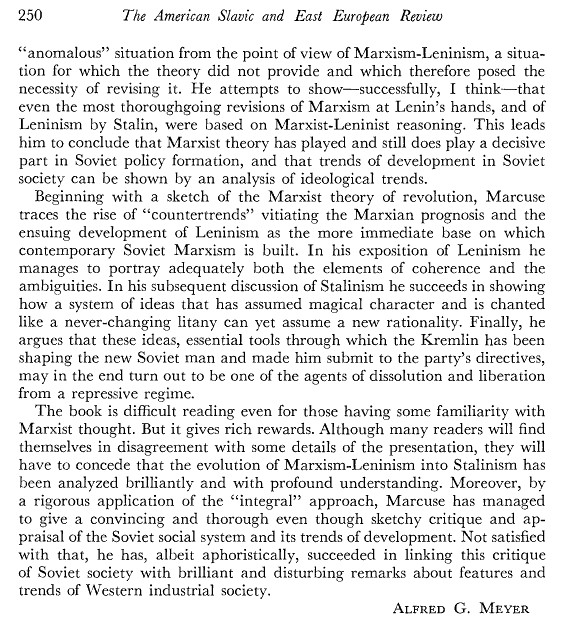
      • Alfred G. Meyer, review of SM, in: American Slavic and East European Review 18:2 (April 1959), pp. 249-250
      • Sidney Monas, rev. of SM, in: American Sociological Review 25:2(Apr., 1960), 286-287.
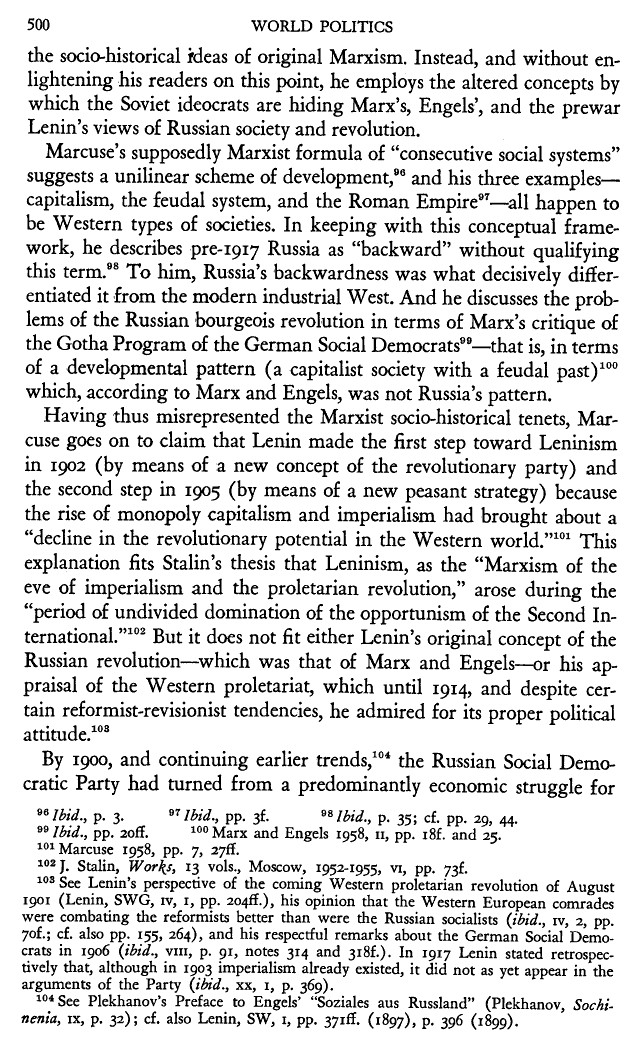
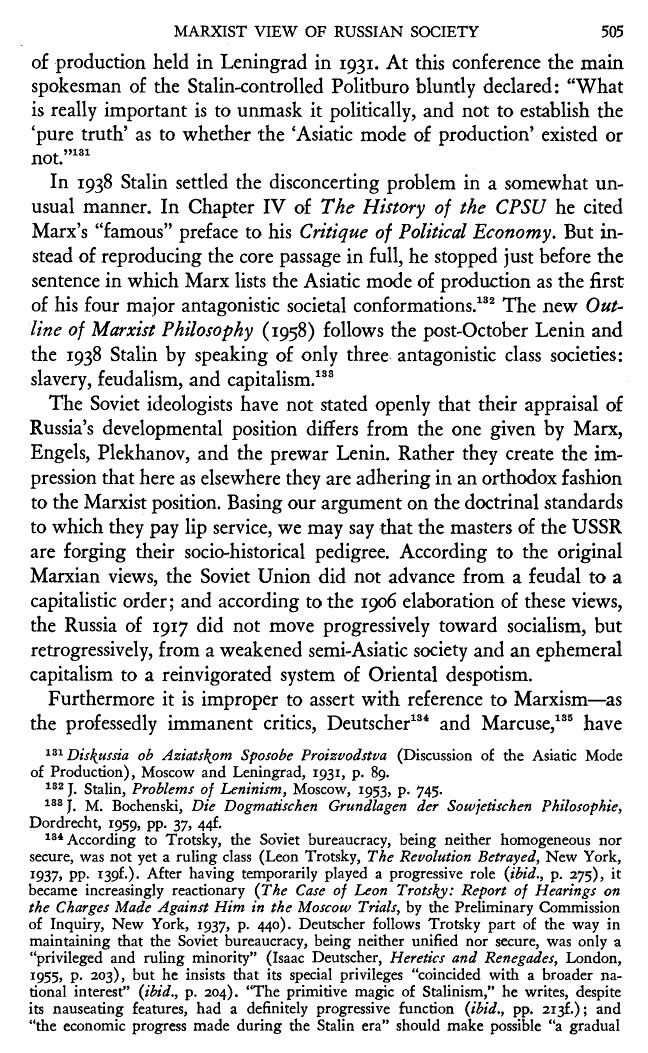
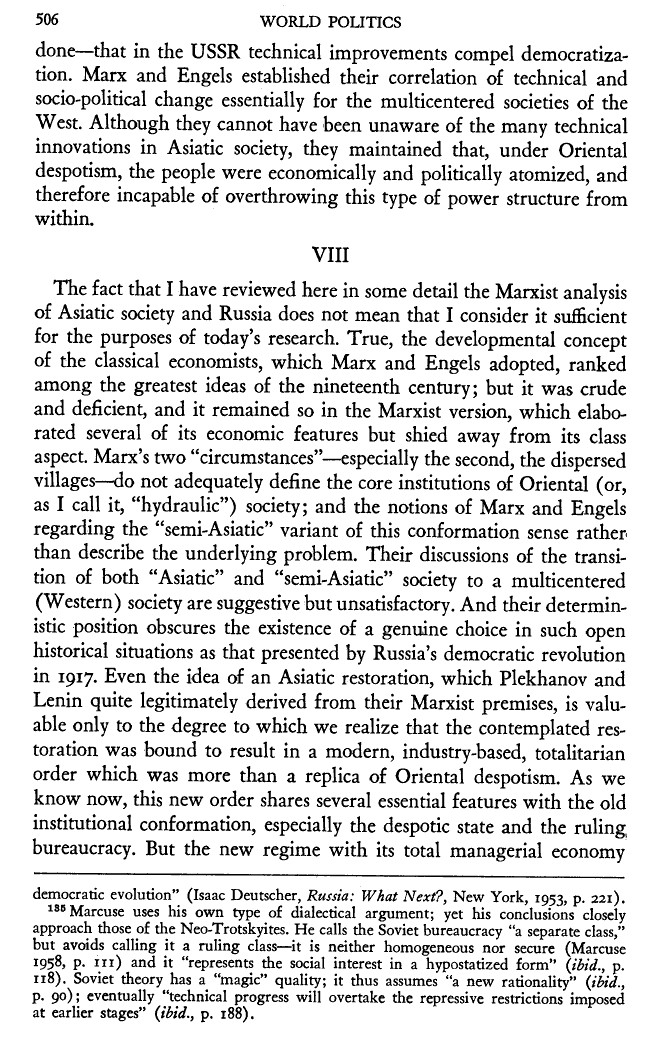
      • discussed in: Karl A. Wittfogel, "The Marxist View of Russian Society and Revolution," in: World Politics 12:4(July 1960), pp. 487-508: 499, 500, 505, 506 (2.36M pdf)
      • Douglas Kellner, Introduction to new paperback edition (New York: Columbia University Press, 1985), vii-xviii.
      • See chapter 2: "Between Apology and Critique: Marcuse's Soviet Marxism," in: Andrew Arato, From Neo-Marxism to Democratic Theory: Essays on the Critical Theory of Soviet-Type Societies (New York: M. E. Sharpe, 1993), 22-58.
    • German: Die Gesellschaftslehre des sowjetischen Marxismus (Neuwied: Luchterhand, 1964), 260 p
    • French: Le marxisme soviétique: essai d'analyse critique; préf. de l'auteur; trad. de l'anglais par Bernard Cazes (Paris:Gallimard,1971, orig. 1963), 378 p.
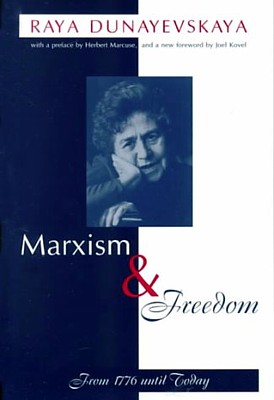
  • Raya Dunayevskaya (-1987)Dunayevskaya, Marxism and Freedom, Marxism and Freedom: From 1776 Until Today
    • first published 1958, 3rd ed. 1982
    • preface of the 1958 edition by Herbert Marcuse amazon.fr page
    • Description: In this classic exposition of Marxist thought, Raya Dunayevskaya, with clarity and great insight, traces the development and explains the essential features of Marx's analysis of history. Using as her point of departure the Industrial and French Revolutions, the European upheavals of 1848, the American Civil War, and the Paris Commune of 1871, Dunayevskaya shows how Marx, inspired by these events, adapted Hegel's philosophy to analyze the course of history as a dialectical process that moves "from practice to theory." The essence of Marx's philosophy, as Dunayevskaya points out, is the human struggle for freedom, which entails the gradual emergence of a proletarian revolutionary conciousness and the discovery through conflict of the means for realizing complete human freedom.
      In spite of the profound derailment of Marxist political philosophy in the twentieth century, Dunayevskaya points to developments such as the Hungarian revolt of 1956 and the civil rights struggles in the United States as signs that the indomitable quest for freedom on the part of the downtrodden cannot forever be repressed. The Hegelian dialectic of events propelled by the spirit of the masses thus moves on inexorably with the hope for future achievement of political, economic, and social freedom and equality for all.
    • R.D. had formerly been Trotsky's secretary. The entire Dunayevskaya-Marcuse correspondence is available on the 1986 microfilm publication of RD's papers.
    • See also: Quarterly Journal of Ideology, Vol. 13, no. 4 (1989) (2MB pdf)
      this issue of the journal can be purchased at: lsus.edu/la/journals/ideology/archives.htm
    • Excerpts from the Dunayevskaya-Marcuse Correspondence: 1954-79
      Douglas Kellner, In Memoriam: Raya Dunayevskaya, 1910 to 1987
      Kevin Anderson, A Preliminary Exploration of the Dunayevskaya-Marcuse Dialogue, 1954 to 79
      Douglas Kellner, A Comment on the Dunayevskaya-Marcuse Dialogue
      Kevin Anderson, Response to Kellner on the Dunayevskaya-Marcuse Dialogue
  • 1959 "Soviet Theory and Practice," Partisan Review, 26, no. 1 (Winter 1959): 157-158.

1960s (back to top)

  • 1960: "De l'ontologie à la technologie: les tendences de la société industrielle," Arguments, 4, no. 18 (1960): 54-59.
  • 1961: "Language and Technological Society," Dissent, 8, no. 1 (Winter 1961): 66-74.
  • 1962: "Idéologie et société industrielle avancée," Mediations, 5 (Summer 1962): 57-71.
  • 1962: "Emanzipation der Frau in der repressiven Gesellschaft: Ein Gespräch mit Herbert Marcuse und Peter Furth," Das Argument, 23 (October-November 1962): 2-12.
  • 1963: "Dynamismes de la société industrielle," Annales: Economies, Sociétés, Civilisations, 18 (1963): 906-933.
  • 1963: "Zur Stellung des Denkens heute," in Zeugnisse: Theodor W. Adorno zum sechzigsten Geburtstag, edited by Max Horkheimer (Frankfurt am Main: Europäische Verlagsanstalt, 1963), pp. 45-49.
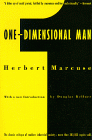
  • 1964: one dimensional manThumbnail of One Dimensional ManOne Dimensional Man (Boston: Beacon, 1964)
    • German: 2003 ed. of One Dimensional ManThumbnail of  Der eindimensionale MenschDer eindimensionale Mensch: Studie zur Ideologie der fortgeschrittenen Industriegesellschaft, translated by Alfred Schmidt
      • Neuwied: Luchterhand, 1st+2nd eds. 1967; 5+6th 1968; 60-64.000 1974; 9th 1977, 21st 1987; 24th 1990; 25th 1991 [281 pages]
      • Zürich: Buchclub Ex Libris, 1969
      • Frankfurt: Suhrkamp, 1989 (Schriften Bd. 7), reprinted zu Klampen 2004.
      • Munich: dtv 1994; 2nd ed. 1998, 3rd 2002, DM20/€7.80 from amazon.de;
        4th ed. April 2004 [picture on right] €10/7.50 at amazon.de.
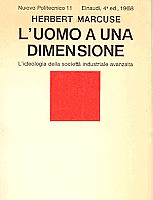
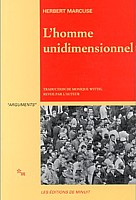
    • French: cover of italian edition l'uomo a una dimensionecover of homme unidimensionnelL'homme unidimensionnel: essai sur l'idéologie de la société industrielle avancée; trad. de l'anglais par Monique Wittig et l'auteur (Paris: Ed.de Minuit, 1968), 284 p. amazon €14
    • Italian: L'uomo a una dimensione: l'ideologia della societa` industriale avanzata; introduzione di Luciano Gallino; traduzione di Luciano Gallino e Tilde Giani Gallino (Torino: Piccola biblioteca Einaudi, 1967, 11th ed. 1971, 1999)
    • Spanish: El Hombre Unidimensional (Barcelona: Editorial Seix Barral, 1972=IX edición)HombreUnidomensional, cover
    • Turkish: full translated text "Tek-Boyutlu Insan," translated by Aziz Yardimli, 1986-97. at ideayayinevi.com
    • Korean: Ilch?awo?njo?k in?gan : pujo?ng / Maru?k?uje ; Ch?a In-so?k yo?k. Publisher So?ul T?u?kpyo?lsi : Samso?ng Ch?ulp?ansa, 1982 (1987 printing), 406 p. Series Samso?ngp?an, segye sasang cho?njip =Great books of the world ;29 [UCLA]
    • An excerpt from Chapter 5. Negative Thinking: The Defeated Logic of Protest, is available on bluereality.org's (a social criticism website) Marcuse page. (last found March 2004; need to create an archive copy)
    • Reviews and Discussions
      • The Books About Page on this site lists monographic critiques by:
      • review by Edgar Z. Friedenberg in: Commentary 37:4(April 1964), teaser on-line; pdf
      • review by Wagner, Helmut R., in: Social Research 32:1(Spring 1965), 116-122 (pdf)
      • Herbert Marcuse, "Reply to M. Berman's review of One-Dimensional Man," Partisan Review, 32 (Winter 1965): 159-160.
      • chapter by chapter summary by Jason McManus (2002) on essortment.com/ pagewise.com, a platform that publishes articles.
      • Michael G. Horowitz gave a pithy summary of the book in the profile he published in Playboy in 1970.
      • Henk Tuten's website has a very abbreviated, interpretative summary of One Dimensional Man
      • Marianne Dekoven, "Psychoanalysis and Sixties Utopianism," Journal for the Psychoanalysis of Culture & Society, 8(2003). (available from questia.com)
        Subjects: Marcuse, Herbert--Criticism, interpretation, etc., One-Dimensional Man (Essay)--Criticism, interpretation, etc., Psychoanalysis--Analysis
      • John Ruskin Clark, What's Wrong with Marcuse's One Dimensional Man
        (San Diego, First Unitarian Church of San Diego, 1968). Transcript of a sermon delivered to the First Unitarian Church of San Diego on Oct. 13, 1968; seven pages.
    • Several recent college courses use selections from ODM: see the Courses Page on this site
  • 1964 "Ethics and Revolution," lecture at the University of Kansas
    • published in 1965 in Kultur und Gesellschaft 2 (Frankfurt, 1965), 130-146
    • also in Schriften, Bd. 8, 100-114.
  • 1964 "World Without Logos," Bulletin of the Atomic Scientists, 20 (January 1964): 25-26.
  • 1965 "Repressive Tolerance"
  • 1965 Kultur und Gesellschaft
    • vol. 101: (Frankfurt: Suhrkamp, 1965, 12th ed. 1975) amazon.de €7.50
      contents:
      Kampf gegen den Liberalismus in der totaltiären Staatsauffassung [originally in: ZfS 3(1934)]
      Über den affirmativen Charakter der Kultur [originally in: ZfS 6(1937)]Cultura y sociedad, cover

      Philosophie und kritische Theorie [originally in: ZfS 6(1937)]
      Zur Kritik des Hedonismus
      [originally in: ZfS 7(1938)]
      vol. 135: (Frankfurt: Suhrkamp, 1965; 10th ed. 1979)
    • French: Culture et société; trad. de Gérard Billy, Daniel Bresson, et Jean-Baptiste Grasset (Paris: Ed. de Minuit,1970), 391 p.; bibliographie chronologique des travaux d'Herbert Marcuse revue et complétée par N. Dumont
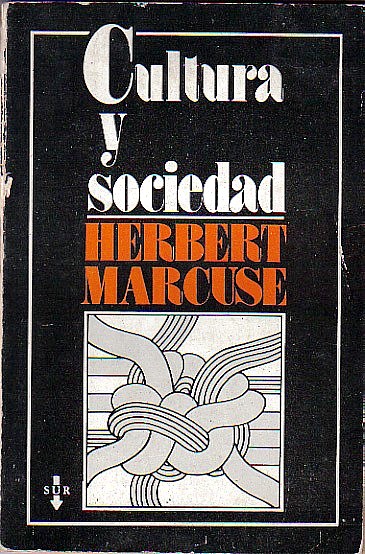
    • Spanish: Cultura y Sociedad (Buenos Aires: Editorial Sur, 1978). Contains a selection of 4 articles from the 2 German vols.
    • UCSB: HM101.M344
  • 1965: "Remarks on a Redefinition of Culture," in Science and Culture, edited by Gerald Holton (Boston: Houghton Mifflin, 1965), pp. 218-223.
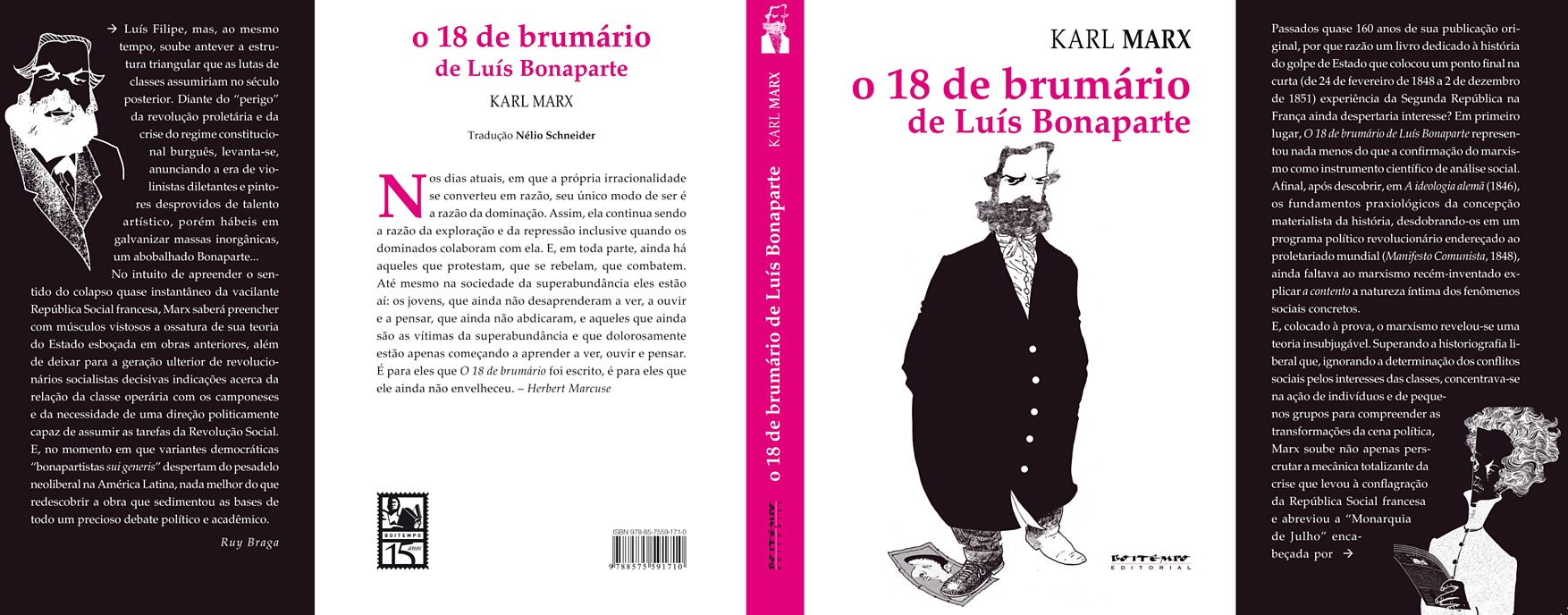
  • 1965: Karl Marx, Der 18. Brumaire des Louis Bonaparte, afterword by Marcuse (Frankfurt: Insel, 1965), pp. 143-150; Marcuse's afterword translated as "Epilogue to the New German Edition of Marx's 18th Brumaire of Louis Napoleon Bonaparte," in Radical America (Cambridge, 1969), pp. 55-59.
  • 1965 "Perspektiven des Sozialismus in der entwickelten Industriegesellschaft," Praxis, l, nos. 2 and 3 (1965), 260-270; translated as "Socialism in the Developed Countries," International Socialist Journal, 2 (April 1965): 139-152.
  • 1965 "A Tribute to Paul A. Baran," Monthly Review, 16 (March 1965): 114-115.
  • 1965 "Der Einfluss der deutschen Emigration auf das amerikanische Geistesleben: Philosophie und Soziologie," Jahrbuch für Amerikastudien, 10 (1965): 27-33.
  • 1965 "Comes the Revolution: Reply to M. Berman's review of One-Dimensional Man," Partisan Review, 32 (Winter 1965): 159-160.
  • 1965 "Statement on Vietnam," Partisan Review, 32 (Fall 1965): 646-649.
  • 1965 "Einige Streitfragen," Praxis, 1, nos. 2 and 3 (1965): 372-379.
  • 1965: "Socialist Humanism," in Socialist Humanism: An International Symposium, edited by Erich Fromm (Garden City, N.Y.: Doubleday, 1965), pp. 107-117.
  • 1965: "On Science and Phenomenology," in Boston Colloquium for the Philosophy of Science (1962-1964): Proceedings, edited by Robert S. Cohen and Marx W. Wartofsky, Boston Studies in the Philosophy of Science, volume 2 (New York: Humanities Press, 1965), pp. 279-290 (full text)[with comment by Aron Gurwitsch, 291-305].
  • 1965 Walter Benjamin (1892-1940), Zur Kritik der Gewalt und andere Aufsätze.
    Nachwort von Herbert Marcuse
    (Frankfurt: Suhrkamp, 1965), 106 p.
  • 1966 "The Individual in the Great Society"
    • in: Alternatives 1(1966), issue 1: 14-16, 20 and issue 2: 29-35.
    • German: "Das Individuum in der Great Society" in: Ideen zu einer kritischen Theorie der Gesellschaft (Frankfurt, 1969), 157-184, translated by Alfred Schmidt
    • also in Schriften, Bd. 8, 167-193.
  • 1966 "Ethics and Revolution," in Ethics and Society: Original Essays on Contemporary Moral Problems, edited by R. T. de George (Garden City, N.Y.: Anchor, 1966), pp. 133-147.
  • 1966 "Sommes-nous-déjà des hommes?" Partisans, 28 (April 1966): 21-29.
  • 1966 "Vietnam: Analyse eines Exempels," Neue Kritik, 36/37(June-Aug. 1966),: 30-40.
    • statement from May 22, 1966 attacking U.S. policy in Vietnam. May have been at a conference organized by the Sozialistischer Deutscher Studentenbund.
    • reprinted in: Wolfgang Kraushaar (ed.)., Frankfurter Schule und Studentenbewegung: Von der Flaschenpost zum Molotowcocktail, 1946-1995 (Hamburg, 1998), vol. 2, pp. 205-9.
    • available full text in English and German at the GHI's German History in Documents site
  • 1966 "Zur Geschichte der Dialektik," Sowjetsystem und Demokratische Gesellschaft, 1 (1966): 1192-1211.
  • 1967 "The Inner Logic of American Policy in Vietnam," in Teach-Ins, USA: Reports, Opinions, Documents, edited by Louis Menashe and Ronald Radosh (New York: Praeger, 1967), pp. 65-67.
  • 1967 "The Obsolescence of Marxism?" in Marx and the Western World, edited by Nikolaus Lobkowicz (Notre Dame, Ind.: University of Notre Dame Press, 1967), pp. 409-417.
  • 1967 "Thoughts on the Defense of Gracchus Babeuf," in The Defense of Gracchus Babeuf Before the High Court of Vendôme, by François Noël Babeuf, edited and translated by John Anthony Scott (Amherst: University of Massachusetts Press, 1967), pp. 96- 105.
  • 1967 "The Responsibility of Science," in The Responsibility of Power: Historical Essays in Honor of Hajo Holborn, edited by Leonard Krieger and Fritz Stern (Garden City, N.Y.: Doubleday, 1967), pp. 439-444.
  • 1967 Wolfgang Abendroth (ed.); Otto Bauer, Herbert Marcuse, Arthur Rosenberg [et al.] Faschismus und Kapitalismus: Theorien über die sozialien Ursprünge und die Funktion des Faschismus eingeleitet von Kurt Kliem [et al.] (Frankfurt, Europäische Verlagsanstalt, 1967), 185 p.
  • 1967 Philosophy and Revolution (three essays, from 1930, 1932, 1929)
    • German: Philosophie und Revolution
    • French: Philosophie et révolution: trois études; traduit de l'allemand par Cornélius Heim (Paris: Denoël-Gonthier,1971), 158 p.
  • 1967: "Art in the One-Dimensional Society," Arts Magazine 41:7(May 1967)
  • 1967: "Die Gesellschaft als Kunstwerk," Neues Forum vol. 14, no. 167-168 (Nov /Dez. 1967)
  • 1967 cover of das ende der utopiecover of dialectics of liberation, 1968lecture "Liberation from the Affluent Society"
    • in: David Cooper (ed.), The Dialectics of Liberation
      (Harmondsworth/Baltimore: Penguin, 1968), 175-192
    • presentation at the London Dialectics of Liberation conference (book introduction)
    • full text with sound clip (2:20 mins; 417K .wav file), and added 12/8/07: full sound recording (.wmp files):
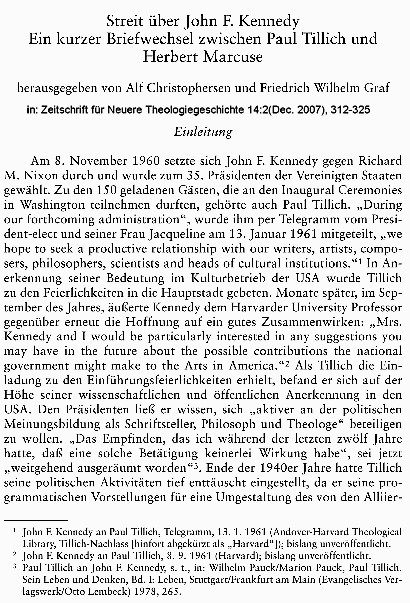
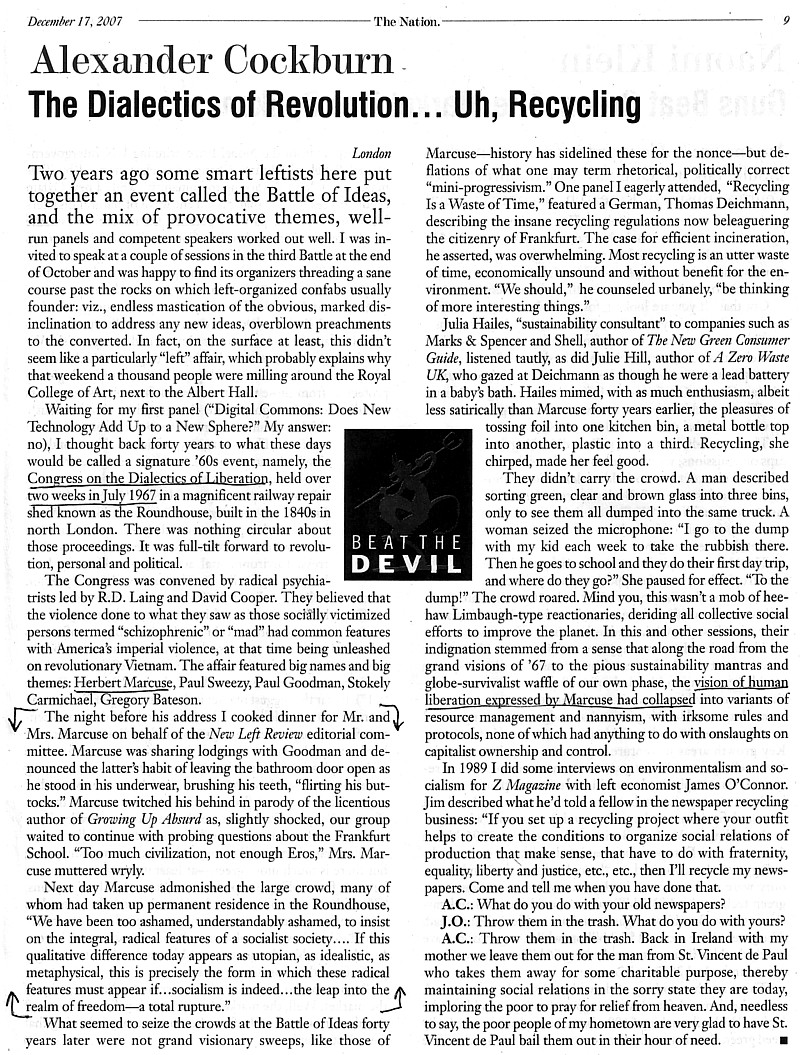
    • 12/8/07: 12/(17)/07 Nation column by Alexander Cockburn "The Dialectics of Revolution ... Uh, Recycling" (jpg scan). He includes a cute anecdote about when he cooked dinner for Herbert & Inge the night before Herbert's talk.

    • Spanish translation, see below, 1970: Sociedad Carnivora
  • 1967: Das Ende der Utopie: Vorträge und Diskussionen in Berlin 1967 (Berlin: Maikowski, 1967; Frankfurt: Neue Kritik, 1980), 190p.
    • Includes Das Problem der Gewalt in der radikalen Opposition; the 1980 German edition includes 2 additional discussions
    • German full text (scanned images)
      • For a recent discussion, see the 2006 essay by P.-E. Jansen (19page pdf)
    • English: "The End of Utopia," in: Five Lectures: Psychoanalysis, Politics, and Utopia; trans. Jeremy Shapiro and Shierry Weber (Boston: Beacon, 1970), 62-81.
      English full text with discussion, as well as The Problem of Violence
    • French: La fin de l'utopie; traduit de l'allemand par Liliane Roskopf et Luc Weibel (Paris: Le Seuil, 1968), 142 p.
      • review by Alain Revon, A, "H. Marcuse. La Fin de l'utopie," Revue française de sociologie 10:3 (juil/sept 1969), 375-377 (pdf)
    • Italian: La fine dell'utopia; traduzione de Saverio Vertone (Bari: Laterza, 1968), 176 p
    • Swedish: Protest, demonstration, revolt; Översättning av Maj och Paul Frisch (Stockholm: Aldus/Bonnier, 1968), 131 p. Translation of Das Ende der Utopie.
      "Boken bygger pa° material fra°n diskussioner vid Freie Universität i Västberlin den 10-13 juli 1967."
    • Turkish "Utopyanin sonu," translated by Dogan Baris, in the philosophical journal, Bibliothec 2(2007), 56-59. (4 page pdf)
  • 1967 "Ziele, Formen und Aussichten der Studentopposition," Das Argument, (1967): 398-408.
  • 1967 "Zum Begriff der Negation in der Dialektik," Filosoficky casopis, 15, no. 3 (1967): 375-379
    • translated by Karl Bogere as "The concept of Negation in the Dialectic," Telos, 8 (Summer 1971): 130-132.
  • 1967 "On Changing the World: A Reply to Karl Miller," Monthly Review, 19 (October 1967): 42-48.
  • 1967 "Die Gesellschaft als Kuntswerk," Neues Forum, 14 (November/December 1967): 863-866.
  • 1967 "Ist die Idee der Revolution eine Mystifikation?" Kursbuch, 9 (1967): 1-6
    • translated as "The Question of Revolution," New Left Review, 45 (1967): 3-7.
  • 1968 "The Paris Rebellion," Peace News (28 June 1968): 6-7.
  • 1968: "The People's Choice," co-author of letter to the editor of The New York Review of Books 11:3(August 22, 1968). available on-line at nybooks.com.
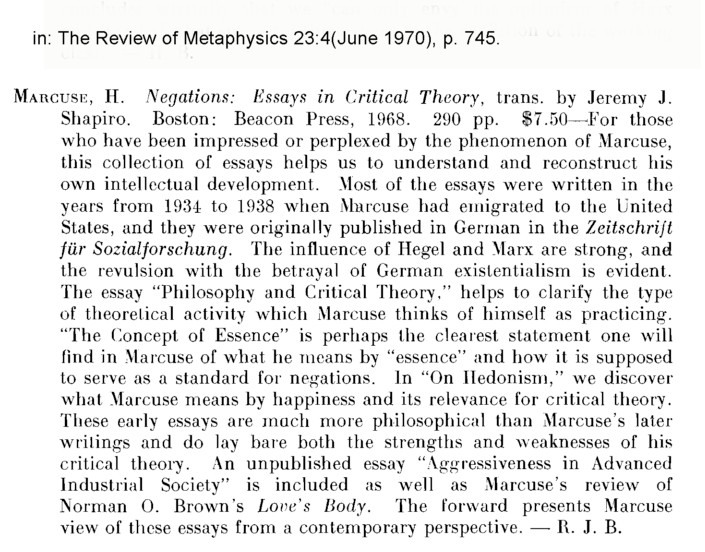
  • 1968 Negations: Essays in Critical Theory; with translations from the German by Jeremy J. Shapiro (London: Penguin, 1968; Boston: Beacon, 1969; London: Free Association, 1988), 290 p. [UCSB HM101 .M345]
    • Contents
      The struggle against liberalism in the totalitarian view of the state. [originally in: ZfS 3(1934)]
      The concept of essence (pp. 43-87). [originally in: Zfs 5(1936)]; pp. 55-62 available at autodidactproject.org
      The affirmative character of culture. [originally in: ZfS 6(1937)]
      Philosophy and critical theory (pp. 134-158). [originally in: ZfS 6(1937)]; pp. 147-154 available at autodidactproject.org
      On hedonism. [originally in: ZfS 7(1938)]
      Industrialization and capitalism in the work of Max Weber. (text in Portugese)
      Love mystified; a critique of Norman O. Brown and a reply to Herbert Marcuse by Norman O. Brown. (pdf)
      Aggressiveness in advanced industrial society
  • 1968 "Aggressivität in der gegenwärtigen Industriegessellschaft"
    • full text at wbenjamin.org; archived at marxists.org
    • in: Aggression und Anpassung in der Industriegesellschaft (Frankfurt: Suhrkamp, 1968)
      • other essays in collection:
        A. Rapoport, "Das Klasseninteresse der Intellektuellen und die Machtelite"
        K. Horn, "Über den Zusammenhang zwischen Angst und politischer Apathie"
        A. Mitscherlich, "Aggression und Anpassung"
        D. Senghaas, "Aggressivität und Gewalt: Thesen zur Abschreckungspolitik"
        M. Markovíc, "Möglichkeiten einer radikalen Humanisierung der Industriektultur"
        Bibliographische Notiz (p. 163)
    • revised and expanded version of a talk that Herbert gave in 1956 (see above) at the Chicago Psychiatric Society
    • first published in translation in Neue Rundschau 78(1967), 7-21.
    • also published in Kultur und Gesellschaft, vol. 1 (Suhrkamp, 1965)
    • review by Bernd P. Löwe (Halle) in: Deutsche Zeitschrift für Philosophie 19:9 (1971) p.1152-1159 (pdf) East German
    • Spanish: La agresividad en la sociedad industrial avanzada y otros ensayos (Madrid : Alianza Editorial, 1971), 135 p.
    • Portugese: Liberdade e agressão na sociedade tecnológica (full text)
  • 1968 Psychoanalyse und Politik (Frankfurt, Europäische Verlagsanstalt, 1968), 78 p
    • Contents: Psicoanalisis, cover
      -- Trieblehre und Freiheit. [in Frankfurter IfS (ed.), Sociologica, 1955)]
      --Die Idee des Fortschritts im Licht der Psychoanalyse.
      --Das Problem der Gewalt in der Opposition.
      --Das Ende der Utopie.
    • Spanish: Psicoanálisis y Política (Barcelona: Ediciones Península, 1968, 1969, 1973), 155 p.; prologo de Carlos Castilla del Pino
    • Portugese: A noção de progresso à luz da psicanálise (full text at antivalor)
  • 1968 "Friede als Utopie," Neues Forum, 15 (November- December 1968): 705-707.
  • 1968 "Zur Situation der Neuen Linken," Manuskript eines am 4. Dezember 1968 in New York von Herbert Marcuse gehaltenen Festvortrages.
  • 1969 "The Realm of Freedom and the Realm of Necessity: A Reconsideration," Praxis, 5, no. 1(1969): 20-25.
    • full text as page scans (includes a discussion between Herbert and Ernst Bloch
    • Turkish translation by Dogan Baris Kilinc: (5-page, 126K pdf), published in the philosophical journal Felsefe Yazýn 10(2007), 40-43.
  • 1969 "Revolutionary Subject and Self-Government," Praxis, 5, no. 2 (1969): 326-327. (full text available, also in this 7M, 7-page pdf)
  • 1969 "Nicht einfach zerstören," Neues Forum, 16 (August- September 1969): 485-488.
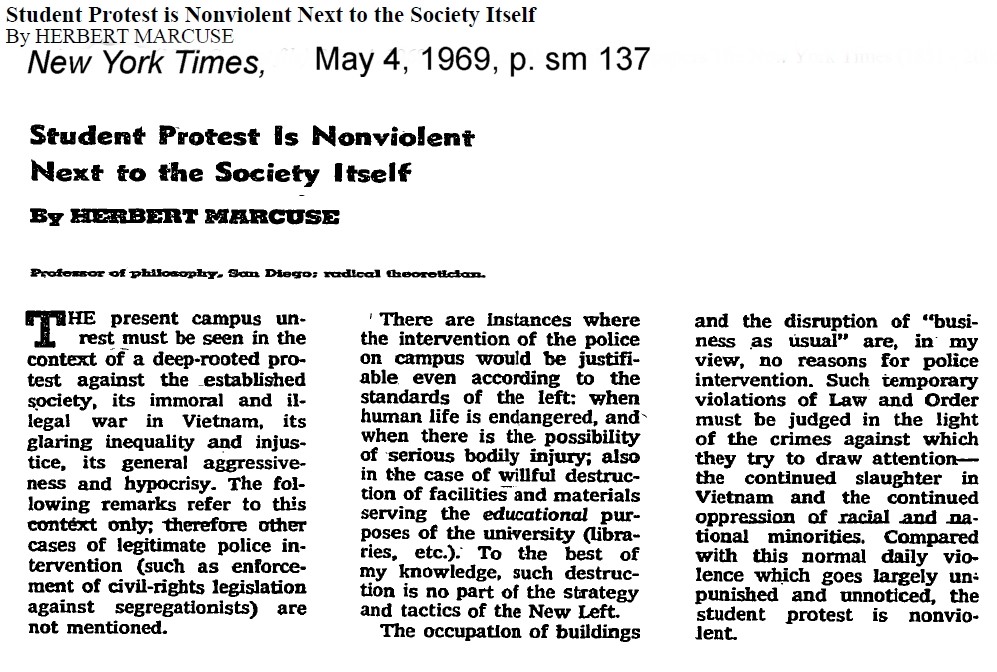
  • 1969 "Student Protest is Non-violent Next to Society Itself," New York Times Magazine (4 May 1969): 137.
  • 1969 cover of an essay on liberation"An Essay on Liberation" (Boston, 1969)
    • amazon $17 new, $7 used
    • German: Versuch über die Befreiung (Frankfurt, 1969), translated by Helmut Reinicke and Alfred Schmidt
    • French: Vers la libération: au-delà de l'homme unidimensionnel; traduit de l'anglais par Jean-Baptiste Grasset (Paris: Denoël-Gonthier,1972), 172 p.
    • mentioned in: Paul F. Power, "On Civil Disobedience in Recent American Democratic Thought," American Political Science Review 64:1(March 1970), pp. 35-47, 36f note. [jstor]
    • review: Howe, Irving, Herbert Marcuse or Milovan Djilas? The Inescapable Choice of the Next Decade," Harper's Magazine 239(July 1969), 84-90 (pdf)
    • review: MacDonald, Malcolm, Social Science Quarterly 50:3 (Dec. 1969), 768f (pdf)
    • review: Gert Müller, Zeitschrift für philosophische Forschung 26:1 (1972:Jan./März) p.122-125 (pdf)
  • 1969 Ideen zu einer kritischen Theorie der Gesellschaft (Frankfurt: Suhrkamp, 1969)(es 300)
    • collection of older worksSociedad Industrial, cover
    • Includes: "Zum Begriff der Negation in der Dialektik,"185-190
    • French translation: Pour une théorie critique de la société; traduit de l'allemand par Cornélius Heim (Paris: Denoël-Gonthier,1971), 224 p.

  • 1969 Spanish: Sociedad Industrial y el Marxismo (Buenos Aires: Editorial Quintinaria, 1969)
  • 1969 "Re-examination of the Concept of Revolution," in Marx and Contemporary Scientific Thought: Marx et la pensée scientifique contemporaine (The Hague: Mouton, 1969).
  • 1969 "On the New Left," in The New Left: A Documentary History, edited by Massimor Teodori (Indianapolis: Bobbs-Merrill, 1969), pp. 468-473. see German translation of Dec. 1968 presentation "Zur Situation der Neuen Linke," above
  • 1969, Oct: Herbert Marcuse speech in Sproul Plaza [sound recording]: University of California, Berkeley, 1969 Oct. 24. 1 sound tape reel : analog, 3 3/4 ips, 2 track ; 5 in.
    • Speech relates to Angela Davis, University of California and students' roles in society.
    • Transcript also available.
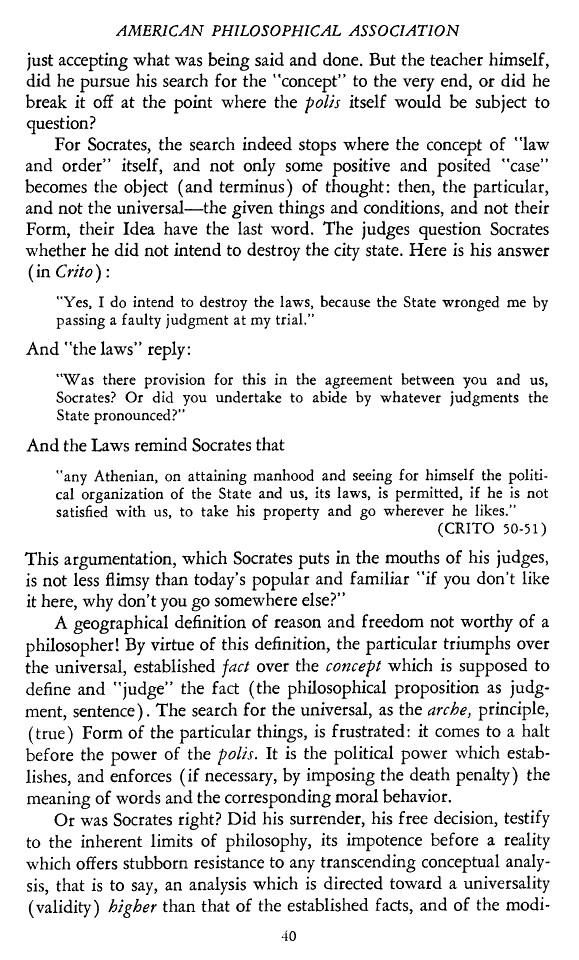
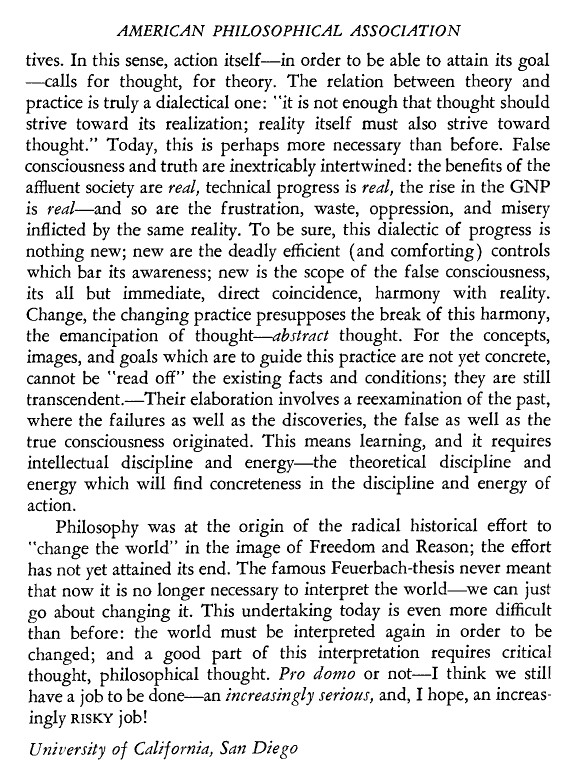
  • 1969, March: "The Relevance of Reality," presidential address to the Pacific Branch of the American Philosophical Association in Portland, OR, March 29, 1969. Published in: Proceedings and Addresses of the American Philosophical Association 42(1968), pp. 39, 40-50 (1.2M pdf)
  • 1969, July: "Marx's Concept of Revolution", New Left Review (July 1969) [Ollman]
  • 1969?: The Obsolescence of Psychoanalysis (Chicago: Black Swan Press, 1969?), 15 p [UCB][title of a lecture at the annual meeting of the American Political Science Association in 1963; published in Five Lectures in 1970, where it is listed as "previously unpublished in English".]
  • 1969: "Reflexion zu Theodor W. Adorno - Aus einem Gespräch mit Michaela Seiffe," in: Titel, Thesen, Temperamente: Ein Kulturmagazin (Hessischer Rundfunk, Abteilung Fernsehen, Kunst und Literatur), Sendung am 24. August 1969. Published in: Hermann Schweppenhäuser (ed.), Theodor W. Adorno Zum Gedächtnis: Eine Sammlung (Frankfurt: Suhrkamp, 1971), 47-51.

1970s (back to top)

  • 197x: Apocalypse or apocrypha? Herbert Marcuse, his prescription for the next world. [sound recording] Music Pub. No. Center for Cassette Studies 080-24283 (North Hollywood, Calif.: Center for Cassette Studies, [197-]) 1 sound cassette (48 min.): analog, 2 track. [GTU]
    • Marcuse delineates his neo-Marxist concepts, analyzing the utilization of existing resources by both East and West, the effects of the Third World revolution, the inevitable self-destruction of the consumer society, and the liberation of man through "social idealism."
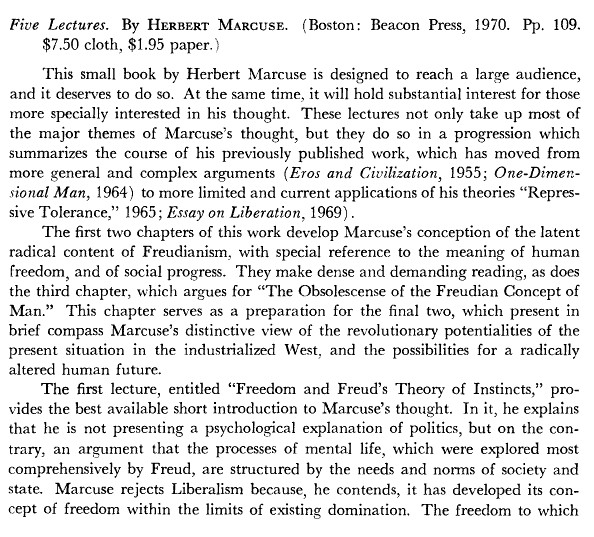
  • 1970: Five Lectures: Psychoanalysis, Politics, and Utopia. Translations by Jeremy J. Shapiro and Shierry M. Weber (Boston, Beacon Press, 1970), 109 p.
    • Four of these lectures were translated from the author's Psychoanalyse und Politik (Frankfurt, 1968).
    • Includes bibliographical references; amazon $5 used
    • Contents
      --Freedom and Freud's theory of instincts, 1-27 [1956 lecture in German, publ. 1957, 1968]
      --Progress and Freud's theory of instincts, 28-43
      --The obsolescence of the Freudian concept of man, 44-61 [1963 lecture at Am. Pol. Sci. Assoc.]
      -
      -The End of Utopia, 62-69, discussion 69-82 [1967 Berlin lecture]
      --The problem of violence and the radical opposition, 83-94, discussion 94-108 [1967 Berlin lecture]
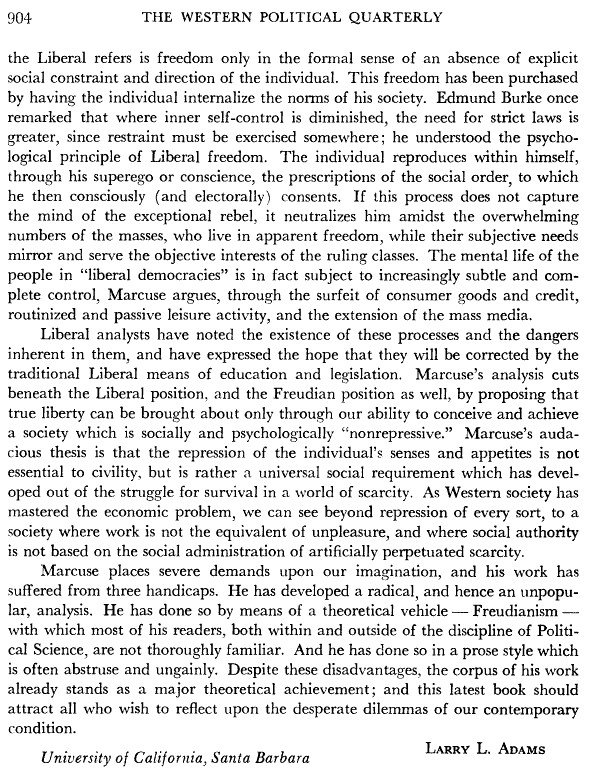
    • reviewed by Larry L. Adams in: Western Political Quarterly 23:4(Dec. 1970), pp. 903-904
    • Turkish translation of The End of Utopia, "Utopyanin sonu," by Dogan Baris Kilinc, in the philosophical journal, Bibliothec 2(2007), 56-59. (4 page pdf)
    • review: Eliseo Vivas, "By and On Marcuse"Modern Age 15:1 (1971:Winter), 80-89 (pdf) review of Five Lectures and books by MacIntyre and Robert Marks.
  • 1970: "Art as a Form of Reality," in: Fry, Edward (ed.), On the Future of Art (New York: Viking, 1970). Republished in New Left Review in 1972, see below Sociedad Carnivora, cover
  • 1970 Spanish: Sociedad Carnívora (Buenos Aires: Editorial Eco Contemporáneo, 1970). Contains the four articles:
    • "Liberándose de la sociedad opulenta"
    • "La rebelión de Paris"
    • "Perspectivas de la nueva izquierda radical"
    • "Exijamos lo imposible".
  • 1970: "Marxism and the New Humanity: An Unfinished Revolution," in Marxism and Radical Religion: Essays Toward a Revolutionary Humanism, edited by John C. Raines and Thomas Dean (Philadelphia: Temple University Press, 1970), pp. 3-10.
  • 1970 "Only a Free Arab World Can Co-exist with a Free Israel," Israel Horizons (June-July 1970): 17.
  • 1970: "Humanismus--gibt's den noch?" Neues Forum, 17 (April 1970): 349-353.
  • 1970 Leo Lowenthal and Norman Gutermann, Prophets of Deceit: A Study of the Techniques of the American Agitator, foreword by Marcuse (Palo Alto, Cal.: Pacific Books, 1970). [from MacKey]
  • 1970: According to an article in the Nov. 1970 Triton Times (student newspaper of the University of California at San Diego) Herbert did NOT write "Riot and Representation: The Significance of the Chicano Riot," which was published under his name. article & disavowal
  • 1971: "Aggression: Das dritte Gespräch," interview with Friedrich Hacker on Dec. 9, 1970
    • published in Friedrich Hacker (1914-), Aggression: Die Brutalisierung der modernen Welt. with a foreword by Konrad Lorenz (Vienna, Munich, Zurich: Molden, 1971), 345-359; (Hamburg: Rowohlt, 1973).
    • discusses offensive and defensive aggression
  • 1971: "The Concept of Negation in the Dialectic," notes, in Telos no. 8 (Summer 1971)
  • 1971: Per una nova definicio de la cultura (Barcelona: Edicions 62, [Oct] 1971), 76 p
  • 1971: Letters to Chicago Surrealists, October 1971-March 1973, published by Franklin Rosemont in: Arsenal 4(1989), 31-38, 39-47.
  • 1971 "Dear Angela," Ramparts, 9 (February 1971): 22.
  • 1971 "The Movement in a New Era of Repression: An Assessment," Berkeley Journal of Sociology, 16 (1971-1972): 1-14.
  • 1971 "Charles Reich as Revolutionary Ostrich," in The Con III Controversy: The Critics Look at The Greening of America, edited by Philip Nobile (New York: Pocket Books, 1971), pp. 15-17. (full text)
    • Ralph Dumain offer the following commentary: "This review was published in a book of criticism of Charles Reich's THE GREENING OF AMERICA. I don't know how many of you are old enough--or I presume American--to remember this awful pop intellectual explanation of the countercultural rebellion of the '60s. (I had an English teacher who claimed he was Consciousnes III, I think because he rode a bicycle, whereas I thought he was still struggling to master Consciousness I.) While Marcuse's essay is a fairly superficial knock-off, it does occasion a remembrance of the competing ideologies of the time, and especially the lite middlebrow fare peddled to the liberal educated middle class, which should serve as a reminder of what kind of literature the culture industry enables for a popular audience. I'm not sure who the first pop intellectual was--I do remember being nauseated by Marshall McLuhan before Reich, Roszak, and others came along. I think pop intellectuals bear some ideological scrutiny, though times have indeed changed and the winds of fashion are blowing their farts in different directions. Pop intellectual products fashioned for middlebrow audiences are revealing of the forces of commodification, fetishism, ideology, mystification, and fragmentation affecting the intelligentsia. Critique itself becomes commodified, not just in terms of marketing but in intellectual content. The more superficial it is, the more it mimics the ideological forms of appearance of its object, the easier it is to generate as well as to sell. It provides us one more layer we have to cut through. Sometimes two, as with Curtis White's THE MIDDLE MIND, a piece of crap that mimics the very middlebrow culture it excoriates.
      As you may recall, Marcuse also faced off against more serious scholars hawking a mystical view of cultural revolution, such as Norman O. Brown, who wrote a serious book, LIFE AGAINST DEATH, with a panoramic vision in competition with EROS AND CIVILIZATION, and a bunch of crap much later on.
  • 1972: Studies in Critical Philosophy; translated [from the German and French] by Joris de Bres (London: NLB, 1972), 227 p.
    • Contents
      -The foundation of historical materialism. [1932 article, discussed by Raya Dunayevskaya in her: Rosa Luxemburg, Womens's Liberation, and Marx's Philosophy of Revolution (New Jersey : Humanities Press, 1982; Berlin: Argument, 1998), p. 81 (scan of page)]
      -A study on authority.
      -Sartre's existentialism.cover of counterrevolution and revolt
      -Karl Popper and the problem of historical laws.
      -Freedom and the historical imperative
    • review by Doniela, W. V, Australasian Journal of Philosophy, 51 (1973), 267-269 (pdf)
  • 1972: Counterrevolution and Revolt
    • outlines aspects of liberation in politics, culture and nature and how liberation is forestalled
    • amazon $18.50 new, $8 used
    • French translation: Contre-révolution et révolte; traduit de l'anglais par Didier Coste (Paris: Le Seuil, 1973), 172 p.
  • 1972, January 2: :Jerusalem Post, "Das ist noch Utopie"
  • 1972 "Art as a Form of Reality," New Left Review 74(1972),
  • 1972 "Art in the One-Dimensional Society," in Radical Perspectives in the Arts, edited by Lee Baxandall (Harmondsworth, U.K.: Penguin, 1972), pp. 53-67.
  • 1972: From Luther to Popper; translated by Joris de Bres (London : NLB, 1972; London: Verso Editions, 1983), 227 p.
  • 1972: The defense of Gracchus Babeuf before the High Court of Vendome, edited & translated by John Anthony Scott; with an essay by Herbert Marcuse & illustrations by Thomas Cornell. (New York: Schocken, 1972), 112 p.
  • 1972: "Uma nova ordem" [A New Order] Portugese on the antivalor site
  • 1972: "A Reply to Lucien Goldmann," Partisan Review, 38 (Winter 1971-1972): 397-400.
  • 1972: "Art and Revolution," Partisan Review, 39 (Spring 1972): 174-187.
  • 1973: "When Law and Morality Stand in the Way," Society, 10 (September-October 1973): 23-24.
  • 1973: Herbert Marcuse, Alfred Schmidt, Existentialistische Marx-Interpretation (Frankfurt: Europäische Verlagsanstalt, 1973), 142 p.
  • 1973 "A Revolution in Values," in Political Ideologies, edited by James A. Gould and Willis H. Truitt (New York: Macmillan, 1973), pp. 331-336.
  • 1974: "Marxism and Feminism," Women's Studies, 2, no. 3 (1974): 279-288.Calas, cover
  • 1975: Zeit-Messungen: Drei Vorträge und ein Interview (Frankfurt: Suhrkamp, 1975, 1978), 68p
    • includes translation "Marxismus und Feminismus," revised version of a lecture held on March 7, 1974 at the Center for Research on Women at Stanford University.
    • French: Actuels (Paris: Éditions Galilee, 1976), 102 p.
    • also in Schriften, Bd. 9.
    • Spanish: Calas en nuestro tiempo (Barcelona: Icaria, 1976), 106 p
      Contents: Marxismo y feminismo.--Teoría y praxis.--La nueva izquierda.--Una entrevista. USA: Cuestión de organización y sujeto revolucionario
  • 1976: "Un nouvel ordre," Le Monde Diplomatique, 268 (June 1976).
  • 1976: response, in Simon Wiesenthal, The Sunflower, with a Symposium (New York: Schocken, 1976), 169. cover of wiesenthal, the sunflower
  • 1977: Die Permanenz der Kunst: Wider eine bestimmte marxistische Ästhetik: Ein Essay (Munich: Hanser, 1977), 77 p
  • 1977: "Mord darf keine Waffe der Politik sein," in: Die Zeit Nr. 39(16. September 1977).
    • translated by Jeffrey Herf as "Murder is Not a Political Weapon," New German Critique, 12 (Fall 1977): 7-8. (pdf)
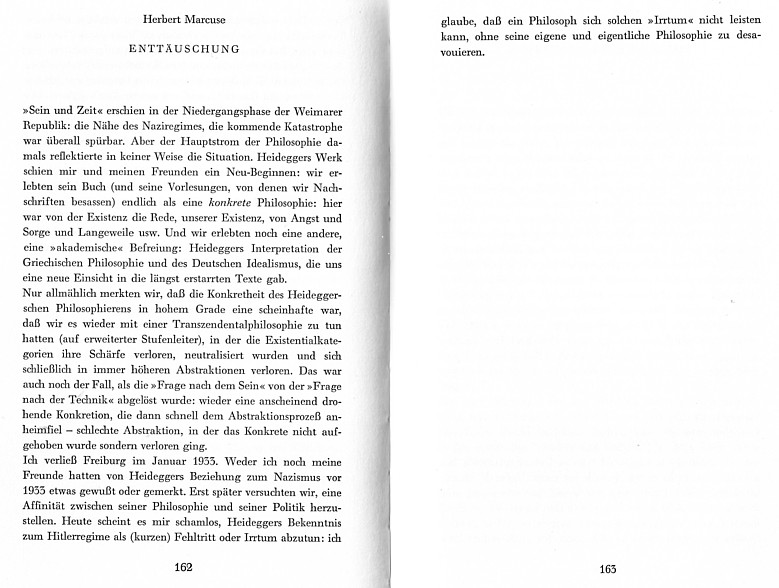
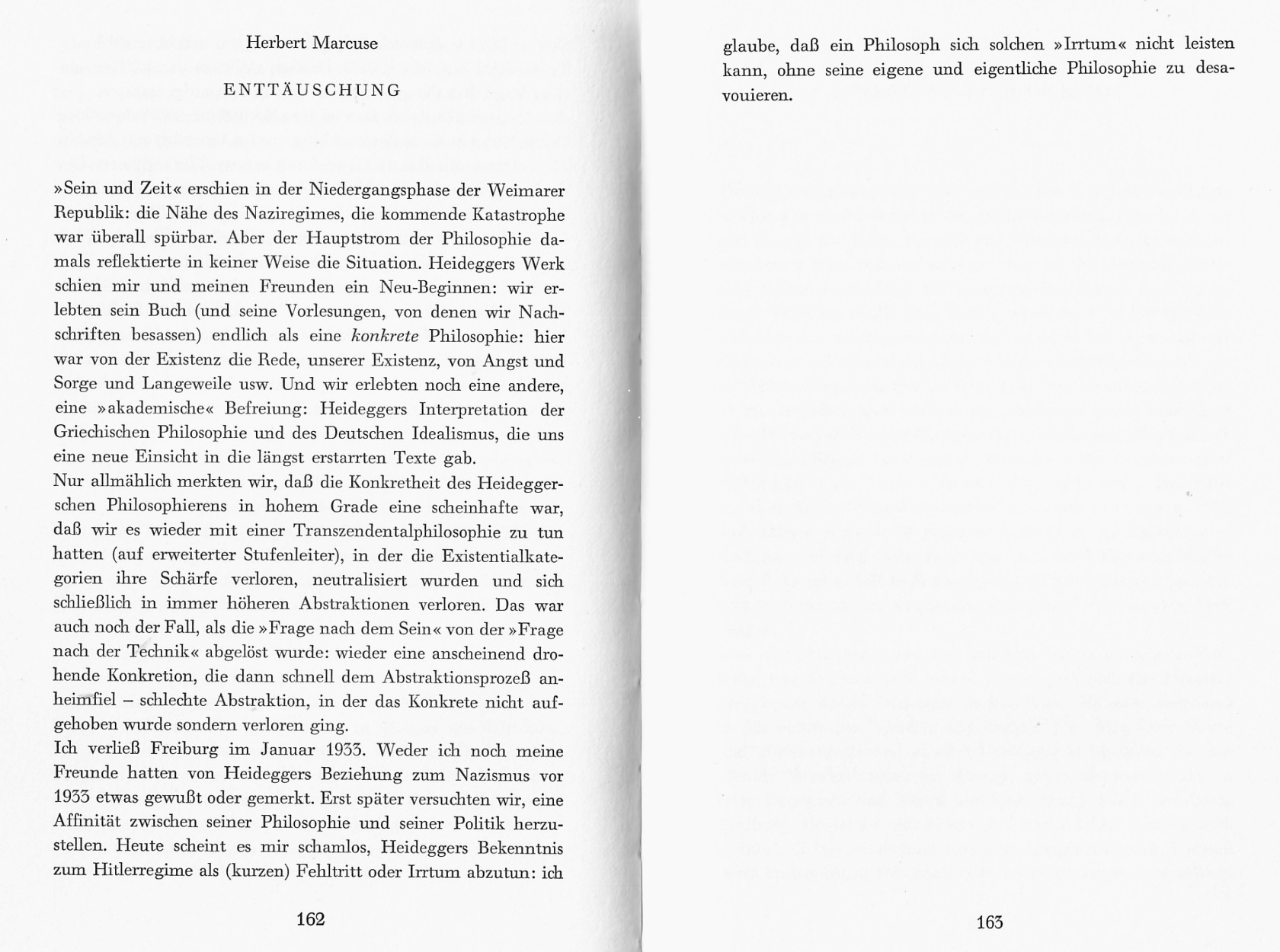
  • 1977 "Enttäuschung," in Erinnerung an Martin Heidegger, edited by Gunther Neske (Pfullingen: Neske, 1977), pp. 162-163. (scan, hi-res version)
  • 1978: Thumbnail of book jacket, The Aesthetic DimensionThe Aesthetic Dimension: Toward a Critique of Marxist Aesthetics  (Boston: Beacon, 1978), 88 pages.
    • expanded translation of Permanenz der Kunst (1977)
    • $13 on amazon. Reader Elliott Green (German major at Princeton, MPhil student in Development Studies at the London School of Economics) wrote on Amazon: "Herbert Marcuse, original member of the so-called 'Frankfurt School', here presents a critique of Marxist aesthetics in one of his last books. Although only 72 pages long, the book is powerful in its argument against the orthodox Marxist view that 'art represents its the interests and world outlook of particular social classes.' Marcuse argues for the importance of art in itself, apart from its source, writing, 'the criteria for the progressive character of art are given only in the work itself as a whole: in what it says and how it says it.' He truly believes that art's place in the world is not to change the world directly but to influence how people perceive the world and thereby lead them to change it. Marcuse also touches upon other aspects of aesthetics, like his belief in a constant standard allowing us to distinguish between high and low art and the question of the 'end of art' as posited by Bertolt Brecht and others. La dimensione estetica italian editioncover of dimension esthetiqueNevertheless his main argument is most powerful: he ends the book by praising art's role in representing 'the ultimate goal of all revolutions: the freedom and happiness of the individual.' Truly a valuable book for all students of art, aesthetics and philosophy."
    • French: La dimension esthétique amazon.fr €12.50
    • Italian: La dimensione estetica e altri scritti: un'educazione politica tra rivolta e trascendenza (Milano: Guerini, 2002) €24.50 at librariauniversitaria.it
    • Reviews
      • E.F. Kaelin, review, in: Art Journal 41:2 (1981:Summer) p.183-188 (pdf)
      • David Kettler, "A Note on the Aesthetic Dimension in Marcuse's Social Theory," in: Political Theory 10:2(May 1982), pp. 267-275 [jstor]
      • Hartwick, Larry. "On The Aesthetic Dimension: A Conversation with Herbert Marcuse," Contemporary Literature, vol. 22, no. 4, Fall 1981, pp. 416-424.
        "This interview, conducted in 1978, originally appeared in a locally distributed publication at the University of California, San Diego." (citation courtesy of Ralph Dumain)
    • 1978: Gespräche mit Herbert Marcuse. (Edition Suhrkamp, 1978, 2002)
      • amazon.de €3 Conversationes, coverThumbnail of book jacket, Gespräche mit Herbert Marcuse
      • Contents:
        • Theorie und Politik  (July 1977 in Starnberg, with Habermas, Heinz Lubasz, and Tilman Spengler)
        • Weiblichkeitsbilder  (July 1977 in Pontresina, Switzerland [Herbert's favorite vacation spot], with Silvia Bovenschen and Marianne Schuller)
        • Salecina  (1975 interview and summer 1977 conversation with Erica Sherover (Herbert's third wife), Berthold Rothschild, Theo Pinkus)
        • Radikale Philosophie: Die Frankfurter Schule  (undated BBC broadcasts, with Lubasz, Alfred Schmidt, Karl Popper, Ralf Dahrendorf, Rudi Dutschke)
        • "So sieht in der bürgerlichen Gesellschaft der Fortschritt aus..."  (Nov. 1977 in La Jolla, with Hans Christoph Buch).
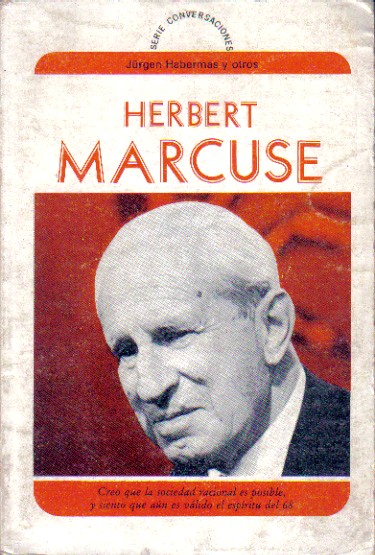
      • Spanish: Conversaciones con Herbert Marcuse (Editorial Gedisa, 1980)
  • 1978: "Protosozialismus und Spätkapitalismus," in: kritik - Zeitschrift für sozialistische Diskussion, 6:19(1978). full text at opentheory.org; print version; link from coforum.de
    Web: http://www.opentheory.org/marcuse_ueber_bahro/
    • Kurz nach dem Erscheinen von Rudolf Bahros »Die Alternative. Zur Kritik des real existieren den Sozialismus« (Köln/Frankfurt 1977) veröffentlichte Herbert Marcuse den hier dokumentierten Aufsatz zu Bahros Werk
      .
  • 1979: Studentenbewegung: Und was danach? by Marcuse and others, Argument Studienhefte, no. 30 (Berlin: Argument Verlag, 1979).
  • 1979 "Die Ideologie des Todes," in: Hans Ebeling (ed.), Der Tod in der Moderne (Frankfurt, 1979), 106-115.
  • 1979 "Failure of the New Left," New German Critique, 18 (Fall 1979): 3-11.
  • 1979 "The Reification of the Proletariat," Canadian Journal of Political and Social Theory, 3 (Winter 1979): 20-23.
  • 1979: "Protosozialismus und Spätkapitalismus: Versuch einer Revolutionstheoretischen Synthese von Bahros Ansatz," Kritik, 6:19 (Berlin, 1979[1978?]), 5-27
    • full German text on-line at opentheory.org
    • translated as "Protosocialism and Late Capitalism: Toward a Theoretical Synthesis"
    • response to: Rudolf Bahro, Die Alternative. Zur Kritik des real existieren den Sozialismus (Köln/Frankfurt 1977)(Heft Nr. 19, 6. Jahrgang, 1978)
    • Based on Bahro's Analysis" in Rudolf Bahro: Critical Responses, edited by Ulf Wolter (White Plains, N.Y.: M. E. Sharpe, 1980), pp. 25-48. [also published in M.E. Sharpe's Journal for International Politics, 1980]
  • 1979: "Die Angst des Prometheus," in tageszeitung (31 July 1979)[shortly after Herbert died]

Posthumously published works Heideggerian Marxism, (back to top)

  • Herbert Marcuse, Heideggerian Marxism, edited by Richard Wolin and John Abromeit (Univ. of Nebraska Press, 2005), 288 pages.


    Publisher's blurb: Marcuse studied with Martin Heidegger at Freiburg University from 1928 to 1932 and completed a dissertation on Hegel’s theory of historicity under Heidegger’s supervision. During these years, Marcuse wrote a number of provocative philosophical essays experimenting with the possibilities of Heideggerian Marxism. For a time he believed that Heidegger’s ideas could revitalize Marxism, providing a dimension of experiential concreteness that was sorely lacking in the German Idealist tradition. Ultimately, two events deterred Marcuse from completing this program: the 1932 publication of Marx’s early economic and philosophical manuscripts, and Heidegger’s conversion to Nazism a year later. Heideggerian Marxism offers rich and fascinating testimony concerning the first attempt to fuse Marxism and existentialism.
    These essays offer invaluable insight concerning Marcuse’s early philosophical evolution. They document one of the century’s most important Marxist philosophers attempting to respond to the “crisis of Marxism”: the failure of the European revolution coupled with the growing repression in the USSR. In response, Marcuse contrived an imaginative and original theoretical synthesis: “existential Marxism.”
    (publisher's page; $35 on amazon-after Nov. 30, 2005) [back to 1920s publications]

Collected Papers [different than Collected-published Works] (back to top)

cover of herbert marcuse papers volume 2
cover of Marcuse papers, volume 3


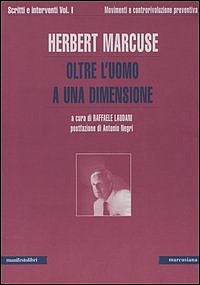
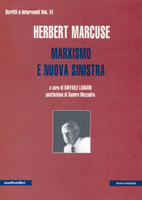
Laudani, Olte L'uomo a una dimensionePsicanalisi coverLaudani, Marxismo nuova sinistra cover

Art and Liberation, book covercover of nachgelassene schriften volume 1cover of nachgelassene schriften volume 1cover of nachgelassene schriften volume 1 cover of Nachgelassene Schriften, volume 4cover of Nachgelassene Schriften, volume 5


Collected Works (back to top)

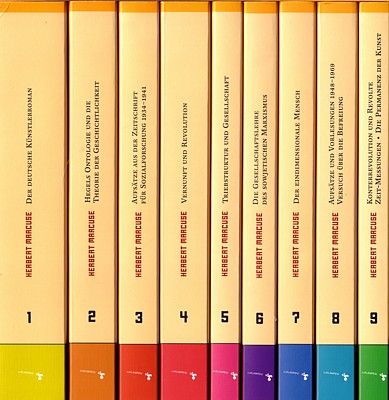
  • Gesammelte Schriften 2004 edition of collected works(Collected Works in nine volumes): new paperback edition issued on the 25th anniversary of Herbert's death in July 2004.
    • Cost: 98 Euros.
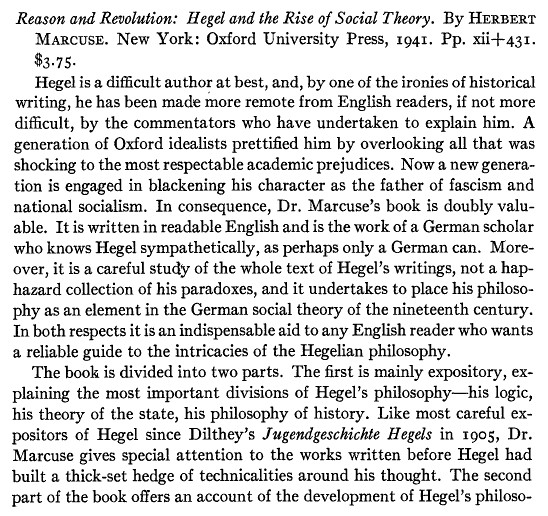
    • In July, on the 25th anniversary of Herbert's death, zu Klampen publishers reissued Herbert's collected works in paperback.
    • publisher's page
    • Schriften in 9 Bänden; Paperback, im Schuber; €98,00; ISBN 3934920462
    • Band 1: Der deutsche Künstlerroman. Frühe Aufsätze, 594 S.
      Band 2: Hegels Ontologie und die Theorie der Geschichtlichkeit, 368 S.
      Band 3: Aufsätze aus der Zeitschrift für Sozialforschung 1934-1941, 320 S.
      Band 4: Vernunft und Revolution. Hegel und die Entstehung der Gesellschaftstheorie, 399 S.
      Band 5: Triebstruktur und Gesellschaft. Ein philosophischer Beitrag zu Sigmund Freud, 232 S.
      Band 6: Die Gesellschaftslehre des sowjetischen Marxismus, 260 S.
      Band 7: Der eindimensionale Mensch. Studien zur Ideologie der fortgeschrittenen Industriegesellschaft, 282 S.
      Band 8: Aufsätze und Vorlesungen 1948-1969, 319 S.
      Band 9: Konterrevolution und Revolte; Zeit-Messungen; Die Permanenz der Kunst, 241 S.
    • Oct. 11, 2004 Deutschlandfunk review by Karin Beindorff.

Other Collections (back to top)

  • UCSD Library Special Collections
    • Elliott, Robert C. (1914-), Papers, 1946-1981
    • Hawkins, Helen S, Collection, 1974-1987; interview conducted for KPBS
    • Urey, Harold Clayton (1893-), Papers, 1928-1981, bulk 1958-1978
    • x
  • UCLA, UCB
    • Higgs, DeWitt A. (1907-), Oral history interview with DeWitt A. Higgs ... oral history transcript, 1991 by Dale E. Treleven, 367 leaves, bound
      Transcript of a ten-and-a-half-hour interview completed under the auspices of the Oral History Program, University of California, Los Angeles, and the California State Archives, State Government Oral History Program.
      Higgs discusses his family background, education, entrance into and development of his law practice and firm, and appointment to the University of California Board of Regents. He focuses on numerous policy issues that came before the Board during his tenure from 1966-1982, such as system-wide campus expansion, student dissent, and administrative leadership, with particular focus given to the University of California, San Diego.
  • x

hits since Nov. 2, 2005


1 on 11/2/05
1400 on 1/1/06=23/day
2550 on 2/20/06=22.5/day
2690 on 2/26/06=23/day
4085 on 4/22/06=25.4/day
5245 on 6/21/06=19/day
9400 on 12/31/06=22/day
8000=22/day in 2006
9665 on 1/16/07=16.5/day
16,840 on 12/31/07=20.6/day
7440=20.4/day in 2007
28,133 on 6/9/09=39.2/day
31,489 on 1/4/10=16.2/day

page created by H. Marcuse on Jan. 1, 2005; last updated: see header
back to top; Herbert Marcuse homepage