2010 (back
to top)
- 2010: John Abromeit, "The Limits of Praxis: The Social-Psychological Foundations of Theodor Adorno’s and Herbert Marcuse’s Interpretations of the 1960s Protest Movements," in: Belinda Davis et al (eds.), Changing the World, Changing Oneself: Political Protest and Collective Identities in West Germany and the U.S. in the 1960s and 1970s (Berghahn, 2010), chapter 2. E183.8.G3 C347 2010
- 2010: John Abromeit, "Left Heideggerianism or Phenomenological Marxism? Reconsidering Herbert Marcuse's Critical Theory of Technology," in: Constellations 17:1(March 2010), 87–106. (20 page pdf)
- 2010: Rodney Fopp, "'Repressive Tolerance': Herbert Marcuse’s Exercise in Social Epistemology," in: Social Epistemology: A Journal of Knowledge, Culture and Policy 24:2(2010), 105-122. (doi)
- Abstract: When Herbert Marcuse’s essay titled “Repressive tolerance” was published in the mid-1960s it was trenchantly criticised because it was anti-democratic and defied the academic canon of value neutrality. Yet his argument is attracting renewed interest in the 21st century, particularly when, post 9/11, the thresholds or limits of tolerance are being contested. This article argues that Marcuse’s original essay was concerned to problematise the dominant social understandings of tolerance at the time, which were more about insisting that individual citizens tolerate government policy than governments encourage debate and dissent. The article shows how Marcuse attempted to demonstrate the social production of knowledge about tolerance, and how he diagnosed the social function performed by “impartiality” and “relativism,” and by “neutrality” and “objectivity,” which contributed to tolerance being repressive. In the sense that he was concerned about what counted socially as tolerance, and how it was socially defended and justified, his article can helpfully be conceived as an exercise in social epistemology.
- 2010: Giacomo Francini, "Die Frage nach der Technik von Martin Heidegger und die technologische Rationalität nach Herbert Marcuse: Die Ansichten zweier kontroverser Wissenschaftskritiker" (Studienarbeit, 2009, Zurich), 15 pages (Grin Verlag page; google books preview)
- 2010:
Dimitri Ginev,
"Levinas, Benjamin, Agamben, Marcuse The Erotic Attitude Toward Nature and Cognitive Existentialism," in: Telos 152(Fall 2010), 145-160.
- Editorial: "Dimitri Ginev takes a new look at Herbert Marcuse's search for a new science, and he shows how the development of non-instrumental, dialogic, and erotic relations to nature, especially in contemporary ecosystems ecology, inherits Marcuse's utopian search. We should however also ask what resonates between the hermeneutic critique of science and the hesitations on the part of religion toward the scientific worldview. Such a connection, between religion and other critiques of science, is hardly counterintuitive."
- Excerpt: "I. Marcuse's "New Science": In his celebrated critique of "technological rationality," Herbert Marcuse pleads for a "new science" in which an "erotic" attitude toward nature would permit the entities of the natural world to transform in such a manner that they become free to be what they are. Following this line of reasoning in Eros and Civilization, he reaches the conclusion: "To be what they are they depend on the erotic attitude: they receive their telos only in it."1 In addition, the erotic attitude will reveal aesthetic qualities inherent in nature. This view implies a revolutionary change..."
- pdf of full text available for $5 at telos website
- 2010 Molly Hite, "'Fun Actually Was Becoming Quite Subversive': Herbert Marcuse, the Yippies, and the Value System of 'Gravity's Rainbow'," in: Contemporary Literature 51:4 (Winter 2010), pp. 677-702.
- Richard V. Kahn, Critical Pedagogy, Ecoliteracy, and Planetary Crisis: The Ecopedagogy Movement (New York: Peter Lang, 2010) has extensive discussions of Herbert's work over 36 namings (according to a google books search). Here's a sample:
p. 22: "Recently, Latin American tehorists of ecodedagogy have begun to connect their work to the critical theory of Herbert Marcuse *Magelhaes, 2004; Delgado, 2005) ... . As recent critical readers on marcuse assert (Kellner, Lewis, Pierce & Cho, 2008; Abromeit & Cobb, 2004), ecological politics were an important aspect of Marcuse's revolutionary critique, and he should be considered a central theorist of the relationship between advanced capitalist society and the manifestation of ecological crisis."
- 2010 Thomas Marx, Herbert Marcuse, die Triebstruktur, die Gesellschaft und die 68er Bewegung [2006 Seminararbeit, Jena] (Grin Verlag, 2010), 16 Seiten (Grin Verlag page; google books preview)
- 2010 Tim B. Müller,
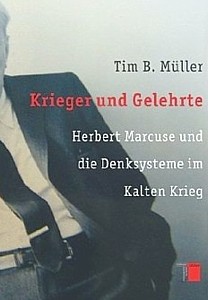 Krieger und Gelehrte: Herbert Marcuse und die Denksysteme im Kalten Krieg (Hamburger Edition, 2010), 736 Seiten Krieger und Gelehrte: Herbert Marcuse und die Denksysteme im Kalten Krieg (Hamburger Edition, 2010), 736 Seiten
- EUR 35/25 at amazon.de
- Perlentaucher page summarizes a 24 Sept. 2010 review in Frankfurter Rundschau by Rolf Wiggershaus, titled "Dialektik der Aufklärung"
- review by Detlef Claussen,"Herbert Marcuse als CIA-Agent," (TAZ, Feb. 8, 2011). Claussen likes Müller's reading of Herbert's 1950s books (Reason & Rev; Eros & Civ; Soviet Marxism), but says he misinterprets the CIA connection in order to sensationalize it.
- Jacket text: "Was haben linke Intellektuelle wie Herbert Marcuse, Otto Kirchheimer und Franz Neumann mit den amerikanischen Geheimdiensten zu tun? Anfang der 1940er Jahre nimmt eine Gruppe linksintellektueller Emigranten zusammen mit ihren amerikanischen Kollegen, u.a. den Historikern Stuart Hughes und Carl Schorske oder dem Soziologen Barrington Moore, ihre Arbeit für den amerikanischen Kriegsgeheimdienst, das Office of Strategic Services (OSS), auf. Der demokratische Sozialismus der Emigranten verbindet sich mit dem Linksliberalismus der "New Deal"-Denker, was sich zu Beginn des Kalten Krieges in Forschungs- und Strategiepapieren niederschlägt, die im US-Außenministerium gegen die Blockkonfrontation opponieren und für eine Entspannungspolitik optieren. Am Anfang geht es um das nationalsozialistische Deutschland, nach Kriegsende weitet sich der Einsatz auf das gesamte Europa und die Sowjetunion aus. Die Arbeit der linken Denker findet Anerkennung, personelle Netzwerke entstehen. Sie erschließen der Gruppe im Kalten Krieg institutionelle Ressourcen, die ihnen entweder den Weg in die universitäre Welt der Vereinigten Staaten bahnen oder die Fortsetzung ihrer Forschung unter dem Schirm der Rockefeller-Stiftung ermöglichen, häufig in verdeckter oder offener Kooperation mit dem State Department und auch der CIA. Sind vielleicht sogar Kontinuitäten zwischen Marcuses geheimdienstlicher Gegnerforschung und seiner Kritik der westlichen Moderne, die er seit Beginn der 1960er Jahre radikalisierte, zu entdecken?"
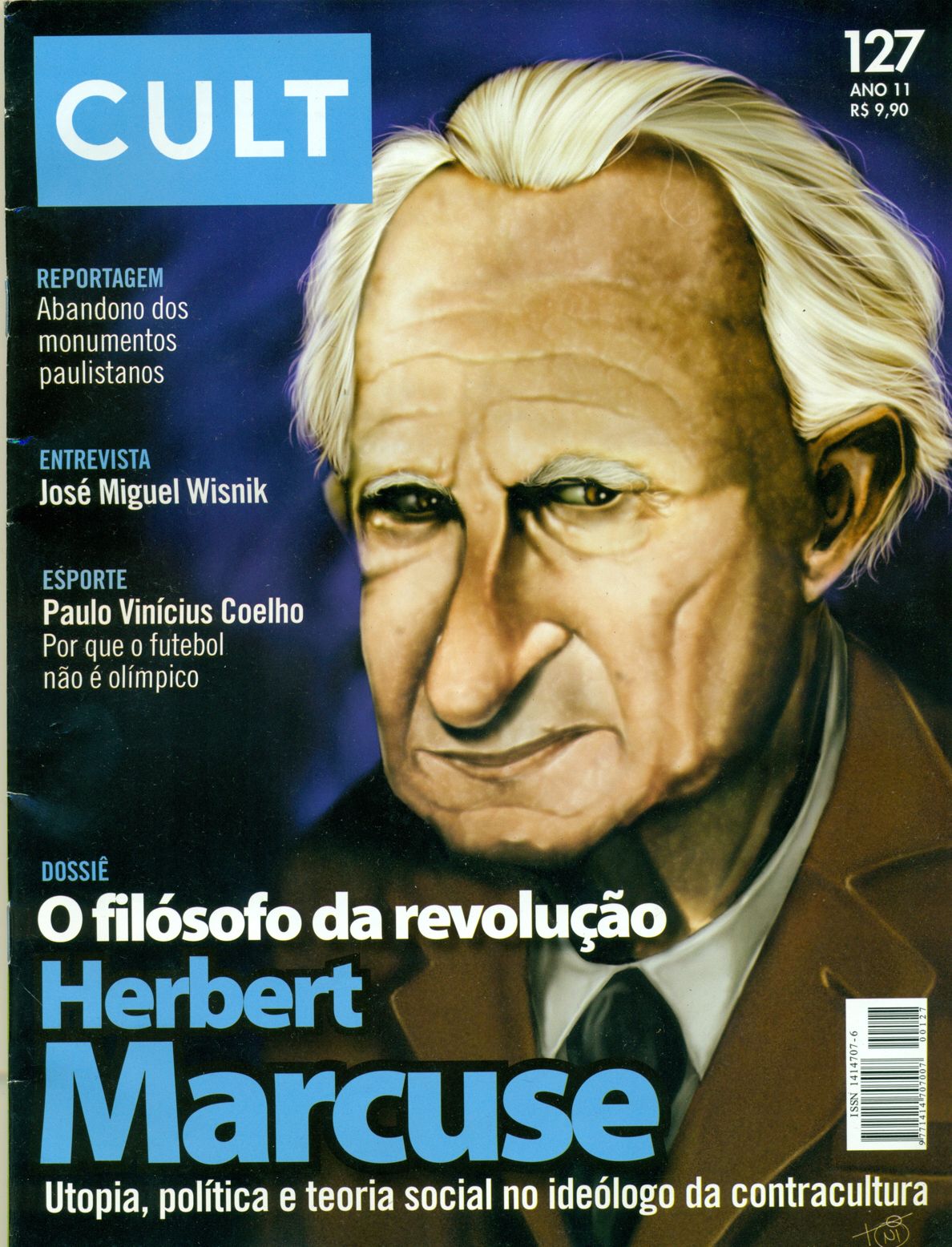
- 2010 Portuguese: Robespierre de Oliveira, "A dialética da libertação: contracultura e sociedade unidimensional," in: CULT (Nov. 17, 2010)
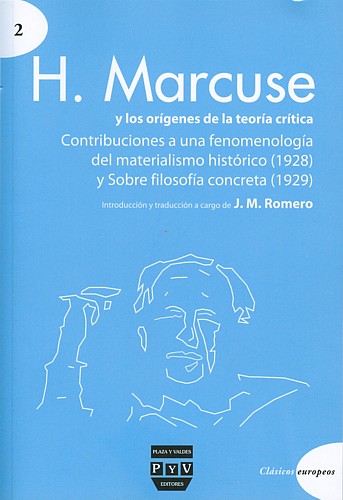
- 2010 Spanish: Jose Manuel Romero, H. Marcuse y los origenes de la teoria critica/ H. Marcuse and the Origins of Critical Theory: Contribuciones a una fenomenologia del materialismo historico(1928) sobre la filosofia concreta(1929)/ Contributions to a Phenomenology of Historic (Plaza y Valdes Editores, 2010), 164 pages. (google books page)
- 2010: Christopher Swift, "Herbert Marcuse on the New Left: Dialectic and Rhetoric," in: Rhetoric Society Quarterly 40:2(26 March 2010), 146-171.
- Abstract: Herbert Marcuse's relationship to the student-activists of the 1960s not only required a different form of discourse from that of his colleague, Theodor W. Adorno, but also indicated the range of conditions that govern political discourse in the academy. Whereas Adorno restricted his political activity almost exclusively to the pursuit of dialectical theory, Marcuse's insistence upon speaking to audiences of activists occasioned a contemporary manifestation of ancient debates over the discursive forms of rhetoric and dialectic. This essay analyzes two different kinds of discourses: (1) a dialectical conversation between Marcuse and Adorno, and (2) a rhetorical address that Marcuse presented to activists. Taken together, these texts reveal the dependence of the academy on more than one form of discourse and suggest that even under our contemporary circumstances, the ancient categories of rhetoric and dialectic continue to operate as counterparts.
- 2010 Italian: G. Battista Vaccaro, Antropologia e utopia. Saggio su Herbert Marcuse (Mimesis, 2010)
- 2010: Hanning Voigts, Entkorkte Flaschenpost: Herbert Marcuse, Theodor W. Adorno und der Streit um die Neue Linke (Berlin: Lit, 2010), 197 pages, bib. pp. 185-197.
- 2010: Emil Walter-Busch, Geschichte der Frankfurter Schule : kritische Theorie und Politik ( München: Fink, 2010), 262 pages, bib. pp. 245-255.
2011 (back
to top)
- 2011: Philosophy, Psychoanalysis and Emancipation [electronic resource] Marcuse, Herbert, 1898-1979 (London/New York : Routledge, 2011).
- 2011: Frank Biess, "Gewalt der Toleranz, Toleranz der Gewalt: Herbert Marcuse: Repressive Toleranz (1965)," in: Gewalt und Gesellschaft: Klassiker modernen Denkens neu gelesen: Bernd Weisbrod zum 65. Geburtstag (Wallstein, 2011), 285-293. (5 page pdf)
- 2011: Richard C. Box, "Marcuse Was Right: One-Dimensional Society in the Twenty-First Century," Administrative Theory & Praxis 33:2(2011),
169-191.
- Abstract: The concept of one-dimensionality identified oppressive characteristics of societies in the 1960s, suggesting that they could intensify over time until few people are able to imagine alternatives. This concept and its related body of work are largely forgotten today, associated with a time and set of circumstances that have passed. This article argues that instead of disappearing, onedimensionality has matured and become commonplace, fulfilling Marcuse's vision of a society that lacks reflexive knowledge and capacity to change. The article describes three aspects of a onedimensional society—work, aggressiveness, and public affairs— and asks whether we are trapped in one societal dimension.
- 2011: Charles Howard (chaplain at UPenn), Huffington Post blog entry "Angela Davis: Power to the Imagination" on Davis's keynote address at the 2011 International Herbert Marcuse Society Conference.
- 2011: Jürgen Habermas, "Grossherzige Remigranten: Über jüdische Philosophen in der frühen Bundesrepublik. Eine persönliche Erinnerung," in: Neue Zürcher Zeitung (July 2, 2011) .
- 2011: Nancy J. Holland, "Looking Backwards: A Feminist Revisits Herbert Marcuse's 'Eros and Civilization'," in: Hypatia 26:1 (Winter 2011), pp. 65-78.
(14 page pdf)
- Abstract: "This paper reconsiders Marcuse's Eros and Civilization from the perspective of Gayle Rubin's classic article "The Traffic in Women." The primary goals of this comparison are to investigate the social and psychological mechanisms that perpetuate the archaic sex/gender system Rubin describes under current conditions of post-industrial capitalism; to open possible new avenues of analysis and liberatory praxis based on these authors' applications of Marxist insights to cultural interpretations of Freud's writings; and to make clearer the role sexual repression continues to play in all forms of oppression, even in a public world seemingly saturated with sex."
- 2011: George Katsiaficus, "Eros and Revolution" Paper Prepared for the Critical Refusals Conference of the International Herbert Marcuse Society Philadelphia, October 28, 2011. Available on the web at ErosEffect.com.
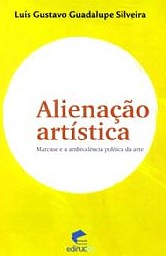 2011 Portuguese: Luis Gustavo Guadalupe Silveira (Brazil), Alienação artística: Marcuse e a ambivalência política da arte (Porto Alegre: Edipucrs, 2010), 144 pages. 2011 Portuguese: Luis Gustavo Guadalupe Silveira (Brazil), Alienação artística: Marcuse e a ambivalência política da arte (Porto Alegre: Edipucrs, 2010), 144 pages.
- The title translates as: Artistic Alienation: Marcuse and the Political Ambivalence of Art
- Blurb: The ambivalent political nature of art, presented by Marcuse in texts spanning five decades of intellectual production (1937-1979), is the object of study of this book.
- 2009 Master's thesis as 166 page pdf
- B$ 20 at ABEU and at Livraria Cultura
- Synopsis: 'Alienação artística' apresenta uma pesquisa que investiga a relação entre filosofia e arte nos escritos de Herbert Mascuse - autor cujo pensamento interliga teoria social, política, arte e práxis transformadora. Neste emaranhado teórico, sobressaem as reflexões estéticas. Como a arte poderia ser instância de crítica e negação da realidade ou mesmo de sua afirmação? O autor postula que essa questão só pode ser respondida ao se levar em conta o caráter 'alienador' da arte.
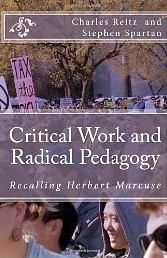
- 2011: Charles Reitz and Stephen Spartan, "Critical Work and Radical Pedagogy: Recalling Herbert Marcuse," 44pages; paper presented at the 2011 Critical Refusals conference of the International Herbert Marcuse Society.
- Reitz wrote in Oct. 2011: "This is a discussion document that can also be seen as supporting the Occupy Wall Street movement through critical analysis and by invoking some of Herbert Marcuse's most radical statements and ideas."
- $15 on amazon.com
2012 (back
to top)
- 2012: The Dunayevskaya-Marcuse-Fromm Correspondence, 1954-1978: Dialogues on Hegel, Marx, and Critical Theory, edited by Kevin B. Anderson, Russell Rockwell (Lanham, Md. : Lexington Books, 2012), lix, 269 pages, includes bibliographical references and index.
UCSD: JC233.M299 D86 2012
- Part one. The Dunayevskaya-Marcuse correspondence, 1954-78: the early letters: debating Marxist dialectics and Hegel's absolute idea; Dunayevskaya's Marxism and freedom and beyond; on technology and work on the eve of Marcuse's One-dimensional man; the later correspondence: winding down during the period of the New Left
Part two. The Dunayevskaya-Fromm correspondence, 1959-78: the early letters: on Fromm's Marx's concept of man and his socialist humanism symposium; dialogue on Marcuse, on existentialism, and on socialist humanism in Eastern Europe; on Hegel, Marxism, and the Frankfurt School in the period of Dunayevskaya's philosophy and revolution; the final letters: on critical theory and on Rosa Luxemburg, gender, and revolution
- review by Bryant William Sculos in: Political Studies Review 12:2(May 2014), 249–250
- 2012 Spanish: Luis Diego Fernandez, "El rescate de un hedonismo libertario," in Ideas
- La reedición de tres obras clave de Herbert Marcuse expone el pensamiento de uno de los portavoces del “freudomarxismo”.
- 2012: Christian Garland, "Negating that which Negates us: Marcuse, Critical Theory and the New Politics of Refusal," (forthcoming 2012/13) in Radical Philosophy Review. Version of paper presented as part of Panel 24: ‘Looting, Refusing, Negating, Embodying’, 'Critical Refusals’ Fourth Biennal Conference of the International Herbert Marcuse Society, University of Pennsylvania, 27-29 October 2011. (pdf)
- 2012 Italian: Raffaele Laudani (ed.), Il nemico tedesco: Scritti e rapporti riservati sulla Germania nazista (1943-1945) by Franz Neumann, Herbert Marcuse, Otto Kircheheimer (Bologna: Il mulino, 2012), 559 pages. Original English sources in Italian translation.
- 2013 published by Princeton in English, see below.
- 2012: Malcolm Miles, Herbert Marcuse: An Aesthetics of Liberation (London: Pluto, 2012), 194pp.
- 2012 Internet: Glenn Wallis, "The Power of Negative Thinking," Nov. 12, 2012 post on SpeculativeNonBuddhism.com.
- Glenn Wallis holds a Ph.D. in Buddhist studies from Harvard University. He is the author of Mediating the Power of Buddhas. From the text:
- "One of the animating ideas of the non-buddhism critique is that contemporary x-buddhism persistently “denies its own promises and potentialities.” That phrase is from Herbert Marcuse’s 1960 essay “A Note on Dialectic.”* In this post, I will briefly present Marcuse’s notion of dialectical, or negative, thinking. Then, I will suggest ways that readers might use this analytical tool in their own encounters with x-buddhist teachers, literature, on-line sites and beyond."
* The essay served as a preface to the revised edition of Marcuse’s Reason and Revolution: Hegel and the Rise of Social Theory, originally published in 1941.
2013 (back
to top)
- 2013: Joseph Cunningham, "Praxis Exiled: Herbert Marcuse and the One Dimensional University," in: Journal of Philosophy of Education 47:4 (December 2013), 537–547, (11 page pdf).
- Abstract: "Leading Frankfurt School theorist Herbert Marcuse possessed an intricate relationship with higher education. As a professor, Marcuse participated in the 1960s student movements, believing that college students had potential as revolutionary subjects. Additionally, Marcuse advocated for a college education empowered by a form of praxis that extended education outside the university into realms of critical thought and action. However, the more pessimistic facet of his theory, best represented in the canonical One Dimensional Man, now seems to be the dominant ideology in the contemporary college experience. With the rise of the corporate university, knowledge is commodified and praxis is supplanted by rampant consumerism.Once a haven for critical theory, the college experience has been overtaken by capitalism, substantially limiting the revolutionary potential for college students in favour of an institutionalised, one dimensional university."
- 2013: Andrew Feenberg, "Marcuse's Phenomenology: Reading Chapter Six of One-Dimensional Man," in: Constellations 20:4 (December 2013), 604–614. (11 page pdf)
- 2013: Andrew Feenberg, "Heidegger and Marcuse: On Reification and Concrete Philosophy," in: F. Raffoul and E. Nelson (eds.), The Bloomsbury Companion to Heidegger (Bloomsbury Press, 2013), pp. 171-176. (12 pages on academic.edu)
 2013: Raffaele Laudani (ed.), Secret Reports on Nazi Germany: The Frankfurt School Contribution to the War Effort Franz Neumann, Herbert Marcuse & Otto Kirchheimer, foreword by Raymond Geuss (Princeton University Press, 2013), 704 pages. (PUP website with TOC & pdf of introduction; $40 at amazon.com) 2013: Raffaele Laudani (ed.), Secret Reports on Nazi Germany: The Frankfurt School Contribution to the War Effort Franz Neumann, Herbert Marcuse & Otto Kirchheimer, foreword by Raymond Geuss (Princeton University Press, 2013), 704 pages. (PUP website with TOC & pdf of introduction; $40 at amazon.com)
- Publisher's blurb: " During the Second World War, three prominent members of the Frankfurt School--Franz Neumann, Herbert Marcuse, and Otto Kirchheimer--worked as intelligence analysts for the Office of Strategic Services, the wartime forerunner of the CIA. This book brings together their most important intelligence reports on Nazi Germany, most of them published here for the first time."
- Review by John Bew in New Statesman & Society, Aug. 2013: "What do you get when you put three neo-Marxists from the Frankfurt School in the US's Office of Strategic Services, a forerunner of the CIA? Some of the best analysis of Nazi Germany ever written, says John Bew."
- Some of the reports by Herbert:
2. POSSIBLE POLITICAL CHANGES IN NAZI GERMANY IN THE NEAR FUTURE: (August 10,1943) Herbert Marcuse Pages: 31-37
3. CHANGES IN THE REICH GOVERNMENT: (August 20,1943) Herbert Marcuse Pages: 38-47
5. THE SIGNIFICANCE OF PRUSSIAN MILITARISM FOR NAZI IMPERIALISM: POTENTIAL TENSIONS IN UNITED NATIONS PSYCHOLOGICAL WARFARE (October 20,1943) Herbert Marcuse, Felix Gilbert Pages: 61-73
6. GERMAN SOCIAL STRATIFICATION: (November 26,1943) Herbert Marcuse Pages: 74-92
13. THE GERMAN COMMUNIST PARTY: (July 10, 1944) Herbert Marcuse Pages: 167-198
14. THE SOCIAL DEMOCRATIC PARTY OF GERMANY: (September 1, 1945) Herbert Marcuse Pages: 199-226
18. POLICY TOWARD REVIVAL OF OLD PARTIES AND ESTABLISHMENT OF NEW PARTIES IN GERMANY: (July 22, 1944) Herbert Marcuse Pages: 285-300
31. THE POTENTIALS OF WORLD COMMUNISM: (August 1,1949) Herbert Marcuse Pages: 591-610
- Reviewed by Martin Woessner in Central European History 47:3(Sept. 2014)
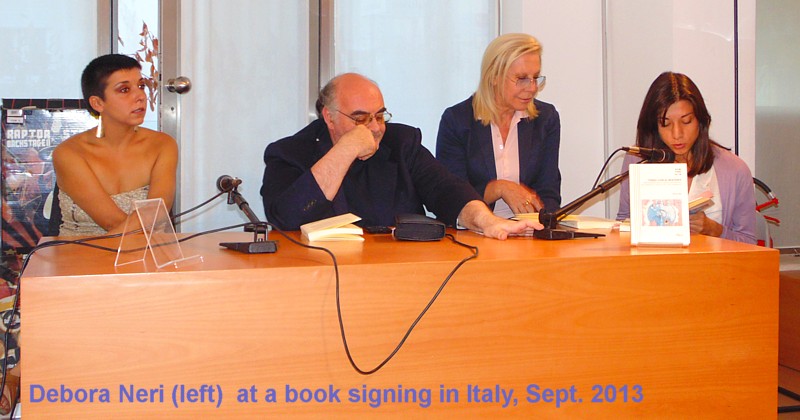
- 2013 Italian: Debora Neri
 , Torno così ai Beatniks: Immaginazione critica e rivolta nell'estetica dell'esistenza da Marcuse alla Beat Generation ['Thus I Return to the Beatniks: Critical Imagination and Revolt in the Aesthetics of Being from Marcuse to the Beat Generation'](Edizioni Tracce, 2013), 224 pages (Tracce book page). , Torno così ai Beatniks: Immaginazione critica e rivolta nell'estetica dell'esistenza da Marcuse alla Beat Generation ['Thus I Return to the Beatniks: Critical Imagination and Revolt in the Aesthetics of Being from Marcuse to the Beat Generation'](Edizioni Tracce, 2013), 224 pages (Tracce book page).
Google translate's version of the blurb on that site:
"From the back cover: A clear, smooth, syntactically well-made text, and the success of the writing also depends on the type of interest from which the author was solicited and which is set out clearly in the conclusion: to rediscover a sense of "currency" and political, to the set of ideas that can be drawn from the convergence between the issues and Marcusian reactive anxieties and creativity of the Beat Generation. Marcuse's thought and experience of the three main representatives of the Beat movement were focused aspects that best lend themselves to communicate such different cultures, and the different portrait of Burroughs, Kerouac and Ginsberg are well written. Pages on bop writings, on interior jazz, are convincing, the theme of the aesthetics of spontaneity, of the inherently political vocation of art, is clearly a central focus. A good work, an example of "caught journalism", capable of restoring an overview of some important phenomena such as to urge readers to the need to know more. I imagine that for many young people today, reading a similar work would be much more profitable than that of a study with greater critical pretensions.
-
Nicola Auciello, Professor of History of Modern Philosophy, University of Salerno
Debora Neri was born in Sulmona in 1982. She earned her Bachelor's Degree in Philosophy in 2006 with a thesis titled " Existence in Sartre and Dostoevsky" and a Master's Degree in History of Philosophy in 2008 with the thesis One-dimensional Society and its Overcoming: A Comparison of the Positions of Herbert Marcuse and Jack Kerouac. This book is an extension and integration of her 2008 thesis. It combines the work of philosophical-historical research, which specifically engages the author (the thought of Herbert Marcuse), with a passion for the literature of American beat. Neri is currently working on a project to analyze the philosophical speculation of the young Marcuse and, specifically, his humanistic Marxism, through a critical examination of his texts from 1928 to 1941 in comparison with the works of thinkers who had the greatest impact on their formation, i.e. Marx, Hegel, Heidegger, Dilthey, Lukács and Korsch."
- 2013: Geoff Pfeifer, "Marcuse, Herbert," in: The International Encyclopedia of Ethics
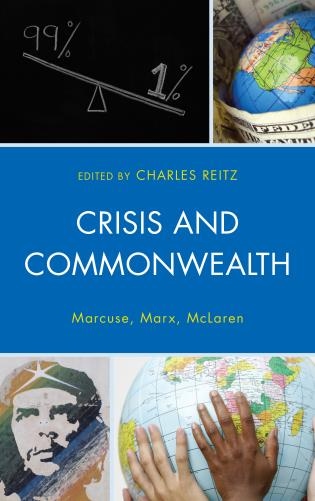
- 2013: Charles Reitz (ed.),
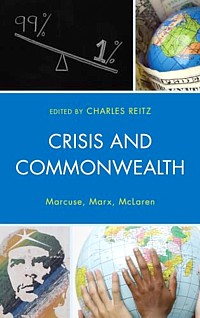 Crisis and Commonwealth: Marcuse, Marx, McLaren (Lexington Books, 2013), 332 pages. ($95 at amazon; $70 at oneclass [9/2013]) Crisis and Commonwealth: Marcuse, Marx, McLaren (Lexington Books, 2013), 332 pages. ($95 at amazon; $70 at oneclass [9/2013])
- Publisher's webpage with Table of Contents
- Blurb: This book "advances Marcuse scholarship by presenting four hitherto untranslated and unpublished manuscripts by Herbert Marcuse from the Frankfurt University Archive on themes of economic value theory, socialism, and humanism. Contributors to this edited collection, notably Peter Marcuse, Henry Giroux, Peter McLaren, Zvi Tauber, Arnold L. Farr and editor, Charles Reitz, are deeply engaged with the foundational theories of Marcuse and Marx with regard to a future of freedom, equality, and justice. Douglas Dowd furnishes the critical historical context with regard to U.S. foreign and domestic policy, particularly its features of economic imperialism and militarism. Reitz draws these elements together to show that the writings by Herbert Marcuse and these formidable authors can ably assist a global movement toward intercultural commonwealth. The collection extends the critical theories of Marcuse and Marx to an analysis of the intensifying inequalities symptomatic of our current economic distress. It presents a collection of essays by radical scholars working in the public interest to develop a critical analysis of recent global economic dislocations. Reitz presents a new foundation for emancipatory practice—a labor theory of ethics and commonwealth, and the collection breaks new ground by constructing a critical theory of wealth and work. A central focus is building a new critical vision for labor, including academic labor. Lessons are drawn to inform transformative political action, as well as the practice of a critical, multicultural pedagogy, supporting a new manifesto for radical educators contributed by Peter McLaren. The collection is intended especially to appeal to contemporary interests of college students and teachers in several interrelated social science disciplines: sociology, social problems, economics, ethics, business ethics, labor education, history, political philosophy, multicultural education, and critical pedagogy."
- 2013: Federico Sollazzo, "Through Sartre and Marcuse: For a Realistic Utopia," in: Annals of Philosophy of the University of Craiova n. 31(2013), pp. 90-100. (cropped, archived pdf)
- 2013: Federico Sollazzo, "Marcuse lettore de L'être et le néant di Sartre," in: Annals of Philosophy of the University of Craiova, n. 32(2013), pp. 41-51. (cropped, archived pdf) [Marcuse reads Sartre's On Being and Nothingness'--1943 book, see Wikipedia Being & Nothingness page]
- 2013: Antje Wichtrey, Herbert Marcuse. Versprechen, dass es anders sein kann. Promise that it can be different; paintings, afterword by Peter-Erwin Jansen. Bilingual reprint of the one-of-a-kind art book by about Hebert Marcuse. (Frankfurt: Edition Boot, 2013), € 25 / $ 30.
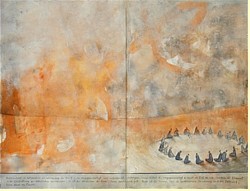
- The book can be purchased by contacting Peter-Erwin Jansen via email: petererwinjansen(a)aol.com.
- You can see 4 (of 15) double page spreads at Anthe Wichtrey's website.
- The quotation text in this sample image reads:
"Rationality is indeed an essential aspect of art: making present (re-present) that which is repressed, hidden, distorted - not as end in itself but as elements in the creation of the aesthetic universe--the universe of form. For it still holds true: form is the triumph over the destructive disorder, and order, the banning of fear."
2014 (back
to top)
- 2014: Ron Aronson, "Marcuse Today Fifty years later, 'One-Dimensional Man' is more prescient than its author could have imagined," in: Boston Review (Nov. 17, 2014). [about 10 printed pages]
- 2014: Alberto Hijar, "Notes on Utopia and the Aesthetic Dimension," Third Text 28:3(2014), 322-330. (doi)
- Abstract: This article addresses aesthetics in Latin America through an exploration of the meaning and impact of ideological theories proposed by thinkers including Karl Marx, Herbert Marcuse, Immanuel Kant and Sigmund Freud. It looks at the implications that these theories have for aesthetics as a critique of society and the potential of revolutionary utopian strategies to counter the capitalist law of value.
- 2014: Brian O'Connor (University College Dublin), "Play, Idleness and the Problem of Necessity in Schiller and Marcuse," in: British Journal for the History of Philosophy 22:6(2014), 1095-1117. (doi)
- Abstract: The central concern of this paper is to explore the efforts of Schiller's post-Kantian idealism and Marcuse's critical theory to develop a new conception of free human experience. That conception is built on the notion of play. Play is said to combine the human capacities for physical pleasure and reason, capacities which the modern world has dualized. Analysis of their respective accounts of play reveals its ambivalent form in the work of both philosophers. Play supports the ideal of ‘freedom from necessity’, understood as a release from all external constraint. But it also appears to serve as a model for ‘freedom as a higher necessity’. In the case of Schiller, the ambivalence encompasses idle play and an obligation to make ourselves worthy of freedom. For Marcuse, play represents a kind of libidinal idleness while also underpinning a non-alienated conception of labour.
- 2014: Bradley J. Macdonald, "Marcuse, Herbert (1898–1979)," in: The Encyclopedia of Political Thought (2014)
- 2014 Spanish: Alfredo Rocha de la Torre, "Herbert Marcuse: Entre Psicología y Filosofía" [Herbert Marcuse: Between Psychology and Philosophy], in:
Límite. Revista Interdisciplinaria de Filosofía y Psicología 9:30(2014), pp. 25-34.
- This contribution seeks to highlight the unitary nature of Herbert Marcuse’s critical-social reflection, pointing the way this German philosopher manages to integrate dialectically the Marxian theory of society with. The Freudian metapsychology, which is basically a clear example of a theory that has been developed in the form of an encounter between psychology and philosophy. To achieve this integration Marcuse recurs to the hidden orientation of psychoanalysis, which gets it near to its utopian social component and reveals also the ignorance of subjectivity that characterizes Marxism, leading it, thus, into dialogue with the Freudian Theory.
- Rocha de la Torre is at the Universidad de Sanbuenaventura, Bogotá-Colombia
- 2014: Stephen J. Whitfield, "Refusing Marcuse: 50 Years After One-Dimensional Man," in: Dissent (Fall 2014). [about 7 printed pages]
- 2014: Nick Thorkelson, "The 50-Year-Old One-Dimensional Man," published on the Dissent blog, Nov. 2014. [4 page comic]
2015 (back
to top)
- 2015: Agnieszka Bates, "The ‘Great Refusal’? A Marcusian response to the Bright Blue vision of education in the ‘Big Society’," in: Journal of Educational Administration and History 47:4(2015), 350-366. (doi)
- Abstract: The modernisation of education and other public services remains a major political objective of the current Coalition government in the UK. This paper focuses on Tory Modernisation 2.0, a blueprint for the second stage of the public sector reform produced by the Conservative pressure group, Bright Blue. From the critical theory perspective expounded by Herbert Marcuse, the Conservative vision of the ‘Big Society’ is a one-dimensional conceptualisation of social relations. In the guise of pragmatic, sensible prescriptions for how the institutions of society should be reformed, Tory Modernisation 2.0 advocates an acceleration of marketisation, which is both potentially destructive and irreversible. Against the backdrop of a bleak, one-dimensional society promoted by the Conservative Party, education has become a site of struggle between what Marcuse terms the dialectic of domination and the ‘Great Refusal’.
- 2015: Shannon Brincat and Damian Gerber, "The Necessity of Dialectical Naturalism: Marcuse, Bookchin, and Dialectics in the Midst of Ecological Crises," in: Antipode: A Radical Journal of Geography 47:4(Sept. 2014), pages 871–893. (pdf)
- Abstract: In the wake of ecological crises, there has been a resurgence of interest in the relation between dialectical thought and nature. The work of Herbert Marcuse and Murray Bookchin offers unique approaches to this question that remain highly relevant. In the first half of the article, we engage with Marcuse's application of the dialectical method in which he gestured to the “vital need” to push beyond the appearance of “the real” and yet lamented the loss of the ability for negative thinking to pierce the dominance of the “technical apparatus” that tied humanity to this “radical falsity”. Here, we suggest the need for a more holistic dialectical understanding of the social totality—one that is directly located within, and takes as foundational, the environmental conditions of human society. In the second half, we examine Murray Bookchin's conception of “dialectical naturalism” as a more thorough engagement with the human/nature relation that surpasses Marcuse's late engagements with ecologism. In particular, we offer critical reflections on the concept of “nature” in the contemporary ecology movement and illustrate how dialectical naturalism is capable of not only transcending dualistic conceptions of “man/nature” but in expanding our awareness of the potentialities of history along what Bookchin terms the “libertory pathways” to a restorative relation between human “second nature” and biological “first nature”. We posit that systemic, interconnected and accelerating ecological crises (climatic, biospheric and oceanic) form the objective and absolute contradiction of contemporary global social life that compels an awareness of the potentialities of an ecological society. Only through this awareness can we break through the reified “solutions” that have often plagued the ecology movement, bringing about the urgent social and ecological transformation that our species requires for its liberation and long-term survival.
- 2015: Charles Reitz and Peter-Erwin Jansen (eds.)
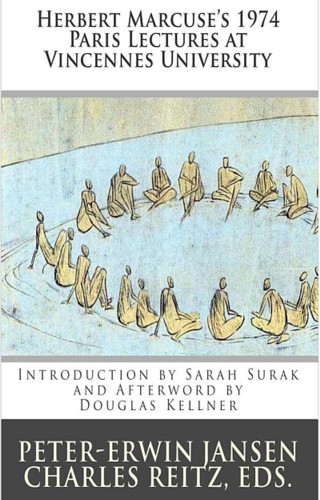 Paris Lectures at Vincennes University, 1974: Global Capitalism and Radical Opposition (CreateSpace editor publication, 2015), 142 pages. (contents) ($20 on CreateSpace; same price on amazon where you might get free shipping) Paris Lectures at Vincennes University, 1974: Global Capitalism and Radical Opposition (CreateSpace editor publication, 2015), 142 pages. (contents) ($20 on CreateSpace; same price on amazon where you might get free shipping)
- Blurb: "This volume advances Marcuse scholarship by presenting seven newly discovered, hitherto unpublished, lectures to students at Vincennes University, a branch of the Sorbonne. Marcuse's critical analysis focuses on core features of American society, its political economy, its culture, and the potential attainability of a free socialist future. These 1974 manuscripts were found in 2014 in the Marcuse archive at the University of Frankfurt by Peter-Erwin Jansen. Jansen and Charles Reitz edited and annotated the lectures for publication. Commentary by Sarah Surak, Detlev Claussen, and Douglas Kellner illuminates the historical context of Marcuse's theoretical perspective and his relevance to contemporary movements for social change."
2016 (back
to top)
- 2016: Special issue of New Political Science 38(4):
"Marcuse in the Twenty-First Century: Radical Politics, Critical Theory, and Revolutionary Praxis"
(doi)
- Robert Kirsch & Sarah Surak, "Introduction," 455-464
- Arnold L. Farr, Amahlia L. Perry-Farr & Louisa N. Perry-Farr, "Meeting report Conference Plenary: When Liberation Movements Become One-Dimensional: On Critical Theory and Intersectionality," 465-475.
- Robert Kirsch, " Introduction: The Rationality of Philosophy Herbert Marcuse," 476-484
- Brandon Absher, "Beyond the One-Dimensional University: A Marcusean Critique of Outcomes Assessment," pp. 485-500
- Dean Caivano, Rodney Doody, Terry Maley & Chris Vandenberg, "Critical Pedagogy in the Neoliberal University: Reflections on the 2015 York University Strike through a Marcusean Lens," pp. 501-515
- Bryant William Sculos & Sean Noah Walsh, "The Counterrevolutionary Campus: Herbert Marcuse and the Suppression of Student Protest Movements," pp. 516-532 (pdf)
- Sarah Surak, "Displaying Garbage: Installations as Spaces of Domination and Resistance," pp. 533-546 (pdf)
- Katherine E. Young, "Herbert’s Herbivore: One-Dimensional Society and the Possibility of Radical Vegetarianism," pp. 547-560. (pdf)
- Nancy D. Wadsworth, " Are We the Walking Dead? Zombie Apocalypse as Liberatory Art," pp. 561-581
- Silvio Ricardo Gomes Carneiro, "Marcuse: A Critic in Counterrevolutionary Times" Pages: 582-597 (pdf)
- Aaron Major, Book review Crisis and Commonwealth: Marcuse, Marx, McLaren Pages: 598-599
- David Schultz, Book review The Dialectics of Liberation Pages: 600-602
- Jeffery L. Nicholas, Book review Paris Lectures at Vincennes University, 1974: Global Capitalism and Radical Opposition Pages: 602-604
- Douglas Kellner, Rapid communication Afterword Pages: 605-606
- 2016: Julian Eagles, "The Situationists, Marcuse and the “Great Refusal” of the “Hopeless Cases”: The Socially Marginalized, Rebellion and Revolution," in: International Critical Thought (2016), 1-26. (doi)
- Abstract: This article looks at two theories—developed (roughly speaking) during the same historical period (largely from the 1950s to the 1970s)—which deal with the issue of the socially marginalized, rebellion and revolution: that of the Situationist International and that of Herbert Marcuse. The article examines both the Situationists' and Marcuse’s thought as regards the social structure of advanced capitalist society and the prospects for “proletarian” revolution in the United States and Europe. Further, the article compares and contrasts the Situationists' and Marcuse’s ideas about revolution in the realm of culture. Finally, the article reflects on the relevance of Situationist and Marcusean ideas—concerning the “great refusal” of the “hopeless cases”—in the post-2008 period.
- 2016: Casey Ryan Kelly, "Chastity for democracy: Surplus repression and the rhetoric of sex education," in: Quarterly Journal of Speech 102:4(2016), 353-375. (doi)
- Abstract: Moving from opposition to participation, the Adolescent Family Life Act (1981) and the development of abstinence education marks the conservative movement's pivot to a rhetorical strategy of tolerance that enabled it to coopt the public culture of sex discourse. Working from Herbert Marcuse's theory of “surplus repression,” I argue that the New Right seized the liberationist argument for open public discourse about sexuality to sublimate libidinal desires into a national project of familial (re)productivity. The AFLA is significant in the rhetorical history of sex education because it demarcates the transition to a productive form of biopolitics that sought to manage sexuality by instrumentalizing rather than censuring bodily desire. Conservative sex talk illustrates how Eros—transgressive, creative, and erotic desires—is channeled into the discursive production of hyper-functional subjects invested in their own subjugation.
- 2016: Andrew Lamas
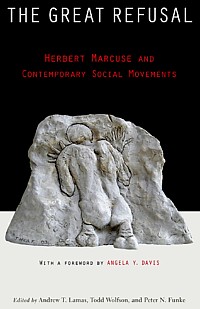 , Todd Wolfson and Peter Funke (eds.), The Great Refusal: Herbert Marcuse and Contemporary Social Movements (Philadelphia: Temple, 2016), 410 pages. ($40 at amazon, w/ preview)(pdf flyer). , Todd Wolfson and Peter Funke (eds.), The Great Refusal: Herbert Marcuse and Contemporary Social Movements (Philadelphia: Temple, 2016), 410 pages. ($40 at amazon, w/ preview)(pdf flyer).
- The cover shows a sculpture of Sisyphus by the contemporary British sculptor Jane McAdam Freud, a great-granddaughter of Sigmund Freud and the daughter of the painter Lucian Freud. (Jane McAdam Freud's wikipedia page)
- Book mentioned and concept discussed over several paragraphs in the Jan. 20, 2017 New Yorker by Emily Eakin, "What Can Artists Accomplish by Saying No to Trump?" Eakin states: Marcuse "remains one of few contemporary thinkers to have articulated a political theory of refusal."
- Book blurb: Herbert Marcuse examined the subjective and material conditions of radical social change and developed the “Great Refusal,” a radical concept of “the protest against that which is.” The editors and contributors to the exciting new volume The Great Refusal provide an analysis of contemporary social movements around the world with particular reference to Marcuse’s revolutionary concept.
The book also engages—and puts Marcuse in critical dialogue with—major theorists including Slavoj Žižek and Michel Foucault, among others. The chapters in this book analyze different elements and locations of the contemporary wave of struggle, drawing on the work and vision of Marcuse in order to reveal, with a historical perspective, the present moment of resistance. Essays seek to understand recent uprisings—such as the Zapatistas in Mexico, the Arab Spring, and the Occupy movement—in the context of Marcuse’s powerful conceptual apparatus. The Great Refusal also charts contemporary social movements against global warming, mass incarceration, police brutality, white supremacy, militarization, technological development, and more, to provide insights that advance our understanding of resistance today.
- Reviewed by Peter Seybold in: Socialism & Democracy 31:3(Nov. 2017), 164-167. 4p.
- 2016: Malcolm Miles, "Eco-aesthetic dimensions: Herbert Marcuse, ecology and art," in Cogent Arts & Humanities 3:1(2016). (doi: pdf)
- Abstract: In his last book, The Aesthetic Dimension (1978), Marcuse argued that a concern for aesthetics is justified when political change is unlikely. But the relation between aesthetics and politics is oblique: “Art cannot change the world, but it can contribute to changing the consciousness … of the men and women who could change the world.” (p. 33). Marcuse also linked his critique of capitalism to environmentalism in the early 1970s: “the violation of the Earth is a vital aspect of the counterrevolution.” (Ecology and Revolution, in The New Left and the 1960s, Collected Papers 3, 2005, p. 173). This article revisits Marcuse’s ideas on aesthetics and ecology, and reviews two recent art projects which engage their audiences in ecological issues: The Jetty Project (2014) by Wolfgang Weileder—which used recycled material and community participation to construct a temporary monument within a wider conservation project on the Tyne, N-E England—and Fracking Futures by HeHe (Helen Evans and Heiko Hansen)—which turned the interior of the gallery at FACT, Liverpool, into what appeared to be a fracking site. The aim is not to evaluate the projects, nor to test the efficacy of Marcuse’s ideas, more to ask again whether art has a role in a shift of attitude which might contribute to dealing with the political and economic causes of climate change.
- 2016: Bryant William Sculos & Sean Noah Walsh, "The Counterrevolutionary Campus: Herbert Marcuse and the Suppression of Student Protest Movements," in: New Political Science 38:4(2016),
516-532. (doi; pdf)
- Abstract: With the recent surge of college protests against various forms of economic, political, social, and racial injustice, there have been persistent and pernicious reactions from other students, administrators and public figures that function to undermine the emancipatory impulses animating these demonstrations. The reactions are often justified under the banners of tolerance, chastising students to listen instead of protest. This article, focusing on Marcuse’s concepts of repressive toleration and counterrevolution, evaluates the reactionary responses to these events, as well as the critical potential of this fledgling student sensibility, a burgeoning refusal represented by protest events at American universities. We maintain that many of the calls for tolerance are actually demands for silence and belong to a wider counterrevolutionary phase of late capitalism observed by Marcuse. Bedrock liberties are dialectically inverted whereby speech and toleration are repressively deployed against demands for justice. This article concludes by arguing that it is crucial to the success of this resurgent sensibility for justice—and progress toward a radical socialist movement that coincides with the emancipatory vision of Herbert Marcuse—that the counterrevolutionary character of the responses are demystified.
- 2016: Javier Sethness-Castro, Eros and Revolution: The Critical Philosophy of Herbert Marcuse (Leiden: Brill, 2016) ($28 on amazon)
- Investigating the origins and development of Herbert Marcuse's dialectical approach vis-à-vis Hegel, Marx, and Freud as well as the central figures of the Frankfurt School, Sethness Castro chronicles the radical philosopher's lifelong activism. Beyond examining Marcuse's revolutionary life and contributions, the author contemplates the philosopher's relevance to contemporary struggles, especially with regard to ecology, feminism, and Anarchism.
- Review by David Clark, "A New Marcusean Moment? A Review of Eros and Revolution: The Critical Philosophy of Herbert Marcuse," in: Capitalism Nature Socialism 28:4(Nov. 2017), 111-116. (pdf archive copy)
- 2016: Federico Sollazzo, "The Marcusean Inheritance as a Possibility Not Yet Realized: From a Pre- to a Post-Technological Culture and Society," in «Polis», special issue: "The Contribution of Critical Theory in Understanding Society," F. Sollazzo ed. 4(2016), pp. 25-48.
- 2016 German: Ziege, Eva-Maria, Review of Im Kampf gegen Nazideutschland: Die Berichte der Frankfurter Schule für den amerikanischen Geheimdienst 1943-1949. Herausgegeben von Raffaele Laudani. Aus dem Englischen von Christine Pries. Review By: Ziege, Eva-Maria. H-Net Reviews in the Humanities & Social Sciences. Dec. 2016, p1-3.
2017 (back
to top)
- 2017: Richard J. Bernstein, "The Unresolved Problems of Late Critical Theory" (review), in: History & Theory 56:3(Sept. 2017), 418-432. 15p.
- Abstract: Martin Jay's sweeping account of reason in Western philosophy provides the context for understanding the crisis that the Frankfurt School thinkers faced when they spoke of the 'eclipse of reason.' In the background of the thinking of the first generation of Frankfurt thinkers such as Max Horkheimer, Theodor Adorno, and Herbert Marcuse is a hankering for a more substantive conception of reason that bears affinities with what Hegel called Vernunft (reason), which he contrasted with Verstand (understanding). According to Jay, the first generation of Frankfurt thinkers never quite succeeded in elaborating this substantive concept of reason and grew increasingly pessimistic in the face of the self-destruction of reason. Habermas sought to elaborate a communicative theory of rationality that did not fall into the misleading promises of Hegelian Vernunft but could nevertheless provide a normative basis for the critique of instrumental, strategic, and systems rationality-a normative basis for critical theory. Jay presents an extremely lucid account of Jürgen Habermas's theory of communicative rationality. He concludes by reviewing some of the outstanding problems and questions that have been raised about the adequacy and success of Habermas's project. I seek to do justice to the strengths and weaknesses of Jay's narrative, and I focus on a number of deep, unresolved issues that confront the future of critical theory in its attempt to develop an adequate conception of rationality. I also raise concerns about what precisely is distinctive about critical theory today.
- 2017: Michael Bot, "Politics as Radical Creation: Herbert Marcuse & Hannah Arendt on Political Performativity," (review), in: Political Theory. Oct2017, Vol. 45 Issue 5, p731-734. 4p.
- 2017 Russian: E.A. САМАРСКАЯ, " ПОЛИТИЧЕСКИЕ ИДЕОЛОГИИ И ТЕХНИКА" [Political Ideologies and Technology], in: Journal of Philosophical Sciences / Filosofskie Nauki 2017, Issue 11, p22-39. 18p. Language: Russian.
- Abstract: This article explores the analytical relations between traditional (these are termed “partial”) and “total” ideologies. Traditional ideologies originated in 18th-19th century Bourgeois revolutions; as such, they embody social and political aspirations of certain social groups (conservatism, liberalism, socialism). Those ideologies which we termed “total” are of technocratic type: they follow the route of progress and embrace those of etatist attributes which are appropriate to it. At present, partial ideologies are in crisis; the latter resulted from disintegration of the social entities which used to form the foundation of democratic states. “Total” ideologies undergo intensification insofar as technological progress continues; they may be anonymous (Jürgen Habermas “Technology and Science as Ideology”) or, otherwise, receive corresponding theoretical fulfillment. They may coexist with traditional ideologies and influence them or strive to supersede them. “Total” ideologies (they are epitomized by science and technology) are a cause of a heavy stress which oppresses people, deprives them of alternative thinking capacity insofar as the present state of society is concerned (Herbert Marcuse). The above mentioned themes are analyzed with reference to early technocratic theories (C.-A. Saint-Simon, A. Comte, A. Bogdanov), as well as to contemporary technocratic systems the authors of which (G. Ellul, K. Kastoriadis, A. Gorz), better than anybody, perceive the anonymous pressure of technology and administrative state
- 2017: Patrick Duggan, "On the Radical Political Potential of Performance: Witnessing, Implication, and Ethics in Representations of the Northern Irish Dirty Protests and Hunger Strikes (1976–81)," in: Contemporary Theatre Review 27:4(2017), 445-461. 17p.
- Abstract: Looking at the ‘dirty protests’ (1976–81) and hunger strikes (1981) that took place in the Maze Prison, Northern Ireland, this essay recuperates Herbert Marcuse’s work in The Aesthetic Dimension(1978) to analyse the relations between radical protest and aesthetic figurings of those events in order to unpack the potential for art to act as a radical–if incremental–means with which to (re)position individual politics. The argument advances to propose that particular arts practices might not only offer a means through which to renegotiate understandings of the historical actual (in this instance almost from directly within the historical moment) but also to suggest a process by which art can be deployed as a mechanism for interrogating, remediating, and iteratively refiguring the politics of the real more broadly. That is, Marcusian theory alongside performance theory, provides a means to articulate the radical potential of art. The essay suggests a means not only of re-negotiating understandings of the historical actual but also a process by which art might be deployed as a mechanism for interrogating the politics of the Real more broadly. Analysing the protests alongside the under explored cultural objects of Peter Sheridan’s (unpublished) play Diary of a Hunger Strike and James Hamilton’s installation and painting The Citizen, this essay suggests that through confluence of meaning created between historical instance, representative art practice, and particular kinds of spectator engagement, art can have the radical potential to remediate experience of the social real towards a more complex, ethically charged politics of the Real.
- 2017 Dutch/Afrikaans: Pieter Duvenage, "Filosofie as aktualiteitsinterpretasie. Marinus Schoeman as denker" [Philosophy as an interpretation of our times. Marinus Schoeman as thinker], in: Tydskrif vir Geesteswetenskappe. Mar2017, Vol. 57 Issue 1, p7-21. (15p pdf)
- Abstract: Marinus Schoeman completed a career spanning 42 years as a philosopher at the University of Pretoria. This contribution focuses on Schoeman's remarkable career as a kind of Socrates figure in a country where thinking is not always first on the agenda of philosophers. The contribution starts (part 1) ... In part 3 Schoeman's first major study on the Critical Theory of Herbert Marcuse is given close attention. In this study Schoeman basically reconstructs Marcuse's position against the backdrop of Hegel's, Marx's, and Freud's contributions to our understanding of contemporary society. In Marcuse's version of Critical Theory, Marx's theory of class repression and Freud's instinctual theory is given a new twist, with less emphasis on the biological-determinist sketch of humankind's oppression. In his fascinating work, Eros and Civilization (1955), Marcuse is even hinting in the direction of a society with less repression despite the danger of the achievement principle in contemporary capitalism. Schoeman, though, has problems with Marcuse's sketch of such a repression-less society, especially with regard to new forms of repression needed to create greater freedom. Eventually, at the end of this early study, he sides, quite enigmatically, with the thinking of Heidegger and his mentor, Dreyer as alternative to Marcuse. In part 4 a critical evaluation of Schoeman's early reading of Marcuse is provided. The author commends Schoeman for his reading and critique of Marcuse, but still asks why Schoeman never furthered his interest in Marcuse as a member of the first generation of Critical Theory. The author is of the opinion that if Schoeman had expanded his criticism of Marcuse in the direction of the second generation of Critical Theory (Habermas and Honneth), he could have deepened and expanded his critique of Marcuse. Schoeman's further career is then sketched as a turning away from Critical Theory ...
- 2017 Portuguese: Pamella Ferreira, "A Leitura Como fazer Crítico: O Potencial Emancipatório dos Clássicos à Partir de Marcuse, Thais Magalhães; de Albuquerque MarahÃo, Carolina Machado Saraiva," in: Nucleus 14:1(2017), 27-40. 14p.
- Abstract: This work aims to contribute towards critical debate regarding the importance of reading the classics in the administration, since its instructional process directs you to an uncritical performance, functional to reduce the capital caregivers as a way to perpetuating the current economic system, while the classic will provide the denaturalization of reality as well as providing the administrators the use of subjective reason potential form at the expense of replicating knowledge techniques. To achieve these objectives, it presents the work: Ideology of Industrial Society: The One-Dimensional Man (1973) Herbert Marcuse as a classic can be an alternative that enables the flow of critical reflections on the subject, especially in students in management. Faced with complaints of Marcuse work together with factors that lead to the understanding of the importance of the classics, it is believed the reading of the work of Herbert Marcuse (1973) as a reading, a necessary rescue, since his work behaves as an alternative as a possibility to provide the denaturalization of the concrete universe, through historical mediations, triggering the critical supply and implying the appearance reflective, autonomous managers, able to deny the universe of things established, to promote qualitative transformation and especially in its constitution of subject ethical that will transform the fairest and equal for all.
- 2017: Greg Foyster, "How artists can rewrite the climate story," in: Eureka Street 27:22(11/5/2017), p45-47. 3p.
(pdf)
- Abstract: The article discusses the use of art to depict social cause. Topics discussed include paper by Dr Samuel Alexander at Melbourne Sustainable Society Institute on use of art to reimagine culture, the critical theorist Herbert Marcuse and need to encourage artists to engage with the social and environmental issues.
- 2017: David French, "Malign Marcuse," in: National Review 69:7(Apr. 17, 2017), 32-34. (pdf)
- Abstract: The article profiles life and career of Herbert Marcuse, the German-American philosopher. It discusses his 1965 essay "Repressive Tolerance", which states capitalist democracies might show totalitarian aspects and has been criticized by the conservatives. Marcuse's views on rationality and genuine tolerance as oppose to repression and governance are elaborated.
- 2017:
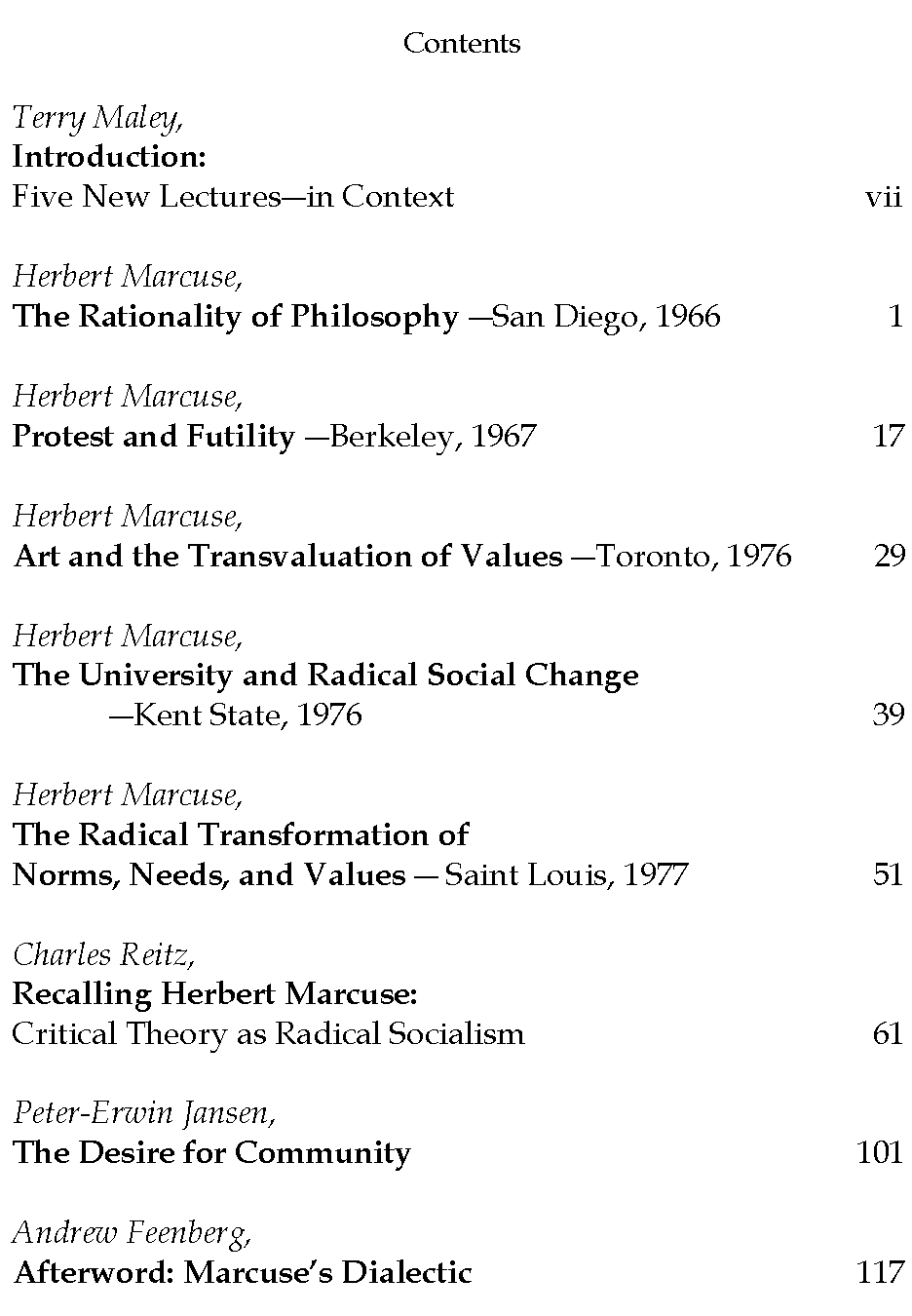
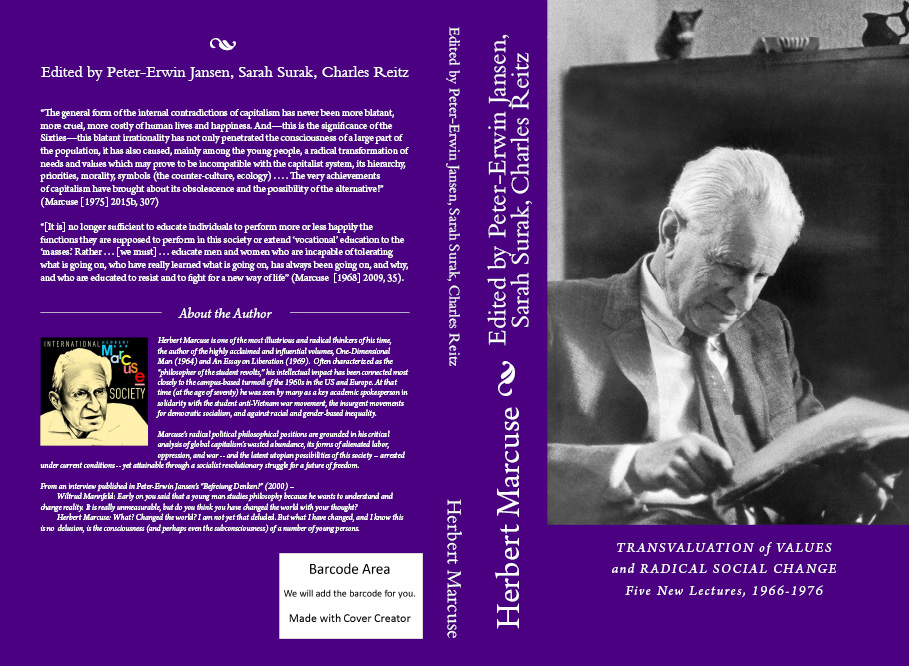
  Peter-Erwin Jansen, Sarah Surak and Charles Reitz (eds.); Herbert Marcuse, Transvaluation of Values and Radical Social Change: Five New Lectures, 1966-1976 Peter-Erwin Jansen, Sarah Surak and Charles Reitz (eds.); Herbert Marcuse, Transvaluation of Values and Radical Social Change: Five New Lectures, 1966-1976
- Introduction by Terry Maley, commentary by Andrew Feenberg
- (amazon $20).
- Blurb: "Herbert Marcuse's lectures recently discovered in the Marcuse Archive Frankfurt on the growing emergence of a "new sensibility," and a"transvaluation of values" that since the Sixties has activated key sectors of U.S. society against: alienation, economic oppression, racial and gender inequality; and for: the radical rather than minimal goals of socialism."
- 2017: Pauline Johnson, "In search of a leftist democratic imaginary: what can theories of populism tell us?" in: Journal of Political Ideologies. Feb2017, Vol. 22 Issue 1, p74-91. 18p.
- Abstract: It might seem that Herbert Marcuse was right: leftist politics can no longer avoid the challenge of devising its own positive normative grounds. The neoliberal political rationality that is now hegemonic must be taken on by a new imaginary: radical, leftist and democratic. This article explores what major theories about new populism have to offer to a radical leftist attempt to reinvent itself. The regeneration of populist movements across the globe appears to offer signposts to guide a new radical politics. Yet I argue that populism is no ideologically empty mobilizing strategy able to be harnessed to all manner of political purposes. Embedded in its demagogic form are key presumptions about the character of democratic justification that collude with a neoliberal political project. Theories of new populism help us to shed light, instead, on the challenges that face the Left in its own self-reconstitution amidst liberal democratic crisis. Circumspection concerning the ideological load that is carried by a populist rendering of democratic politics needs to be united with an insight into how the rise of populism itself issues a warning about aspects of a social democratic past that cannot be reclaimed unchanged
- 2017: David Kennedy, " An Archetypal Phenomenology of Skholé," in: Educational Theory 67:3(June 2017), 273-290. 18p.
(pdf)
- Abstract: In this essay David Kennedy argues that children represent one vanguard of an emergent shift in Western subjectivity, and that adult-child dialogue, especially in the context of schooling, is a key locus for the epistemological change that implies. Following Herbert Marcuse's invocation of a 'new sensibility,' Kennedy argues that the evolutionary phenomenon of neoteny - the long formative period of human childhood and the paedomorphic character of humans across the life cycle - makes of the adult-child collective of school a primary site for the reconstruction of belief. After exploring child-adult dialogue more broadly as a form of dialectical interaction between what John Dewey called 'impulse' and 'habit,' Kennedy identifies three key dimensions of dialogic schooling, all of which are grounded in a fourth: the form of dialogical group discourse called community of philosophical inquiry (CPI), which is based on the problematization and reconstruction of concepts through critical argumentation. As a discourse model, CPI grounds practice in all of the dialogic school's emergent curricular spaces, whether science or mathematics, whether literature, art, or philosophy. Second, CPI opens a functional space for shared decision making and collaborative governance, making of school an exemplary model of direct democracy. Finally, CPI as a site for the critical interrogation of concepts encountered in the curriculum (such as 'alive,' 'justice,' 'system,' and 'biosphere') and as a site for democratic governance leads naturally to expression in activist projects that model an emergent 'new reality principle' through concrete solutions to practical problems on local and global levels.
- 2017:
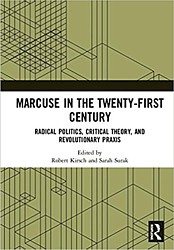 Robert Kirsch and Sarah Surak (eds.), Marcuse in the Twenty-First Century: Radical Politics, Critical Theory, and Revolutionary Praxis (Blackwell, 2017) ($134 on amazon). Robert Kirsch and Sarah Surak (eds.), Marcuse in the Twenty-First Century: Radical Politics, Critical Theory, and Revolutionary Praxis (Blackwell, 2017) ($134 on amazon).
- This book engages the critical theory of political philosopher Herbert Marcuse to imagine spaces of resistance and liberation from the repressive forces of late capitalism. Marcuse, an influential counterculture voice in the 1960s, highlighted the "smooth democratic unfreedom" of postwar capitalism, a critique that is well adapted to the current context. The compilation begins with a previously unpublished lecture delivered by Marcuse in 1966 addressing the inadequacy of philosophy in its current form, arguing how it may be a force for liberation and social change. This lecture provides a theoretical mandate for the volume’s original contributions from international scholars engaging how topics such as higher education, aesthetics, and political organization can contribute to the project of building a critical rationality for a qualitatively better world, offering an alternative to the bleak landscape of neoliberalism. The essays in this volume as whole engage the current context with an urgency appropriate to the problems facing an encroaching authoritarianism in political society with an interdisciplinary lens that speaks to the complexity of the problems facing modern society. The chapters were originally published as a special issue in New Political Science in 2016.
- 2017: Andrew Lyndon Knighton, "Beyond 'Education in Sickness': A Biopolitical Marcuse and Some Prospects for University Self-Administration," in: Theory & Event.20:3(July 2017), 769-787. 19p.
- Abstract: The late work of Herbert Marcuse repeatedly, if fragmentarily, poses the question of the cultural and political function of higher education, identifying there a centrifugal logic that pushes education beyond institutional boundaries, and exhorting educators to take responsibility for the improvement of both mind and body. This essay investigates how Marcuse's utopian visions have been realized in perverse fashion by the increasingly inescapable managerial calculus governing university administration since the 1970s, exploring how the contemporary trend for "community engagement" offers one strategic site for cultivating faculty self-administration in defense of the university's public mission.
- 2017: Andrew Lamas, "Losing Well: Make America Radical Again," Radical Philosophy Review 20:1(2017), 1-30.
- The concept of "losing well" is introduced and defined as radical praxis of the Left that catalyzes social democracy, stimulates critical consciousness, and develops counterformations of solidarity for struggle in the nonrevolutionary situation. Walter Benjamin's idea of amazement is interpreted as a personal praxis for self-critique and critical awareness. Herbert Marcuse's conception of the one-dimensional society is interpreted as a society organized for maintaining the nonrevolutionary situation--the "society without opposition." My own view is that Marcuse was trying to develop a theory of revolution for the nonrevolutionary situation. This is the introductory essay for the second of two special issues of Radical Philosophy Review marking the occasion of the fiftieth anniversary of the publication of one of the twentieth century's most provocative, subversive, and widely read works of radical theory--Marcuse's One-Dimensional Man, which we now reassess to contribute to the liberation theories of our time. A summary of each of the articles featured in this special issue is also provided.
- 2017: Charles Leadbeater, "The shipwrecked minds," in: New Statesman Mar. 24, 2017, Vol. 146 Issue 5359, 26-30. (5p pdf)
- Abstract: The article talks about the disagreement between U.S. President Donald Trump and the U.S. Congress. The philosophy of two pre-war intellectual refugees Herbert Marcuse and Eric Voegelin is influencing the new battles between Trump and his opponents. Voegelin's attack on perfectionism reflects in Republican's reactionary criticism of Obamacare and Marcuse's ideas of refusing to accept an unacceptable reality, also called the Great Refusal, has gained momentum.
- 2017: Peter Marcuse, "Marcuse's Concept of Dimensionality: A Political Interpretation," in: Radical Philosophy Review 20:2(2017), 31-47.
- Abstract: "The title of Herbert Marcuse's famous book One-Dimensional Man implies the existence of one or more other dimensions beyond the one-dimensional. This essay theorizes two alternative and opposing dimensions--utopia and barbarism--and perhaps a fourth, the aesthetic dimension. This expanded treatment of the concept of dimensionality may be useful for generating theory and informing praxis in the struggle for liberation."
- 2017: Noëlle McAfee, "Two ways of being a left-Heideggerian: The crossroads between political and social ontology," in: Philosophy & Social Criticism 43:9(Nov. 2017), 966-931. 19p.
- Abstract: This article looks at how various political cultures and imaginaries occlude the public's deeply democratic political role, especially the currently reigning anti-political culture of neo-liberalism. Even in an era when millions of people the world over take to the streets in protest, dominant political imaginaries position most of the world's people as largely powerless. What is needed is a radical political imaginary along the lines that Cornelius Castoriadis suggests. This imaginary foregrounds the ways in which all social and political formations are already constituted by human beings' ability to create new formations in the absence of foundations. But ignorant of this power, people are trapped in imaginaries where it seems that power resides elsewhere, only in halls of state or corporate boardrooms. This article offers an account that identifies where power originates and how it can be reclaimed through a more radical democratic political imaginary. The article proceeds as follows: the first two sections discuss varieties of political culture and how, despite seeming natural, they are actually products of underlying political imaginaries. Then I explain the concept of political imaginary and how the current reigning imaginary of neo-liberalism curiously undercuts the practice of politics itself. Under neo-liberalism, market solutions are seen as superior to political ones. Yet now even at the time of this writing, there is a backlash against neo-liberalism: from the right in a search for an older order (which is still anti-political) and from the left for more public power on the streets. While the latter is, in my view, far better than the former, it still does not go far enough in imagining politics and power otherwise. In the final section I draw on Castoriadis to flesh out the idea of a radical political imaginary.
- 2017 Portuguese: Marílla Mello Pisani, "Drones, ciborgues y flame war: la formación de la sensibilidad en la cultura digital contemporánea" [Drones, cyborgs and flame war: the formation of sensibility in a contemporary digital culture], in: Impulso. mai-ago 2017, Vol. 27 Issue 69, p99-119. 21p.
(pdf)
- Abstract: This essay was written with the aim of establishing some approximations between the forms of violence and aggressiveness experienced in social networks and the new type of violence proper to the drone as a weapon of war. The two cases chosen for this text were juxtaposed as two forms of experiences that allow us to interpret and provide some reflections on the relationship between violence and technology based on the technical structure of the device. For this, we use the work of Grégoire Chamayou about philosophy of the drone (published in 2013) and the scientific researches conducted from the late 90s in the field of social psychology and communication on stress situations in computer mediated communication. The ideas that will be presented in this essay are part of the set of debates and interests of a research network Nexos Research Network and to divulge some hypothesis of research in the field of Critical Theory of technology.
- 2017 New Criterion: Notes & Comments: January 2017 New Criterion. Jan2017, Vol. 35 Issue 5, p1-3.
- Abstract: The article presents an introduction to the issue wherein the editor explains that a large portion is devoted to essays on free speech in the academy, and discusses discourses of free speech, legitimate uses of epistemic sabotage and the attack of the late philosopher Herbert Marcuse on tolerance. Topics discussed include tuition at the University of Pennsylvania in 2017, hiring of writer Glenn Thrush by "The New York Times," and responses to the death of former Cuban President Fidel Castro.
- 2017: Jeffrey L. Nicholas, "Refusing Polemics: Retrieving Marcuse for Maclntyrean Praxis," in: Radical Philosophy Review 20:2(2017), 185-213. 29p.
- Abstract: Today's Left has inherited and internalized the rift that split the New Left. This split led to Alasdair M acIntyre's Herbert Marcuse: An Exposition and a Polemic, a book that angered many because of MacIntyre's harsh treatment of Marcuse. I situate MacIntyre's engagement with Marcuse against the background of the sp lit in the New Left: on the one side, E. P. Thompson, MacIntyre, and those who then saw the revolutionary class in the proletariat, and on the other side, Perry Anderson, Robin Blackburn, and Marcuse who seemed to put their faith in radical student intellectuals, Third World movements, and identity politics. 1 examine--without polemics-- this r if t in search of a new basis for Left unity, particu la rly as regards the question of radical, working class subjectivity. I argue that we must draw from MacIntyre his concept of revolutionary practices and from Marcuse--in One-Dimensional Man and Eros and Civilization-- the analysis of technological rationality, aesthetic reason, phantasy, and imagination.
- 2017: Eleni Papouli, "The role of arts in raising ethical awareness and knowledge of the European refugee crisis among social work students. An example from the classroom," in: Social Work Education (2017), 1-19. (doi)
- Abstract: This paper presents and discusses an arts-based project, carried out by the first-year students in the classroom, at the Department of Social Work, in Athens, Greece. The project was designed for raising ethical awareness and knowledge of the 2015 Europe’s refugee crisis among social work students. The purpose of this project was three-fold: (1) to help students to better understand the refugee crisis as an emerging problem in Europe and in the rest of the world; (2) to help students raise their ethical awareness about the plight of refugees and to learn how to avoid discrimination and racism; and (3) to improve students’ abilities to work effectively with refugee populations. The project used art-based activities (drawing, writing, photos, etc.) as a powerful pedagogical tool for teaching students and supporting their learning in the classroom. As the literature has shown, the use of arts in social work education helps student to learn through an artistic and creative way and provides a secure base, from which they can explore real-life situations and try to give meaning to them.
- 2017: Nina Power, "Society without Opposition: Herbert Marcuse's One-Dimensional Man Meets Mark Fisher's Capitalist Realism," in: Radical Philosophy Review 20:2(2017), 107-116. 10p.
- Abstract: This essay seeks to read Herbert Marcuse's One-Dimensional Man and Mark Fisher's Capitalist Realism together in the context of what Marcuse calls the "society without opposition." It seeks to extract a conception of hope as method from within these two otherwise rather bleak analyses. Their shared conception of hope is understood as the attempt to speak from a conception of capitalism as hell, and to continue to speak anyway. The essay concludes by defending a conception of hope that haunts rather than a hope that promises.
- 2017: Radical Philosophy Review special issue, "Losing Well: Make America Radical Again," in: Radical Philosophy Review 20:2(2017), 1-30. 30p.
- Abstract: The concept of "losing well" is introduced and defined as radical praxis of the Left that catalyzes social democracy, stimulates critica l consciousness, and develops counterformations of solid arity for struggle in the nonrevolutionary situation. Walter Benjamin's idea of amazement is interpreted as a personal praxis for self-critique and critica l awareness. Herbert Marcuse's conception of the one-dimensional society is interpreted as a society organized for maintaining the nonrevolutionary situ atio n-- the "society with out opposition." My own view is that Marcuse was trying to develop a theory of revolution for the nonrevolutionary situation. This is the introductory essay for the second of two special issues of Radical Philosophy Review marking the occasion of the fiftie th anniversary of the publication of one of the twentieth century's most provocative, subversive, and widely read works of radical theory--Marcuse's One-Dimensional Man, which we now reassess to contribute to the liberation theories of our time. A summary of each of the articles featured in this special issue is also provided.
- Andrew Lamas, "Losing Well: Make America Radical Again," p1-30.
- Ben Fine, "From One-Dimensional Man to One-Dimensions Economy and Economic," pp. 49-74.
- Lauren Langman, "After Marcuse: Subjectivity--from Repression to Consumption and Beyond," pp. 75-105.
- Caleb Basnet, "On the Legacy of One-Dimensional Man: Outline of a Creative Politics," 141-161.
- Laura J. Miller, "Relevance without Resonance: One-Dimensional Critique Today," p163-183.
- Jeffrey Nicholas, "Refusing Polemics: Retrieving Marcuse for Maclntyrean Praxis," p185-213.
- 2017: Sid Simpson, "The gaya scienza and the aesthetic ethos: Marcuse's appropriation of Nietzsche in An Essay on Liberation," in Constellations: An International Journal of Critical & Democratic Theory 24:3(Sept. 2017), 356-371. 16p.
- Abstract: The article focuses on the "Essay on Liberation," by philosopher Herbert Marcuse which draws on philosopher Friedrich Nietzsche explicitly in his formulation of the gaya scienza, or the aesthetic ethos of liberation. Topics discussed include Marcuse's articulation of Nietzschean critiques of the self-undermining logic of modernity, the repressive effects of entrance into society and the Great Refusal, and an analysis of the various differences between the two thinkers' positions. DOI: 10.1111/1467-8675.12288.
- 2017: Theory and Event special issue, July 2017, Vol. 20 Issue 3.
- Andrew Poe, " Introduction: Reflecting Paralysis," 746-755. 10p.
Abstract: What is the contemporary task of criticism? This essay proffers a response to this question through a rereading of Herbert Marcuse' short essay "The Paralysis of Criticism: Society without Opposition." While Marcuse once used this essay to critique an endangered oppositional imagination, this essay asks what is the form of contemporary opposition, and how productive is that opposition today? By way of an answer, this essay introduces readers to the concept of paralysis as a central facet of critical theory, understanding paralysis as the necessary "loosening" that critical theory deploys in political thinking, and a vital resource in identifying modes of political opposition. This essay also serves as an introduction to the essays included in this special section, entitled The Paralysis of Critical Theory, which together work to develop reimaginings of critical theory in response to the rise of those new forms of capitalism and fascism that occupy the present moment of the 21st century.
- Robyn Marasco, " Critical Theory and the Pursuit of a Political Education," 756-768.
This essay considers the role of "critical theory" in the university and the shape of future research in this intellectual tradition. I draw from Max Horkheimer's early elaborations on a "social philosophy" to identify the theoretical terrain on which the "Frankfurt School" was founded and the principles upon which it might be renewed today. I also treat Adorno's melancholy science and Marcuse's philosophy of liberation in light of Horkheimer's original research program and statement. The larger argument is on behalf of a critical theory that attends to human needs, passions, and desires, not as timeless essences or inward feelings, but as social and historical forces.
- Andrew L. Knighton, " Beyond "Education in Sickness": A Biopolitical Marcuse and Some Prospects for University Self-Administration," pp. 769-787.
- Daniel Loick, "21 Theses on the Politics of Forms of Life," pp. 788-803.
Abstract: In this position paper, I take up Herbert Marcuse's notion of the 'great refusal' to describe several phenomena that can be subsumed under the concept of a 'politics of forms of life', especially in the context of the revolts of 1968: projects like communes, anti-authoritarian childcare centers, solidary sub-economies and many more. After naming some shared characteristics of politics of forms of life, I defend a politicization of forms of life against a liberal critique as well as hint at specific challenges. Finally, I suggest which insights of past politics of forms of life I find to be most relevant for a revitalization of critical theory today.
- Zhivka Valiavicharska, "Herbert Marcuse, the Liberation of "Man," and Hegemonic Humanism," pp. 804-827. 24p.
- Adam Sitze, "The Paralysis in Criticism," pp. 828-852. 25p.
Abstract: This essay outlines the concept of life that operates as the problematic of Herbert Marcuse's critical theory. After raising a series of questions about Marcuse's 1964 One-Dimensional Man, it responds to those questions by turning to Marcuse's 1932 book Hegel's Ontology and the Theory of Historicity, which it reads as part of Marcuse's dispute with Martin Heidegger. The essay concludes by showing that Marcuse's work revolves around an antithesis to life that is neither death nor unlivability, but paralysis.
- 2017: Zhivka Valiavicharska, "Herbert Marcuse, the Liberation of 'Man,' and Hegemonic Humanism," in: Theory & Event 20:3(July2017), 804-827. 24p.
- Abstract: This essay revisits Marcuse's most influential book, One-Dimensional Man, to situate his intervention within the debates and disagreements that made up the larger Marxist-humanist turn in Western Europe, the United States, Eastern Europe, and the global South. Drawing on Marxist-feminist and decolonial critical traditions, it develops a feminist and decolonial critique of Marcuse's notions of labor, technology, freedom, and revolutionary subjectivity. The essay joins efforts in decentering male-centric and colonial genealogies of Western critical theory and contributes to unraveling the social histories of its formation from its margins and its undersides.
- 2017 Croatian
 : Maroje Višić, 'Critique and Resistance: Foundations of Herbert Marcuse's Critical Philosophy' [Kritika i otpor: Osnovne crte kritičke filozofije Herberta Marcusea]
(Zagreb : Naklada Breza, 2017),
267 pages. : Maroje Višić, 'Critique and Resistance: Foundations of Herbert Marcuse's Critical Philosophy' [Kritika i otpor: Osnovne crte kritičke filozofije Herberta Marcusea]
(Zagreb : Naklada Breza, 2017),
267 pages.
- Blurb from publisher's webpage (google translate): 'The purpose of this work is to examine the intellectual legacy of Herbert Marcuse, a once exceptionally influential, and today largely forgotten critical-utopian thinker, fifty years after the first publication of One-Dimensional Man. Marcuse's entire philosophy and genealogy of his thoughts are depicted, with an emphasis on early works in which he established his position, as well as Marcuse's most significant critics, such as MacInytre and Schoolman. In conclusion, the author contemplates the actuality and applicability of Marcuse's philosophy in today's social situation.'
2018 (back
to top)
- 2018 Italian: Renata Bascelli, Per una filosofia concreta. Alle radici del pensiero di Marcuse (Clinamen, 2018), 132 pages. ['For a concrete philosophy. To the roots of Marcuse's thought'](google books; publisher's page)
- Blurb (google translate version): The need for a "concrete philosophy" is the reason that constantly inspires the reflection of Marcuse, from the first writings, which constitute the object of analysis of the present work, up to the works of maturity. And it is in the perspective of that philosophy, in which thinking never appears disjointed from action, which are central concepts such as ideology, truth, utopia, radical action, dialectic, Being, existence, life, need, work, essence, historicity. The author points out how the youthful reflection of Marcuse appears as a result of not marginal Hegelian, Marxian, Diltheyane, Heideggerian influences and at the same time determines the prelude of the original reworking delivered to the texts of clearer notoriety: "Man to a Dimension "; "Eros and civilization".
The thought of Marcuse, from its origins, in virtue of the lucid vision that characterizes it, can still constitute a lesson for the contemporary world and, more generally, to draw a rationally founded and oriented towards praxis as the only viable path in order to face, and perhaps try to solve, the total crisis that is gripping humanity today.
- Renata Bascelli was a student of Cesare Luporini, with whom she graduated in Moral Philosophy, in 1979, at the University of Florence. Professor of Philosophy and History in the State High School "C. Lorenzini" di Pescia. Among the many works published by her we mention: Notturni (Lepisma 2007), Francesco and the ten places of destiny (Polistampa 2009), The consistency of the devil (Gruppo Editoriale L'Espresso 2011).
- 2018: Christian Fuchs, "Authoritarian capitalism, authoritarian movements and authoritarian communication," in: Media, Culture & Society 40:5(July 2018), 779-791. 13p.
- Abstract: Paolo Gerbaudo’s book The Mask and the Flag: Populism, Citizenism and Global Protest, whose approach is reflected in his Crosscurrents piece in the issue of Media, Culture & Society at hand, is a response to these societal, political and academic challenges. This CrossCurrents comment asks, I ask, the following: Why is it that right-wing authoritarian populism in recent times has become much more popular than left-wing movements? How do right-wing authoritarian movements communicate? Why is it that right-wing political communication strategies seem to garner and result in mass support? The critical theory of authoritarianism advanced by the Frankfurt School and related authors on fascism, Nazism, and the authoritarian personality help us to critically analyse the communication of authoritarianism. In this context, particularly the works by Franz Leopold Neumann, Erich Fromm, Theodor W. Adorno, Herbert Marcuse, Leo Löwenthal, and Willhelm Reich are relevant.
- 2018: Marcial González, "Herbert Marcuse's Repudiation of Dialectics: From Reason and Revolution to One-Dimensional Thinking," in: Science & Society Vol. 82, No. 3, pp. 413-439.
- Abstract: Marxist dialectics continue to be relevant for both the study of society and political practice—a premise based on an analysis of selected works by Herbert Marcuse. In Reason and Revolution: Hegel and the Rise of Social Theory, published in 1941, Marcuse draws on Hegelian dialectics to defend Marxism, and he criticizes Marxists who have abandoned the dialectic and, consequently, their revolutionary goals. By the 1960s, however, Marcuse himself had shifted from a Hegelian-Marxist standpoint to a New Left rejection of dialectics and class struggle. Even though his work was immensely popular during the 1960s among intellectuals, students and activists on the left, his anti-dialectical theories weakened the analysis and contestation of capitalism during that time. His theories were also symptomatic of a larger trend among New Left intellectuals to abandon Marxism. This critique of Marcuse's later works suggests that for our contemporary moment dialectical Marxism is more strategically viable than Marcuse's 1960s theories of one-dimensionality and the techno-industrial society.
- The author is professor of English at UC Berkeley
- https://guilfordjournals.com/doi/abs/10.1521/siso.2018.82.3.413
- 2018: Thomas Kilkauer, "Marcuse @ 50!," Extended Book Review in: Capital & Class42:1(Feb. 2018), 161-165. 5p.
- About One-Dimensional Man.
- 2018: Maria Kli, "Eros and Thanatos: A Nondualistic Interpretation: The Dynamic of Drives in Personal and Civilizational Development From Freud to Marcuse," in: Psychoanalytic Review 105:1(Feb.2018), p67-89. 23p.
- Abstract: The Freudian theory of drives gave prominence to the idea that there is an inherent principle of entropy, a tendency for dissolution of life, referred to as the Death drive, or Thanatos. Freud recognized a counterbalancing tendency for sustaining life, known as the Life drive, or Eros. The psychoanalytical expounding of the struggle of Eros and Thanatos in the context of the civilizational process sparked the philosophical critique of civilization. Although Freud tended to consider repression an indispensable dimension of this process, the author proposes in this paper that Herbert Marcuse's political critique took Freud's metapsychology further philosophically, suggesting a nondualistic interpretation of Freud's position.
- 2018: Inge Konik, "Revisiting The 11th Hour in Critical Ecological Times," in: Critical Arts: A South-North Journal of Cultural & Media Studies 32:2(Apr. 2018), 67-82. 16p.
- Abstract: To contribute to a consideration of the societally transformative potential of environmental films, a Marcusean-ecological framework is applied to Leila Conners Petersen and Nadia Conners’s The 11th Hour (2007). First discussed are Herbert Marcuse’s theorisations concerning the potential function of art to precipitate social change. What also receives emphasis is Marcuse’s and other theorists’ related stress on the importance of memory and time to critical thought. The amnesiac mainstream culture that prevents revolt and perpetuates social and ecological harm is challenged through various arguments advancing the necessity of remembering past horrors, non-industrial/non-capitalist times, and alternative futures in order to instigate the transformation of subjectivities and societies. Against this theoretical backdrop The 11th Hour is analysed, first considering published criticisms of the film, before critiquing the film on the grounds that while it evokes alternative registers of time in an environmentally progressive manner, it blunts its critical edge by proposing certain solutions to the climate crisis that dovetail with the ethos and accelerated time of the capitalist-consumerist status quo. Further reflections are then offered on the potential role of film in addressing the climate crisis, and on how an adjusted Marcusean-ecological frame might help to hone the critical edge of such environmentally-centred film art.
- 2018: William S. Lind, "The Scourge of Cultural Marxism," in: American Conservative 17:3(May/Jun2018), 12-12. 1p. (pdf)
- Abstract: The author discusses the forceful imposition of cultural Marxism or political correctness or multiculturalism on people as of 2018. Topics covered include the ideology's disguised goal of destroying Western culture and the Christian religion, its historical development, and the contributions of intellectuals Georg Lukacs, Max Horkheimer, and Theodor Adorno to the new Marxism. Also noted is political theorist Herbert Marcuse's cultivation of cultural Marxism in American campuses.
- 2018: Ömer ÖĞÜNÇ, "Thomas Hardy'nin Jude The Obscure Eserinde Tek Boyutlu İnsan" ["The One-Dimensional Man in Thomas Hardy's Jude the Obscure (1895)], in: Social Sciences Review of the Faculty of Sciences & Letters University of Uludag / Fen Edebiyat Fakültesi Sosyal Bilimler Dergisi. 2018, Vol. 19 Issue 34, p323-354. 32p.
(pdf)
- Abstract (English): Thomas Hardy's Jude the Obscure (1895) successfully represents the conflict between the individuals and the bourgeois industrial society in the late Victorian period. Herbert Marcuse's criticism of the contemporary industrial society, which is actually a one dimensional society that imposes absolute norms on the individuals who are forced to become one dimensional wo/men, is quite relevant for a critical approach on this conflict. Marcuse's approach enables a critical analysis of the social hegemony on such characters as Jude Fawley and Sue Bridehead in the novel. According to Marcuse, the institutionalised form of social oppression on the individuals aims to force people to lead one dimensional lives in accordance with dominant social norms. Marcuse underlines the conflict between individuality and social order. Hence, the protection of social harmony and the established bourgeois social order depends on the subjection of these individuals to the rules of the one dimensional society and actually destroys individuality. So, this article argues that, viewed from Herbert Marcuse's perspective, social oppression in Hardy's Jude the Obscure suppresses individuality to create one dimensional characters in a one dimensional society.
- 2018:
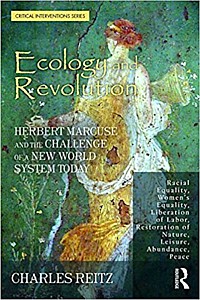 Charles Reitz, Ecology and Revolution: Herbert Marcuse and the Challenge of a New World System Today (Critical Interventions)(Routledge, 2018), 208pp. ($40 on amazon) Charles Reitz, Ecology and Revolution: Herbert Marcuse and the Challenge of a New World System Today (Critical Interventions)(Routledge, 2018), 208pp. ($40 on amazon)
- "A timely addition to Henry Giroux’s Critical Interventions series, Ecology and Revolution is grounded in the Frankfurt School critical theory of Herbert Marcuse. Its task is to understand the economic architecture of wealth extraction that undergirds today’s intensifying inequalities of class, race, and gender, within a revolutionary ecological frame. Relying on newly discovered texts from the Frankfurt Marcuse Archive, this book builds theory and practice for an alternate world system. Ecology and radical political economy, as critical forms of systems analysis, show that an alternative world system is essential – both possible and feasible – despite political forces against it. Our rights to a commonwealth economy, politics, and culture reside in our common works as we express ourselves as artisans of the common good. It is in this context, that Charles Reitz develops a GreenCommonWealth Counter-Offensive, a strategy for revolutionary ecological liberation with core features of racial equality, gender equality, liberation of labor, restoration of nature, leisure, abundance, and peace."
- 2018: Werner Sollors, " ‘Everybody Gets Fragebogened Sooner or Later’: The Denazification Questionnaire as Cultural Text," in: German Life & Letters 71:2(Apr. 2018), 139-153. 15p.
- Abstract: Disseminated in millions of copies to post‐war Germans, the Allied denazification questionnaire, in its best-known version, asked 131 questions not only about membership of the NSDAP, SS, SA, and fifty other affiliated associations, but also about individuals’ pre-Nazi voting record, implicated relatives, and such data as weight, height, and foreign-language expertise. Erich Kästner and Ina Seidel filled in such a questionnaire in 1945. While its massive circulation made it a site of German cultural memory, it also became a bureaucratic nightmare for those who had to evaluate the piles of these forms in the Allied armies and the German ‘Spruchkammern’. The ʻFragebogenʼ provoked writers on both sides of the Atlantic to represent it in fiction and non‐fiction. Just Scheu composed a song about it, and Wolfgang Borchert, Margret Boveri, Stig Dagerman, David Davidson, Alan Marcus, John Dos Passos, Zelda Popkin, and Ernst von Salomon commented on it in prose, often critically, calling it a merciless catechism of 131 questions or an ideological equivalent of tax returns. Though often perceived as an embodiment of American culture, it had emerged with the help of Franz Neumann and Herbert Marcuse, German Marxist intellectuals in exile, who hoped that denazification would bring about revolutionary change in Germany.
- 2018: Special issue on Herbert Marcuse in Dissonância: Revista de Teoria Crítica (in Portuguese).
2019 (back
to top)
- 2019:
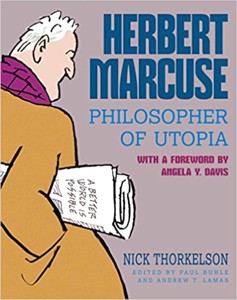 by Nick Thorkelson, edited by Paul Buhle and Andrew Lamas, with a forward by Angela Y. Davis, Herbert Marcuse, Philosopher of Utopia: A Graphic Biography (forthcoming Mar 19, 2019)($16 on amazon) by Nick Thorkelson, edited by Paul Buhle and Andrew Lamas, with a forward by Angela Y. Davis, Herbert Marcuse, Philosopher of Utopia: A Graphic Biography (forthcoming Mar 19, 2019)($16 on amazon)
- The life, times, and work of Herbert Marcuse, one of the 20th century's most remarkable cultural figures. Herbert Marcuse (1898-1979) was a little-known German scholar when he became one of the 20th century’s most unlikely pop stars: a celebrity philosopher. In the 1960s, his argument for a “principled utopianism” catalyzed the ideals of a rebellious generation, and Marcuse became an intellectual guide for activists and revolutionaries around the world. The legacy of his contribution to a radical shift of consciousness has resonated in social-change movements ever since.
This comics-format biography brings Marcuse’s life, work, and times to a new generation. From his youth in Weimar Germany and early studies with Martin Heidegger, to his emigration from Nazi Germany along with colleagues of the Frankfurt School, to his rise as one of its major theorists along with Theodor Adorno and Walter Benjamin, to his status as a countercultural icon, readers are introduced to the theories and circumstances that made Marcuse into one of the world’s most influential intellectuals.
Mentor to a young Angela Davis and often referred to as the unofficial faculty advisor to the New Left, Marcuse’s controversial critique of the “comfortable unfreedoms” of post-WWII capitalism entered popular consciousness with the 1964 publication of One-Dimensional Man, which sold over 100,000 copies in its first years in print. His argument for the possibility of a more humane and sustainable world was grounded in a personal knowledge of the violence of authoritarianism, and the risk of its resurgence. Perennially relevant, radical, and inspiring, Marcuse’s concept of the Great Refusal —“the protest against that which is”—is a guide for our times.
|


 Herbert
Marcuse: An Exposition and a Polemic (London, Fontana, 1970; New
York, Viking, 1970), 114 p.
Herbert
Marcuse: An Exposition and a Polemic (London, Fontana, 1970; New
York, Viking, 1970), 114 p. 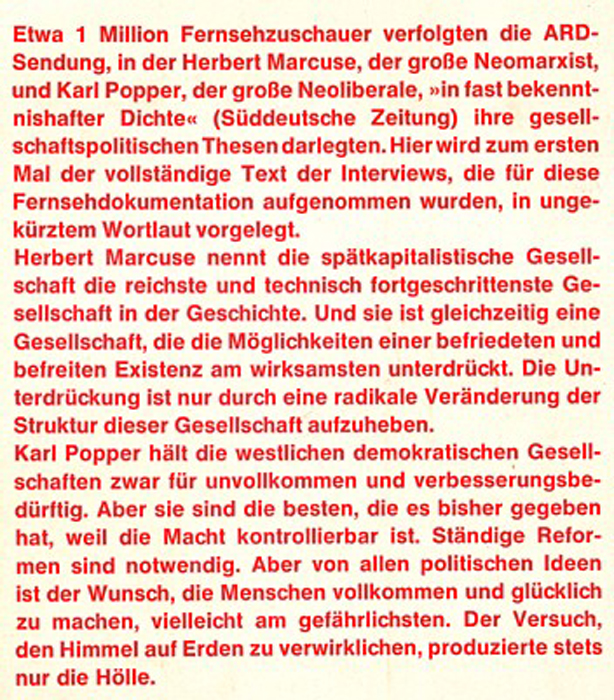

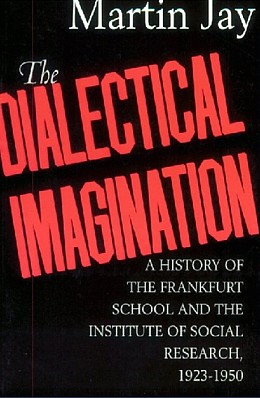
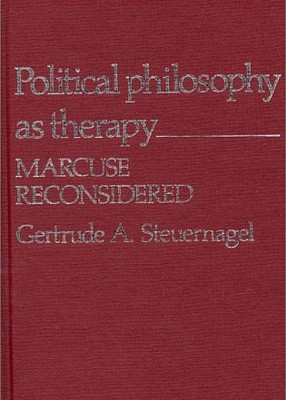
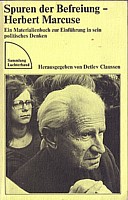
 The
Right to Be Human: A Biography of Abraham Maslow (Los Angeles: J.P.
Tarcher; New York: St. Martin's, 1988: revised and updated edition,
McGraw-Hill, 1999).
The
Right to Be Human: A Biography of Abraham Maslow (Los Angeles: J.P.
Tarcher; New York: St. Martin's, 1988: revised and updated edition,
McGraw-Hill, 1999).
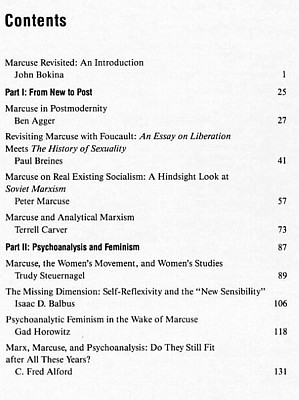

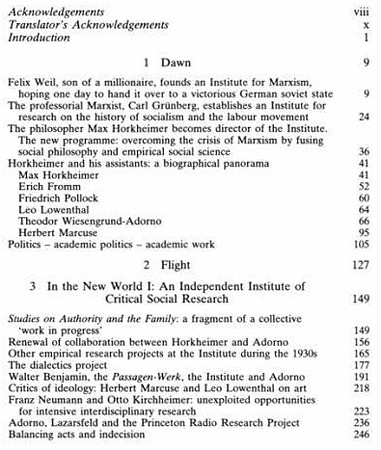
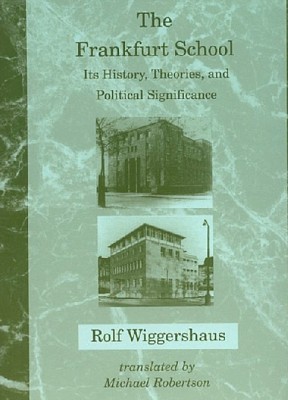
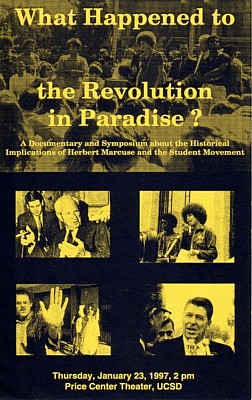
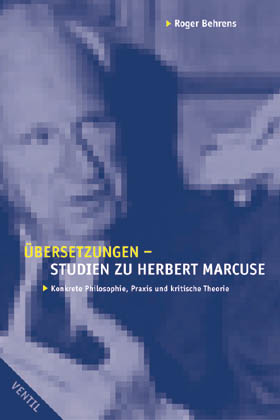
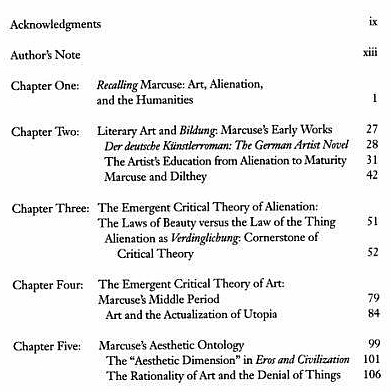
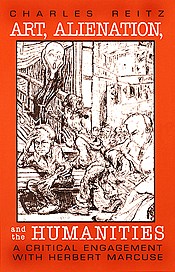
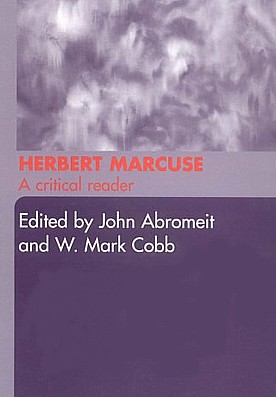
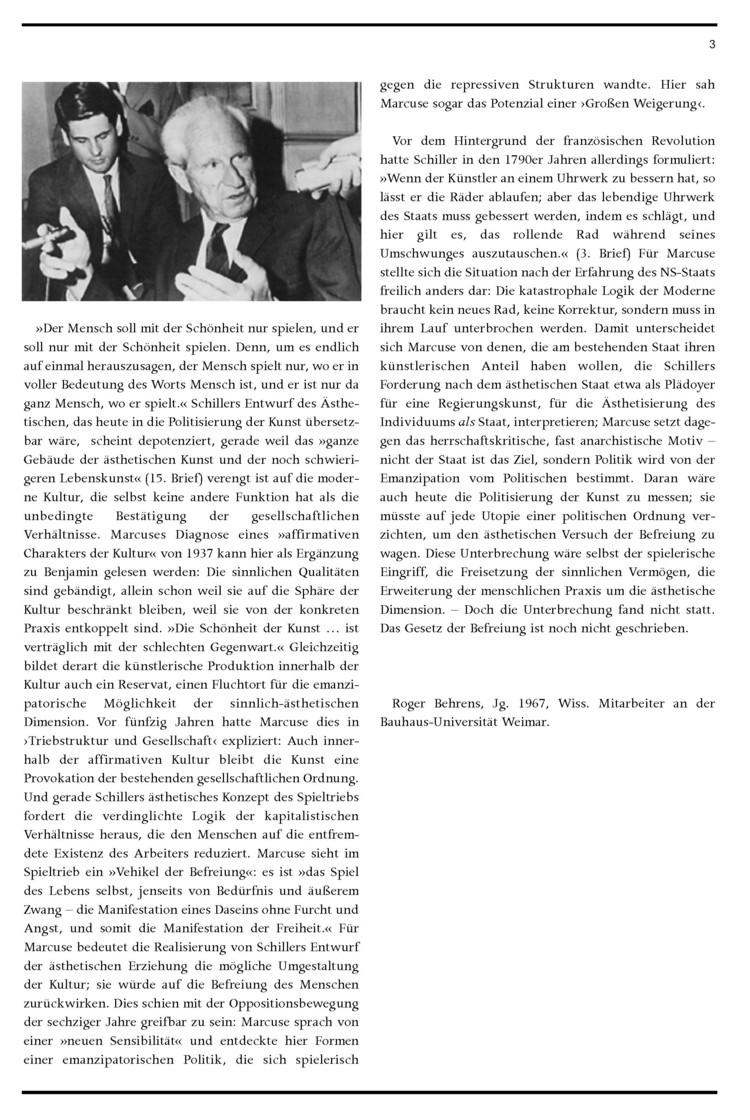
 2.
Herbert Marcuses Kulturtheorie 51
2.
Herbert Marcuses Kulturtheorie 51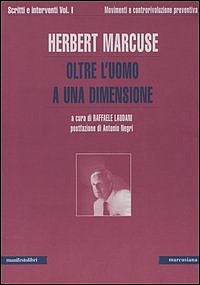
 Il
pensiero di Herbert Marcuse (Edizione del Mulino, 2005), 336 pages.
� 23,00
Il
pensiero di Herbert Marcuse (Edizione del Mulino, 2005), 336 pages.
� 23,00
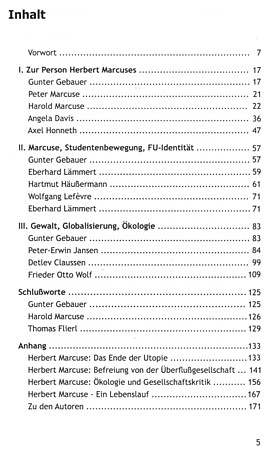
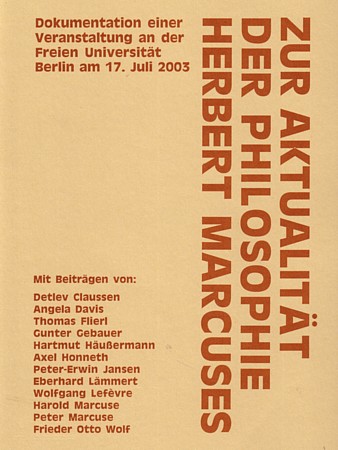
 Douglas Kellner, Tyson E. Lewis, Clayton Pierce, On Marcuse: Critique, Liberation, and Reschooling in the Radical Pedagogy of Herbert Marcuse (Sense Publishers, 2008), 48 pages.